Find one swimming sometime and watch it for thirty seconds. It’s worth doing once.
A leech doesn’t dart. It ripples — a slow vertical undulation down the whole length of the body, the way a ribbon moves if you shake one end of it. It isn’t fast and it doesn’t change direction sharply, and frankly it looks like something that would be easy to catch.
Now think about how most people fish a leech pattern. Long strips, fast, like a fleeing baitfish. The fly is telling a story the animal doesn’t tell.
Where they are
Leeches like soft bottom, weeds, wood and shade, so look along silty margins, inside weed beds, under docks and around submerged timber, or on the edge of a drop where the bottom goes soft.
They’re largely nocturnal and light-averse, which is a useful thing to know. Overcast days, low light, wind chop breaking the surface glare, and the hours at either end of the day put more of them in the open. A flat calm bright afternoon puts most of them back under cover.
They’re also more available in warm water than cold, which makes them a stronger late-spring through fall proposition than an early-season one in most systems. In stillwater like a fertile lake or a beaver pond, they can be a primary food item rather than an occasional one.
Fishing them slower than feels productive
The retrieve that matches the animal is a slow hand-twist or very short, unhurried strips, with pauses.
Which is uncomfortable. Slow retrieves feel like you’re not fishing, and the temptation to speed up is constant. But a leech pattern moving fast is a small streamer, and if the fish wanted a small streamer you’d already know.
Two details make the slow version work.
Let it sink. Leeches are usually near the bottom or coming up off it, and a fly suspended in the middle of the column above a weed bed is in the wrong neighborhood. Count it down. Note how long it takes.
Let the pause do work. A soft material — marabou, rabbit strip, soft hackle — keeps breathing when the fly stops moving. That’s when the take often comes. The strip gets the fish’s attention; the pause is where it decides. It’s the same idea as when doing less changes the presentation.
The vertical version
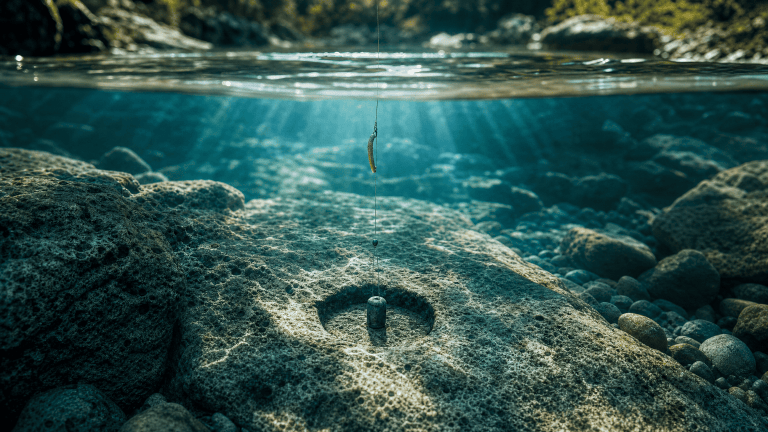
In stillwater there’s a second presentation worth knowing, and it works very well.
Hang a leech under an indicator, well down in the column, and do almost nothing. Give it a slow lift now and then and let it settle back. Wind drift and the small chop provide more movement than you’d think.
That’s a hard presentation to believe in for the first hour. It’s also one of the most productive stillwater methods there is, particularly on a lake with soft bottom and a good weed edge. A slip bobber does the same job with conventional tackle and lets you set the depth precisely, which matters more than the fly.
Size, and why black isn’t superstition
Real leeches run a wide range — some an inch, plenty three or four inches, occasionally larger.
Black, dark olive and dark brown cover most of what you’ll actually encounter. The reason dark works isn’t mystical: a dark fly gives the strongest silhouette against the surface light when a fish is looking up at it, and leeches are mostly being eaten from below.
Wine, purple and maroon have a real following in stillwater and are worth carrying, though whether the fish are seeing color or just seeing a darker value is an argument nobody has settled.
Start with size. A big leech pattern in clear water where the real ones are small gets looked at and declined, and no color change fixes that. The same size-before-color order applies.
In moving water they’re a different fly
Rivers have leeches, mostly in the soft margins, the frog water, the silty inside of a bend, behind boulders where sediment collects.
Fished there, the leech is a slow-water fly, and the presentation is more like a swing or a slow retrieve through soft water than a dead drift. A weighted leech tumbling along the bottom of a deep run also takes fish, and at that point you’re honestly fishing a generic dark thing — which is fine, because a lot of what trout eat is a generic dark thing.
Worth being precise about what you’re claiming. A leech pattern that takes fish in a fast riffle may be getting eaten as a sculpin, a large nymph, or just an available mouthful. It doesn’t matter to the fish and it shouldn’t matter to you, but it matters for what you conclude about the next trip. The piece on labeling evidence honestly is about exactly this kind of quiet guess.
The practical version
Carry three: a small dark one, a medium olive one, and one big black thing that looks slightly ridiculous.
Fish them slow and deep. When the day goes flat and the hatch didn’t happen and you’re standing there with nothing to match, the leech is an honest fallback — not because it’s magic, but because there are leeches in that lake right now and no particular reason a trout would refuse one. That’s a better answer to “what do I tie on” than a shrug, and it’s the one worth passing along.
The undulation is the part to keep. Everything else about the fly is negotiable.
FIELD OBJECT
This one should leave the page.
The article is the long version. These are the pieces worth carrying into the next trip.
The 30-second version
Watch one move and you stop fishing a leech pattern like a streamer. It's a slow vertical ripple that gets nowhere fast, and fish have spent their whole lives learning what that looks like.
What to watch
- Where they are
- Fishing them slower than feels productive
- The vertical version
- Size, and why black isn't superstition
Field card
- Where they are
- Fishing them slower than feels productive
- The vertical version
- Size, and why black isn't superstition
- In moving water they're a different fly
RIGHT TOOL, NEXT
Hatch Match
Turn the observed food, stage, size, silhouette, and behavior into the next presentation decision.