There’s a point in a slow day where changing tackle stops being experimentation — I’m just fidgeting with hooks.
The pattern is familiar: three colors of the same bait, then a spinner, then a jig, then something I bought because the package promised it would flat-out perform. Five casts each through the same dead lane, same angle, same depth, every single time.
If every presentation I try is failing in the same water the same way, the next useful change probably isn’t sitting in my tackle box.
First I ask whether the lure is actually failing
A lure can be perfectly capable of catching fish and still be wrong for the job in front of me.
If it can’t reach the depth I need, keeps fouling in cover, swings out of the current lane, or I can’t cast it accurately in the wind, I change it. That’s a functional mismatch, not a confidence problem.
But if it’s running cleanly, I’ve got good contact, and I can present it at a reasonable speed, no bites yet doesn’t automatically mean the lure is wrong. It might be a location problem or an angle problem. It might be timing. There might just not be fish where I’m casting.
I try to keep “this lure can’t do the job” separate from “this lure hasn’t produced yet.” They’re different problems with different fixes.
Position changes more than color does
Two casts that land ten feet apart can turn into completely different presentations.
Move down the bank and the lure might cross a weed edge instead of running parallel to it. Step onto a point and I can reach the first drop at a better angle. Shift twenty yards and the same crankbait travels along a contour instead of cutting across it.
In current, position changes line belly, swing speed, depth, and how long the lure sits in a soft lane. A “new lure” cast from the exact same spot can still make the same bad trip through the water.
Before I tie on lure number six, I try moving my feet.
Depth deserves an honest test
Changing lure style can feel productive when the actual missing piece is depth.
When I can, I run the same presentation at two or three distinct depths on purpose. Count a sinking lure down. Add or drop weight. Raise or lower the rod tip. Grab a deeper- or shallower-running version of a bait I already trust.
What I try not to do is let depth drift by accident while I’m changing something else. If I swap a heavy jig for a light spinner and suddenly get bit, it’s tempting to credit the flash — when the real difference might just be that the lure stayed above the weeds instead of plowing into them.
A clean depth test tells me something. A sloppy one just adds noise.
Angle is the one I forget about
A fish experiences a lure as a path, not a photo on a package.
A lure coming with the current behaves differently than one cutting across it. A bait pulled uphill along a break stays near bottom differently than one dragged downhill. And a cast that runs parallel to a dock edge keeps the lure in that shade a lot longer than one that clips the dock for two feet and leaves.
I try to make the lure travel through a feature, not just brush past it. If I can’t fix the angle from where I’m standing, I walk, reposition, or find a different feature I can actually approach right.
Sometimes it’s just the wrong water
This is the hardest adjustment for me because it means admitting the spot I picked was wrong.
I look for evidence the area deserves more of my time — baitfish, bugs, birds working, cover, current, green healthy weeds, a temperature break, follows, taps, anything. If the only evidence I’ve got is “this spot usually looks good,” I give myself permission to leave.
When I move, I try to pick something meaningfully different — deeper water, stronger current, a windblown edge, a protected bay, hard bottom instead of weeds, shade instead of sun, or somewhere I can finally reach a transition I couldn’t get to before.
Timing can turn the same spot into different water
A spot can feel dead at noon and come alive later once light, wind, current, temperature, bug activity or boat traffic shifts.
If I still believe the structure is right but the water’s flat right now, I’d rather leave and come back than grind on it. That way I fish other water in the meantime and get a real comparison when I return.
I try to note what actually changed. “Same point, wind picked up, bait moved shallow” tells me something useful next time. “Finally found the right lure” usually doesn’t.
Every lure change should be answering a question
Lure changes work best when each one has a reason behind it.
I switch lures because I need to run shallower, sink faster, come through grass cleaner, cast farther in the wind, push more vibration, cut my profile down, slow the fall rate, or hold in current differently. Those are testable jobs — I can actually tell whether the new lure solved them.
“Maybe they want orange” is worth a shot sometimes, but I try not to let color become my default answer when I haven’t gotten the presentation itself under control yet.
I set a limit before the spiral starts
I give a presentation a fair shot in water that actually suits it. That doesn’t mean some magic number of casts for every situation, but it does mean more than two distracted tosses while I’m thinking about lunch.
I make several clean presentations from angles that make sense. If the lure’s behaving right and the water gives me nothing back, I change one bigger thing — depth, position, feature or location — before I reach for a different bait. The physical side of that, depth and speed and angle, is what Presentation digs into.
Only after that do I decide whether a new lure is actually what the new job needs.
I move the plan before I empty the box
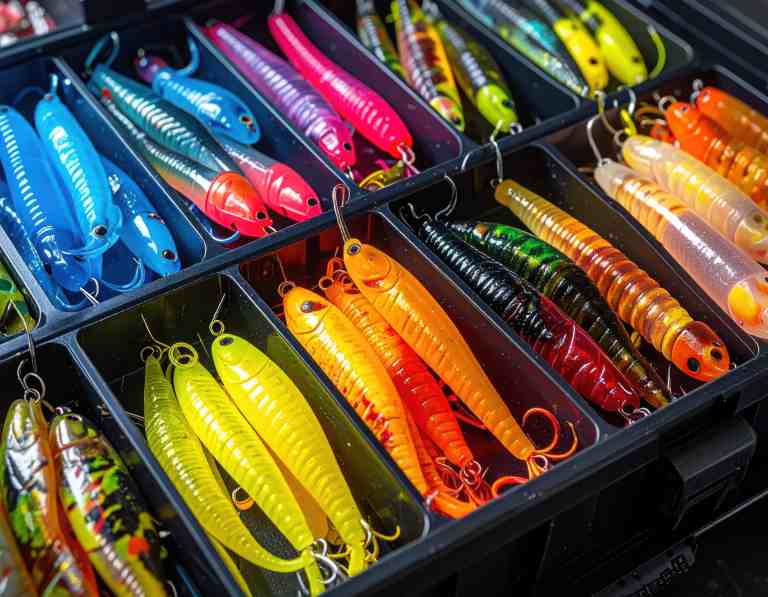
My tackle box is full of tools, and tools only help once I know what the problem is.
If every lure is getting the same cast through the same water and that water isn’t producing, swapping tools won’t fix it. I’ve spent plenty of time retying that a short walk would’ve fixed faster.
So when I catch myself reaching for yet another lure, I put the box down and look at the water again. Usually the fix is a few steps down the bank, a different depth, or different water entirely. Every once in a while it really is the lure, which is annoying, but at least by then I’ve earned the right to say so.
FIELD OBJECT
This one should leave the page.
The article is the long version. These are the pieces worth carrying into the next trip.
The 30-second version
When every lure fails the same way in the same water, I've usually got a position, depth or location problem, and no amount of retying is going to fix that.
What to watch
- First I ask whether the lure is actually failing
- Position changes more than color does
- Depth deserves an honest test
- Angle is the one I forget about
Field card
- First I ask whether the lure is actually failing
- Position changes more than color does
- Depth deserves an honest test
- Angle is the one I forget about
- Sometimes it's just the wrong water
RIGHT TOOL, NEXT
Species & Presentation
Carry the species behavior and presentation question into a narrower water-to-fish-to-presentation handoff.