Description
A full box and an empty answer are the same thing on the water.
Tackle advice starts from the object: is this lure any good, should you buy that one. The question cannot be answered, because a lure is only good at a job, on a water, in front of a fish that has its own opinion. So this starts a step back. There are twelve things a box has to be able to do. You say where you fish, the audit works out which of the twelve your water can actually ask for, and then it asks what you own against each one.
What it does
Scores coverage rather than count: which jobs are held, which rest on a single item, which are open, and which you have bought four times. It runs your terminal system — line, leader, knot, hook wire, hardware, gape — against nine rules that catch the conflicts people discover by losing a fish. Then it puts everything in order, and the order is the product: repair, reassign, adjust, borrow or leave out, and only then add.
Buy nothing is a real verdict here, and on a box that has been fished for a couple of seasons it is a common one.
Who it is for
Anyone whose box is full and who keeps suspecting they still need something. It is most useful before a season, or after the trip where you realised you had no answer for the water in front of you.
Who should not buy it
If what you want is lure recommendations or a brand ranking, this will irritate you — it never names a product. It is also no use without the box in front of you.
What is in it
- The twelve jobs, each with the check that tells you it is covered, what an empty slot costs you on the water, and what the job explicitly is not.
- A working audit that scores your own box live, filters the twelve by your water and platform, and flags duplication, condition faults and unfished stock.
- Nine terminal-system rules, each written as a decision to make on purpose rather than a mistake to feel bad about.
- Five original diagrams: role coverage, the weak link in a terminal chain, four hook points at thumbnail scale, what duplication actually costs, and gape against bait profile.
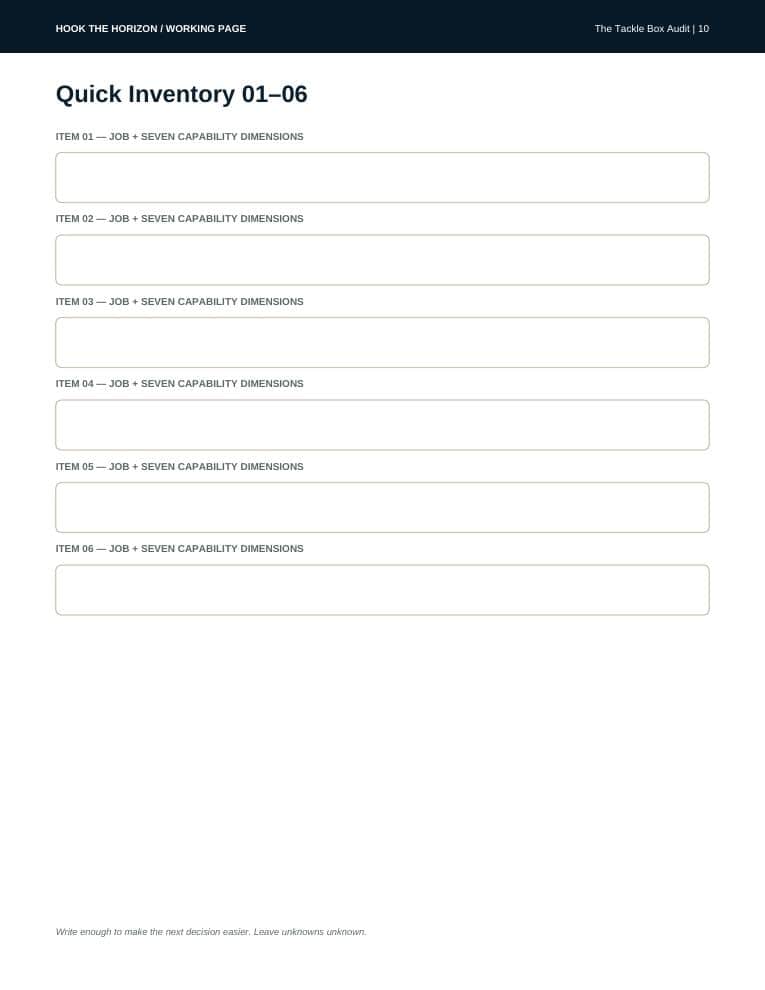
- A blank bench sheet for the twelve jobs, to fill in with a pencil while the box is tipped out on the floor.
Format, offline and printing
Two files. The instrument itself is a single self-contained web page — it opens in any browser on any device, the brand faces are embedded in the file, and once it is on your phone it works with no signal at all. There is no app, no account and no server: everything you type stays in that browser, on that device, and you can export a JSON copy whenever you want one.
The print edition is 18 pages at US Letter, laid out for a cheap printer. The role definitions, the bench grid and the terminal rules print as a reference card set. It is readable in grayscale because nothing in it decides anything by color alone, and the type is set at field sizes rather than desk sizes.
Where it sits beside the free work
The doctrine underneath it is free and stays free: depth, speed, angle and control and how to read water. Tackle Link checks one specific chain; this audits the whole box against the jobs.
What it cannot see
It does not know your hands, what the forage on your water did this year, or that the ugly one in the corner has caught more than everything else combined. It scores coverage from what you tell it. Where your own record disagrees, your record wins.
Version 1.0 · September 2026 · Edition hth.field.tackle-box-audit
Your purchase includes
- The Tackle Box Audit — the instrument, a self-contained web page that works offline.
- The Letter print edition, 18 pages, including the blank bench sheet.
- Eligible corrections and updates to the same Edition, at no further cost.
You may
- Read and print it on your own devices, as often as you like.
- Use its methods and working pages in your own work.
- If you guide, teach or work with clients: use it while serving them, and hand a client a completed output you produced with it.
You may not
- Redistribute the publication, the blank working masters or the print file.
- Resell or republish it, or put the complete work in a shared library or community drive.
- Share your purchase credential in place of a purchase, or use the work for model-training ingestion.
Refunds
Fourteen days, no reason required. A broken, missing or materially misdescribed file is corrected or refunded without relying on that cutoff. Terms of Sale