Description
Keep the end. It knows what happened.
Almost every break-off gets blamed on the knot, and most of them are not the knot. The evidence that would settle it is two inches of line, and it goes back in the water about four seconds after it appears. Then a different knot gets tied, nothing changes, and there is no evidence left to find out why.
Where it starts
With the specimen. Where it let go, what the end looks like under a phone torch, and the moment it happened. Those three answers alone cut eleven candidates down to two or three — a corkscrew at the lure is not the same failure as a whitened inch of leader, and neither is the flat clean end that means something sharp got there first.
Then eleven sites: the knot, abrasion, shock load, line age and storage, the spool, drag, guides and tip, the leader join, terminal hardware, system against quarry, and handling. Each is ranked with the reason it was ranked, and each carries a bench test you can run at home — ten knots to destruction, twenty passes across the rock that ate the last one, a fresh arm’s length against an old one, a bent rod and your own hand on the drag.
If you did not recover the end, it says so, works on a lead instead of a finding, and will not let you retire a knot on that basis.
Proving the correction
Five steps, in order: reproduce it on the bench, read the result, change exactly one thing, repeat the same test, then take it out and give it a real load. A correction that has not been tested is a superstition with better manners, and the protocol exists so that afterwards you can say which change did the fixing.
Who it is for
Anyone losing fish to break-offs and tired of guessing, and anyone who has changed knots three times without the problem going anywhere.
Who should not buy it
If you did not keep the broken end and cannot get another failure to look at, wait until you can.
What is in it
- An intake that reads the specimen and the system it failed in, and ranks all eleven sites with its reasoning shown.
- Eleven site definitions: what each leaves behind, its bench test, how to read the result, the correction, and what it still does not settle.
- Six drawn plates: the six failed ends at large scale, a knot seated against one that slipped, a grooved guide ring, spool fill and what it does later, the drag start-up spike, and the step at a leader join.
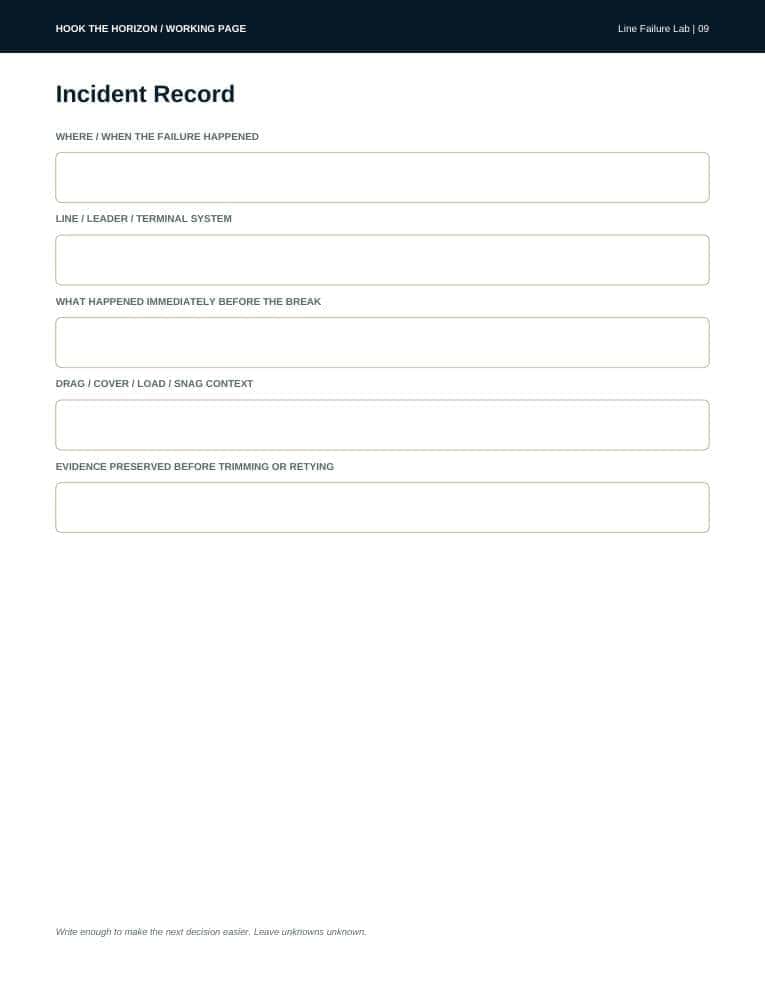
- A printed specimen card with a space to tape the failed end to it.
Format, offline and printing
Two files. The instrument itself is a single self-contained web page — it opens in any browser on any device, the brand faces are embedded in the file, and once it is on your phone it works with no signal at all. There is no app, no account and no server: everything you type stays in that browser, on that device, and you can export a JSON copy whenever you want one.
The print edition is 19 pages at US Letter, laid out for a cheap printer. The end plates are drawn in outline specifically so they survive a grayscale printer. The type is set at field sizes rather than desk sizes.
Where it sits beside the free work
The Line Keeps Breaking and Set the Drag are free. Knot Analyst goes far deeper on the connection itself and will draw it under load. This is the diagnostic that decides which of them you actually need.
Safety
The bench tests put line under tension. Wear eye protection, wrap your hands, and pull away from your face — line that lets go under load moves quickly and does not care what it hits. That one is not a joke.
Version 1.0 · September 2026 · Edition hth.field.line-failure-lab
Your purchase includes
- Line Failure Lab — the instrument, a self-contained web page that works offline.
- The Letter print edition, 19 pages, including the specimen card.
- Eligible corrections and updates to the same Edition, at no further cost.
You may
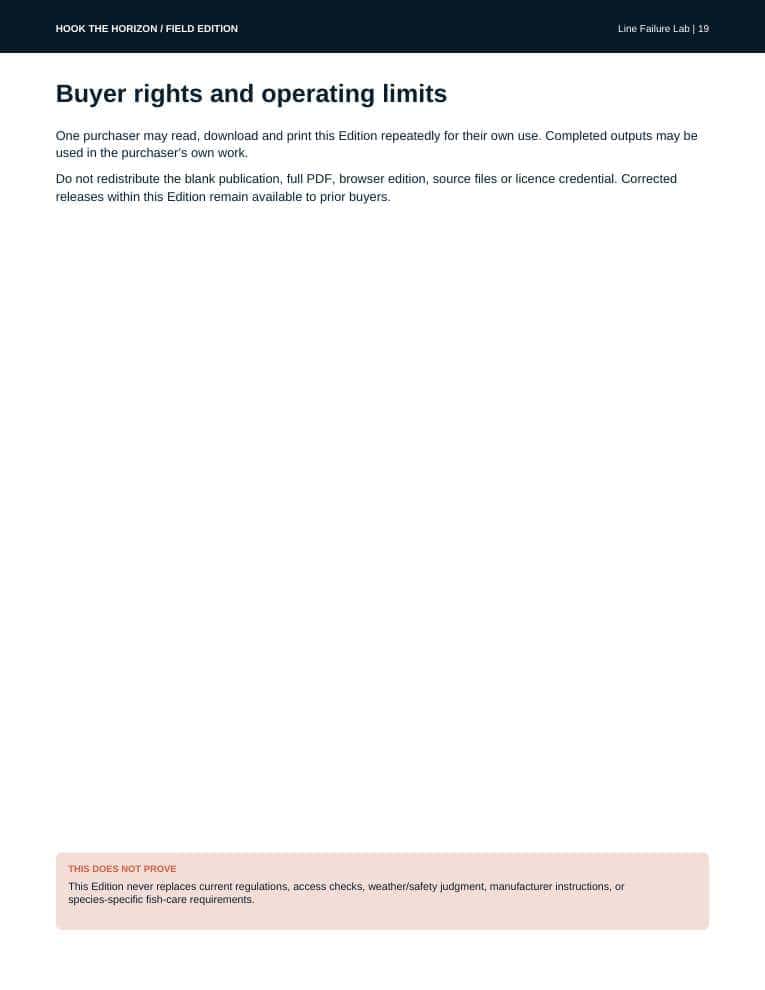
- Read and print it on your own devices, as often as you like.
- Use its methods and working pages in your own work.
- If you guide, teach or work with clients: use it while serving them, and hand a client a completed output you produced with it.
You may not
- Redistribute the publication, the blank working masters or the print file.
- Resell or republish it, or put the complete work in a shared library or community drive.
- Share your purchase credential in place of a purchase, or use the work for model-training ingestion.
Refunds
Fourteen days, no reason required. A broken, missing or materially misdescribed file is corrected or refunded without relying on that cutoff. Terms of Sale