
THE METHOD · SIX SHORT PIECES
You don’t need to read every article.
What helps is the habit of asking a better question and testing one thing at a time. It’s the same method the rest of the site runs on, just laid out in order so you can walk it without getting lost in the shelves.
WHO THIS IS FOR
Nobody here is going to tell you which lure to buy.
If you came for this week’s hot color, this is going to feel slow. But a pond in Georgia, a river seam, a reservoir point and a jetty on a falling tide can all be read with the same brain, and if you want to know why, stay.
Every claim here gets a label: observation, sourced, inference, or unknown.
Nobody here has fishing solved. I change one thing, watch what answers, and keep the surprises.
WALK IT IN ORDER
Six short pieces, all building the same habit.
1 · What the water is doing today
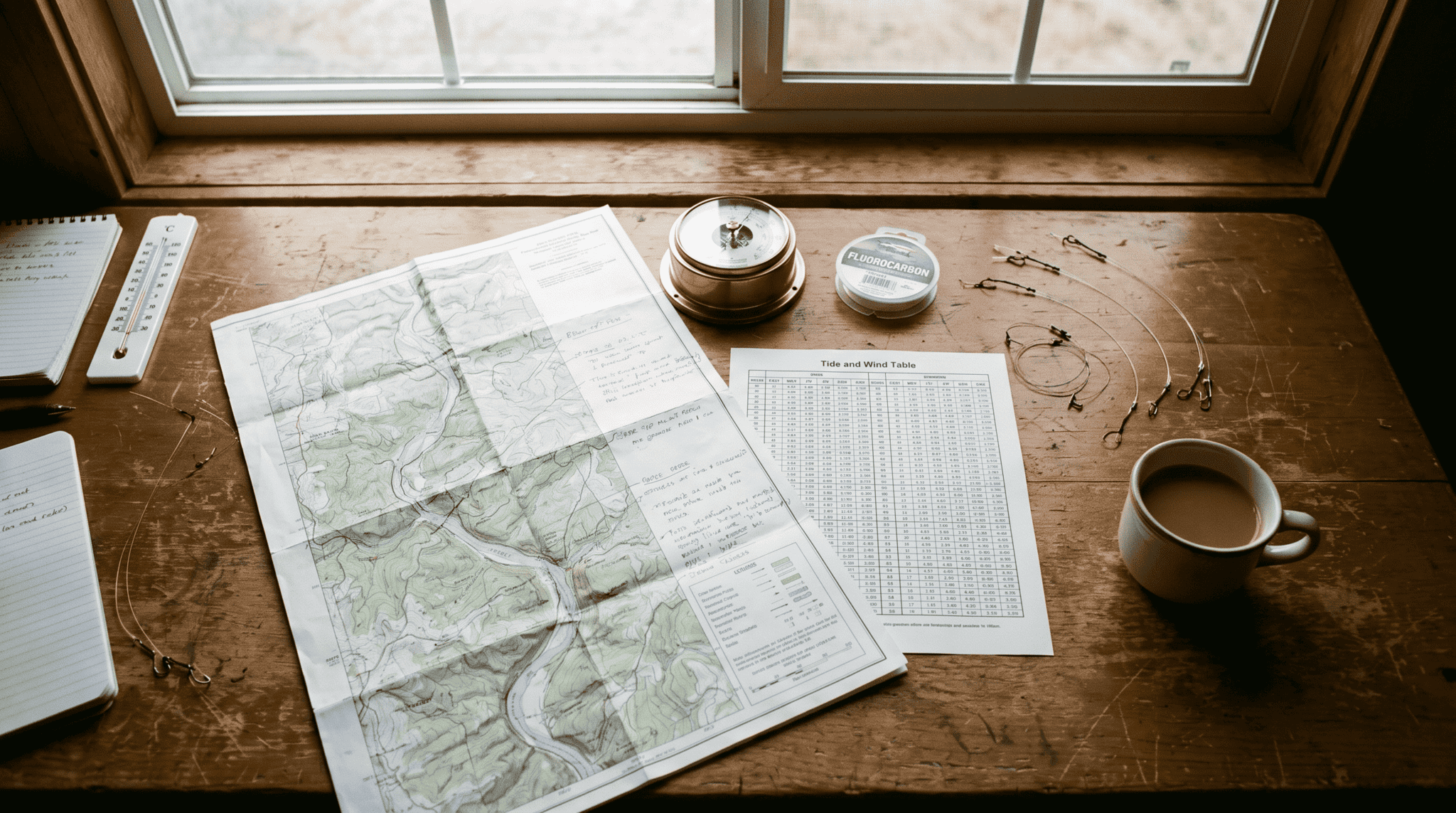
Wind, stain, temperature, current, tide, access. You look at the water before you look at the tackle.
2 · One decision, one test
Change six things at once and you learn almost nothing, because you can’t tell which one mattered.
3 · Tackle as a chain
Rod, reel, line, leader, knot, lure. The whole setup is only as good as whichever of those is weakest.
4 · Reading a window
The useful stretch of the day, and the honest moment to leave.
5 · Labeling what you actually know
Observation, sourced, inference, unknown — and why a surprise still counts as information.
6 · Privacy and conservation
Built in from the start instead of bolted on afterward. No pin-drops, and no “just this once.”
THEN USE IT ON YOUR WATER
The method doesn’t care which state you fish.
Trade the pond edge for a Great Lakes wall and the furniture changes. The questions don’t. Carry the habitat sequence and seasonal personality onto your water. If you fish panfish, a farm pond, inshore salt, or cold-water specialists, start with pond panfish, warm-water stillwater, inshore salt, or cold-water specialists. Any of those is a perfectly good front door. Standing at the truck with five minutes? Use the five-minute snapshot or the tool first run.
Open the water-type frames → · Or go to the Field Library →
After First Cast, walk First 10 Trips, one variable per outing. If wind, stain, pressure or a dead bite is what’s got you stuck, the common situations pages start there. Once you’ve been through all six pieces, open Field Sense Navigator for a named public water, or write one field note that tests a single variable.