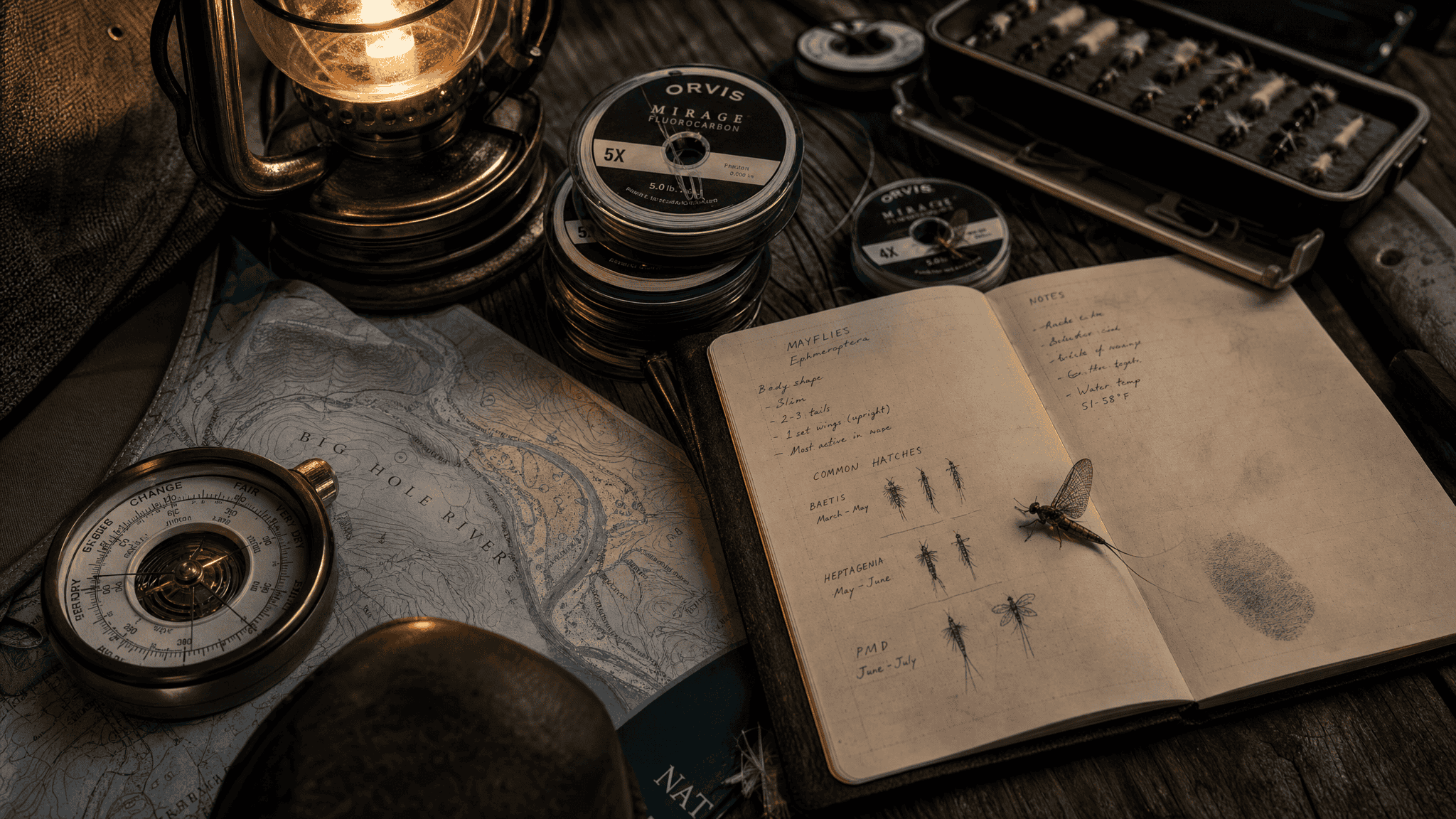

HOW THE FIELD TOOLS FIT TOGETHER
One trip usually turns up more than one kind of question.
The tools are separate because the questions are. Whether you can get on the water has nothing to do with how the fish are acting, and neither one tells you if your rod fits the job. A knot problem definitely isn’t a reason to restart the whole afternoon. Keep the trip in one place, open whichever tool answers the question in front of you, then go back to fishing.
THE NOTEBOOK FOR THE DAY
Field Ops keeps you from starting over every time you open something else.
A trip piles up loose pieces fast: which water, what you were trying to do, the species, your first idea, what happened, what changed, and the thing you want to remember next time. Field Ops keeps those pieces together.
It won’t make the decisions for you. It’s more like the notebook you wish you’d filled out before memory turned a three-hour blank stretch into “we almost had them figured out.”
THE TWO THAT LIVE ON THIS SITE
Some questions are too small to need a whole app.
Most of the tools on this page run as their own apps, because the questions are big enough to need one. Two don’t. They’re quick, mechanical checks that fit right on the page you’re reading, so they’re built into the site.
What Changed? is the one to open when the fishing stopped and you want to know what to do about it. Pick the water you’re standing on and the thing that changed, and it tells you what’s going on underneath, the part almost everybody overcorrects, one test that changes a single thing, and what each result means — including nothing happening, which still counts as an answer.
Set the Drag is the one to open before any of that. Put in your line rating and it gives you a working range in pounds, the real ceiling once a knot’s involved, how to check it with a luggage scale, and the start-up spike that breaks line on the take and never shows up on the knob.
Both run entirely in your browser. Nothing gets sent anywhere or saved, and once the page loads neither one needs a signal — handy, since the moment you want them is usually the moment you’ve got zero bars.
THE THREE QUESTIONS THAT COME UP MOST
Water → fish → presentation.
Can I fish this water the way I planned?
Field Sense is for a named public water: access, rules, hazards, conditions, and the stuff you still need to double-check. Sometimes the most useful thing it tells you is to change the plan before the rods come out.
What could this fish reasonably be doing here?
Species & Presentation brings the biology back to the actual water: holding areas, season, temperature, food and the kind of presentation that could test the idea.
What did the fish say back?
A follow, a short strike, a refusal, weeds on the hook, nothing at all. Those are different answers. The useful next change should come from the answer you actually got, not from panic five casts later.
THE ONES YOU MAY NEVER NEED THAT DAY
Open the extra tool only when you can name the problem.
Hatch Match
You saw something hatching, drifting, schooling or getting eaten and can’t tell what it is well enough to use it. Start there. If it’s already obvious what they’re eating, keep fishing.
Tackle Link
The presentation makes sense, but the rod, reel, line, leader or terminal tackle might not. Tackle Link checks the whole setup together, so you’re not replacing a random part because somebody online called it an upgrade.
Knot Analyst
All that’s left is the connection. What are you tying, with what line, for what job, and how’s it likely to fail? That’s plenty. It doesn’t need to turn into a new-rod conversation.
Rig Signal is for the days the electronics start making claims.
Sonar, sensors and temperature gauges can be useful. They can also make a number on a screen feel more certain than it is. Rig Signal is for when a reading or a product claim is about to change what you do, and you want to know what that measurement can actually back up.
If nobody’s arguing with the fish finder, you can probably leave this one closed.
Don’t hand over more private information than the next question needs.
A water check might need the public water and what you’re trying to do. A species question might need the water type, season and the conditions you’ve confirmed. A knot question needs line materials and what the connection has to do. None of those needs your private coordinates just because another tool happens to have them.
Keep exact spots, private-access details and anything else sensitive where they belong. Move information because it helps, not because software makes it easy.
Quitting early usually means it worked.
If the water’s closed, unsafe or you can’t get to it, stop. If you’ve got a sensible presentation and tackle you already own can pull it off, fish — and if the knot’s fine, leave it alone.
There’s no seven-tool achievement badge waiting at the end of this.
The articles are for the part a tool can’t do.
The articles get into the fish, the water, the mechanics, the weird exceptions, the failures, and why a rule sometimes quits being useful. A tool can narrow a question down. It can’t spend an afternoon watching a fish ignore a perfectly reasonable idea and then wonder what everybody missed.
That part’s still fishing.
Browse the Field Library → The 90-second first run → When a tool refuses → How we check claims →