KNOT ANALYST · PICKING THE KNOT
Which knot, for this line, in the conditions you’re actually standing in?
Every connection is a trade between what holds, what you can tie with the hands and light you’ve got, and how many times you’ll be retying it before dark. Knot Analyst asks about all of that and names the knots that hold up. If a knot doesn’t fit the job, it doesn’t get offered.
WHAT IT ASKS, AND WHY IT ASKS IT
Four questions, and the last two are the ones nobody asks out loud.
01 · The job
Line to hook, line to lure, braid to leader, leader to tippet, loop to loop, line to spool, a snell along a hook shank, a stop on the line. A knot that’s right at a hook eye can be wrong where two diameters meet.
02 · What’s in your hands
Mono, fluoro, braid, fly line, tippet, single-strand wire, hollow core. The material rules out most options before anything gets ranked — stiff fluoro through an undersized eye knocks out doubled-line knots at the hook right away.
03 · Where you’re standing
Wind, cold hands, a dock light instead of daylight, a kayak with one hand on the paddle, an ice hole with no bench. You can’t really inspect a knot in the dark, so a simple one you can check by feel starts beating one with a slimmer profile.
04 · How often you’ll retie
Retie once a day and you can afford the best-finished knot. Retying every twenty minutes, you want the one you can build fast and check at a glance. Same braid-to-leader job, two different answers, and the difference is the kind of afternoon you’re having.
05 · A ranking that shows its work
Two or three knots, each with the reason it made the list and how it fails, so you can look at the answer and disagree with it for a reason.
06 · A Connection Card you can carry
The decision, the wraps, and what to watch while it seats — saved on your device, readable with no signal, and ready to hand to Field Ops if you’re keeping a record of the trip.
Start with the job → Browse the library → Put two side by side →
What it flatly refuses to do.
It won’t tell you the strongest knot. There’s no percentage on a Connection Card and there never will be — a break-strength number from a test bench is a claim about a machine pulling clean line indoors, and you’re outside with line that’s been dragged through guides and gravel since breakfast.
It also won’t offer a knot that fails the check just to look helpful. Ask about single-strand wire and it points you to a wire termination instead of a knot. Ask about hollow-core braid and it says splice. Give it a diameter mismatch that has to cast through guides all day, and most of the joins you were thinking about are gone before the ranking starts.
It won’t pretend the knot was the problem, either, and a lot of the time it wasn’t. A nicked leader, a crossed strand, a burr in a hook eye, a connection that never fully closed — switching knots fixes none of that. That’s what diagnose is for: start from what broke and find out whether you need a different knot or a different habit.
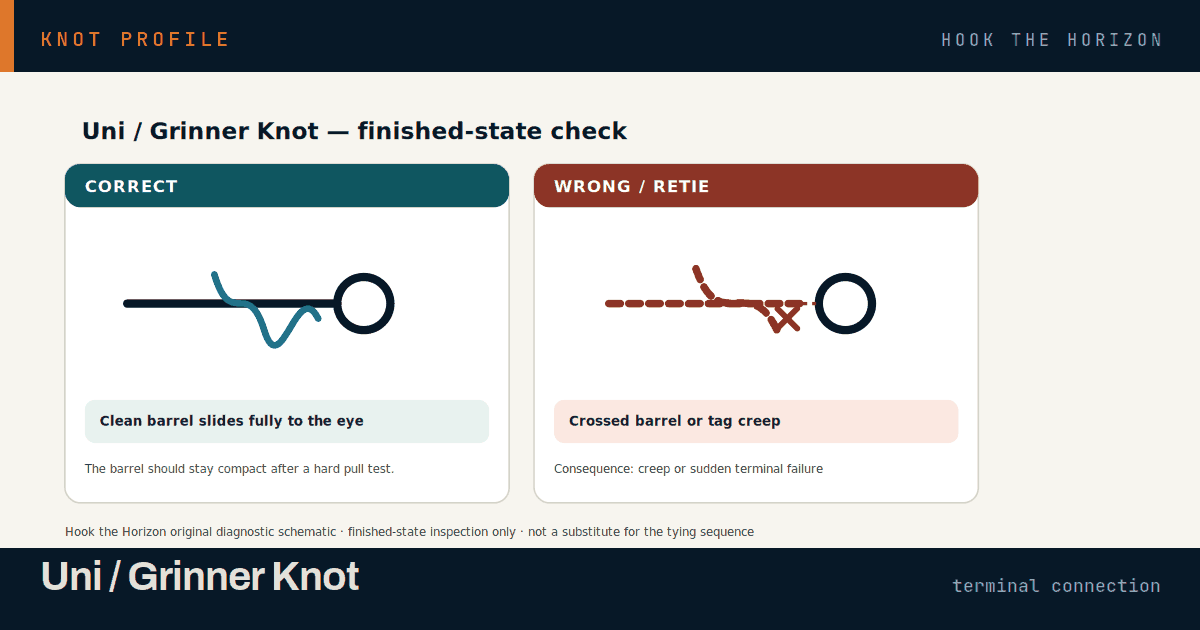
The library tells you how. The analyst tells you which.
The knot articles in the library walk you through the wraps, the seat and the failure checks for any connection you can name, and they’re the right thing to read at home with a hook in a vise. They’re the wrong thing to open on a bank in a rising wind, because they’ll all still be true and you’ll still have to choose.
Choosing is the hard part, and it’s hard for a boring reason: the best knot depends on four things at once, and changing any one of them changes the answer. That’s arithmetic, not wisdom. So the tool does the arithmetic, hands you two or three that survive it, and leaves the judgment to you.
How practiced your hands are counts here
None of the other tools ask you to rate yourself, and that’s on purpose. Knots are the exception, because a knot you can’t tie cleanly in the cold isn’t a strong knot for you — it’s a knot somebody else can tie. You set it, you can change it, and nothing’s hidden from you either way.
What moves, and what stays put
The knot decision goes into Field Ops and comes back out if you send it. Exact locations don’t travel, and nothing moves between tools until you move it.
Where it sits among the other tools.
Before it
Species & Presentation works out what you’re trying to make the bait do. Tackle Link checks whether the rod, reel and line can actually pull that off. The connection is the last link in the chain, and the one most likely to be why you’re retying.
Around it
Open Field Sense when you’re not sure the water’s even workable. Hatch Match helps when the fish are eating something you can’t put a name to, and Rig Signal is for the days a device reading is telling you something you’d like checked.
After it
Field Ops Desk holds the trip the connection belongs to. Log what you tied and what it did, and the next time the same water and the same cold morning come around, you’re arguing with a record instead of a memory.
Decide it once at the bench, and again when the conditions move.
Load one of the example setups if you want to see how the reasoning runs — braid to fluoro at the ramp, a night dock light, two-pound mono to a micro jig over an ice hole. Then put your own job in. It takes one tap, and it’ll show you what it threw out and why.
Tie it at home first, in better light than you’ll get on the water. That part hasn’t changed.
Open Knot Analyst → Start from a failure → Read the knot library →