A fish that keeps “letting go” might never have been hooked in the first place. Sometimes the fish did its part and the hook never had a chance, because the bait was sitting right where the point needed to go.
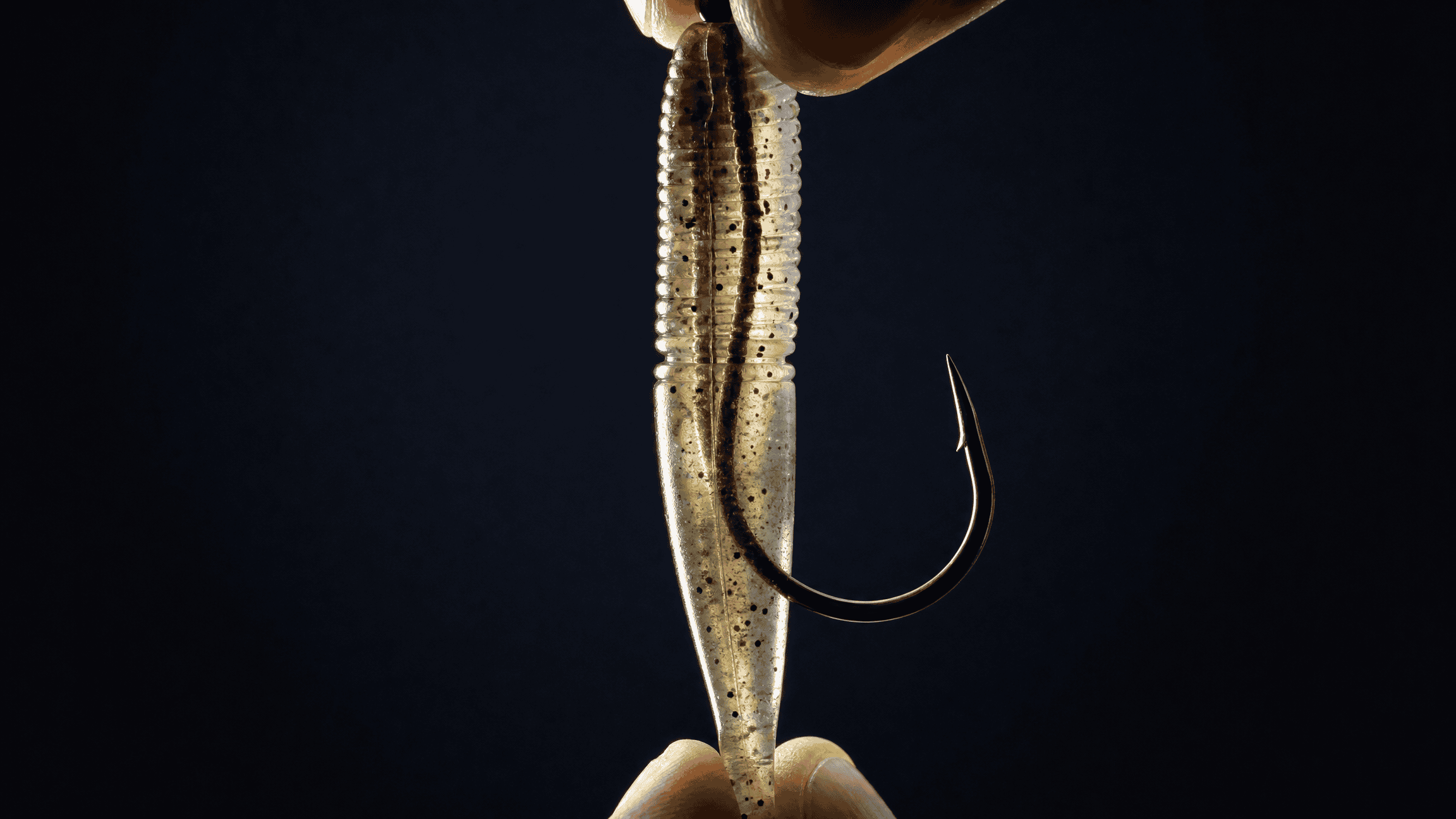
The gap is the open space between the point and the shank, and it’s the part of the hook that actually does the work. On a hookset the point has to swing through that space and out into the fish. If a soft plastic, a live bait or a chunk of cut bait is filling most of it, the point doesn’t travel. It pivots into the bait instead. That feels exactly like a short strike or a fish that let go, which is why this one can eat a whole session before anybody figures it out.
The check is visual and takes one second. Hold the rigged bait up and look at it from the side, the way a fish coming from below would. You want daylight between the point and the body of the bait — actual space, not a hairline. My rough version is that the gap should be about as wide as the bait is thick at that spot. If the plastic is fatter than the gap, the hook is too small for that bait, no matter what the package says or how big the fish you’re hoping for is.
Two other things ride along with the gap. Wire gauge has to match the load, not the bait: light wire in heavy cover straightens out, and heavy wire in a small soft plastic won’t penetrate on light line. Shape matters for bulk, too. Wide-gap and extra-wide-gap bends exist so a fat body can sit in the bend without eating the clearance, which is why a straight-shank hook that’s fine under a finesse worm is wrong under a thick creature bait.
If fish are eating and you’re still missing, check the point before you start swapping hook size. Testing the hook point comes first because a dull point and a buried one feel identical from the rod. When the question gets bigger than one hook, finding the part of your setup most likely to fail looks at how hook, knot, line and hardware work together.
And the fix isn’t just “go bigger.” That problem gets talked about less, but an oversized hook adds weight where the bait didn’t want it, kills a subtle action, makes a small bait roll on the retrieve, and hangs up on everything it touches. You wanted clearance. A hook two sizes too big buys it by wrecking most of what made the bait worth tying on.
FIELD OBJECT
This one should leave the page.
The article is the long version. These are the pieces worth carrying into the next trip.
The 30-second version
A fish that keeps “letting go” may never have been hooked at all. If the bait fills the hook gap, the point turns into the bait instead of the fish.
RIGHT TOOL, NEXT
Tackle Link Analyst
Follow the load path and find the part of the setup that actually limits the rest.