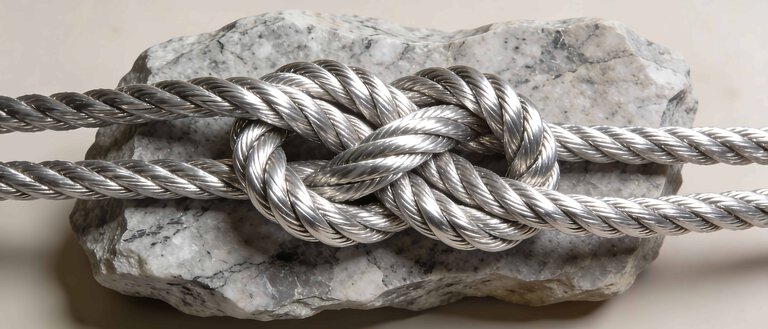
FENDERS · TEMPORARY TIES
I can put this one on a rail with one hand while the boat’s still moving, and slide it up or down six inches without untying anything. That speed’s why I use it. It’s also why people leave whole boats hanging off one, which is where the clove hitch stops being clever.
ORIGINAL HOOK DIAGRAM
Two turns, one tuck, and one spot where it quietly goes wrong.
Watch panel two. Both turns go the same way around the post. Run the second one back the opposite way and it looks identical from the dock, holds just long enough for you to stop watching it, and then doesn’t.
What I reach for it on
Hanging fenders off a rail, where the height has to change every time the tide or the dock does.
How quick
Two turns and a tuck. Over the free end of a rail I can build both loops in my hands and drop the finished hitch straight on without ever letting go of the fender.
Why it creeps
It holds by the two turns pinching each other against the post. Smooth stainless, wet plastic, or a load that keeps swinging to a new angle lets that pinch walk loose.
How I know it’s wrong
The two turns are running opposite ways around the post, or the working end lies across the second turn instead of under it. Either way, what’s on the post isn’t a clove hitch, no matter how solid it looks.
SPEED, AND WHAT IT COSTS
There’s no locking part in it at all.
A clove hitch stays put because the second turn traps the first against the post. That’s the entire mechanism. Nothing has to be forced apart to release it, which is why a pull on the tail walks it open, and why I can shift a fender line without ever taking the hitch off the rail.
On a barnacled piling or an old timber post covered in flaking paint, that grip is more than enough for a long afternoon. On polished stainless it isn’t. Add a load that changes direction constantly, which is what a boat does every time a wake rolls through, and the turns can work themselves loose over an hour or two without anyone touching them.
None of that means I stop using it. It means I put a half hitch behind it any time the cost of it slipping is bigger than a fender dragging in the water. Tying one in place around a post I can’t get the end over was genuinely awkward the first several times, and the awkwardness went away with repetition, not with anybody explaining it better.
How I tie it
- Pass the working end around the post and bring it back across the standing part.
- Carry it around the post again, the same direction, sitting alongside the first turn.
- Tuck the working end under that second turn, so it comes out next to the standing part.
- Pull on both ends and let the two turns settle hard against each other.
- Leave a decent tail. A short one is the first thing to disappear when the hitch shifts.
- If the post has a free end I can reach over, I skip all of that: make two loops the same way round, lay the second on top of the first, and drop the pair over the top.
When it’s the wrong knot
I don’t leave a boat on a clove hitch. Not overnight, not while I walk up to the ramp for the trailer, not on a tide that’s going to change the angle the line pulls at. A dock line onto a piling wants a round turn and two half hitches. Onto a cleat it wants a cleat hitch. Rode onto an anchor wants an anchor bend, and none of those three take meaningfully longer to tie than this does.
The honest test is how long I’ll be away from the line. If I’m standing right next to it and I’ll move it again inside ten minutes, the clove hitch is the right tool and nothing else is faster. If I’m going to lose sight of it, I tie the other knot — every time, no negotiating with myself about it.
EXTERNAL PRACTICE / CROSS-CHECK
Use the animation to see why this is a temporary boat hitch, not a mooring answer.
Animated Knots: Clove Hitch on a rope end shows the tying sequence and is unusually blunt about the limitation: a Clove Hitch can slip under changing boat loads and should not be trusted alone for mooring. That is why this lesson keeps it in the fender/temporary-adjustment job.
THE SIX-MOVE CHECK
Job → Material → Route → Dress → Seat → Test
- Job. Name what the connection has to do before choosing the knot.
- Material. Confirm the line, leader, rope, wire, and hardware actually suit this structure.
- Route. Trace every pass before tightening anything.
- Dress. Put strands, wraps, and loops in their intended order with no accidental crossings.
- Seat. Tighten in the order this knot needs. More force does not repair bad geometry.
- Test. Inspect the finished shape, load it by hand when appropriate, and retie if anything moves or fails the article-specific checks.
Practice / pass test. Tie this knot three clean times without rushing. A tie passes only when it matches this article’s What to check before you trust it geometry, shows none of the listed failure clues, and survives the stated load/inspection test. If you cannot tell why one attempt is better than another, keep practicing—the lesson is recognition, not memorization.
KNOT SPEC
Clove Hitch — the short answers
- ALSO CALLED
- Clove hitch. Older sources also call it the builder’s knot or ratline hitch, but on a boat everybody says clove hitch. No regional variation worth learning.
- KNOT TYPE
- Binding hitch to a post or rail: two turns the same direction, the second trapping the first
- WHAT IT CONNECTS
- Hanging fenders off a rail or stanchion, and quick temporary ties you stand next to. Not a mooring knot, not for a boat you walk away from, and not for a load that keeps changing direction.
- LINE TYPES
- Grips well on rough timber piling, barnacled posts and older rope. Slips on polished stainless rails, wet plastic and slick modern cordage. Three-strand nylon holds better than double-braid. Stiff or frozen rope will not settle the two turns against each other and it creeps.
- STRENGTH BAND
- Not a strength knot — it is a holding hitch, and the useful measure is whether it stays put rather than what it breaks at. It costs rope strength like any knot, and the answer on a boat is rope diameter. It rarely jams, which is both its appeal and its problem.
- DIFFICULTY
- Beginner. Two turns and a tuck, learnable in five minutes, and a child can tie one. Tying it in place around a post you cannot get the end over is the awkward version, and that takes real repetition rather than better explaining.
- STEPS AND WRAPS
- Three moves, two turns, one tuck. No variation by rope type. Over a free post end it collapses to a single move: build two same-handed loops in your hands, stack the second on the first, and drop the pair over.
- TIE TIME
- The fastest hitch there is. Two or three seconds, often one-handed and often while the boat is still moving. That speed is the entire reason to accept its weaknesses.
- POOR CONDITIONS
- Excellent in cold hands, gloves and the dark, because there is nothing to count and no dressing to get right. Rough water is where it costs you: a load swinging to a new angle every wake is exactly what walks it loose.
- THROUGH THE GUIDES
- No rod guides. It ties around a rail, stanchion or piling and never passes hardware. The finished hitch is low-profile and fouls nothing, but the tail hangs free and should be kept short of the water and clear of a propeller.
- LUBRICATION
- Lubrication is irrelevant. Wet rope changes little; a wet, smooth post underneath it changes a lot and it will creep there. It does not jam badly after soaking, which is one of the few moments its lack of grip works in your favour.
- TAG END
- Generous, several inches at least, because this hitch shifts before it fails and a short tail disappears into it. On anything you will not be watching, finish with two half hitches around the standing part using that tail.
- TOOLS
- None. Gloves for cold or rough rope. A knife should never be needed — if a clove hitch has jammed, something else has gone wrong first.
- BEST SUITED TO
- Fenders, fender board lanyards, a temporary tie while you rig something, lashing a boat hook or a pole. Not for dock lines, mooring, anchor rode, towing, trailer loads, or anything holding weight above a person.
The strength bands are rough on purpose. Published knot tests don’t agree with each other — the same braid-to-leader knot has tested near ninety percent of line strength on one machine and under half on another, because the line brand, its diameter, how fast it got cinched, whether it was wet and whose hands tied it all move the number more than the knot does. Use the band to compare this knot with the others, not as a number to quote.
FIELD INTELLIGENCE
Where it earns its place, and where it costs you
Advantages
- Faster than any other hitch on the boat, and it can be tied one-handed.
- Adjustable in place. A fender goes up or down without anything being untied.
- It can be built in the hands and dropped over a free post end, which is the quickest rope move on a dock.
- It never welds itself shut, so it comes off as fast as it went on.
Disadvantages
- There is no locking part at all. What holds it is one turn pinching another, and that pinch can walk loose.
- It slips on smooth posts — polished stainless, wet plastic, fresh paint.
- A load that keeps changing angle, which is what a boat does in a chop, works it open over an hour or two.
- The wrong version, with the turns running opposite ways, looks identical and holds for a while before letting go.
Use a different knot when
- Round turn and two half hitches — for a dock line onto a piling, rail or ring, or anything you will walk away from
- Cleat hitch — when the fitting is a horn cleat
- Anchor bend — for rode onto an anchor ring, where the load pulses all day
- Bowline — when you want a fixed loop to drop over a post rather than a hitch that grips it
WHAT TO CHECK BEFORE YOU TRUST IT
The clove hitch is a knot with a time limit, and the skill is knowing what the limit is. It earns its place when a fender height has to change every time the dock or the tide does, and when the alternative is dropping the fender in the water while you tie something better. Read the surface underneath it: barnacled timber will hold one all afternoon, polished stainless will not hold one for twenty minutes. The tradeoff is blunt. You buy speed and adjustability with security, and the price is paid the moment you stop watching it.
What actually makes it fail
- The two turns running opposite ways around the post, which is not a clove hitch even though it looks like one.
- The working end lying across the second turn instead of tucked under it, so nothing traps the tuck.
- A smooth post — stainless, plastic, fresh paint — where the pinch has nothing to bite on.
- A load that swings to a new angle repeatedly, walking the turns open with nobody touching it.
- A short tail, which vanishes into the hitch the first time it shifts and leaves nothing to take hold of.
How to test it, and how it ages
Check both turns run the same way around the post and that the end emerges from under the second turn beside the standing part. Then pull the standing part hard in the direction the load will actually come from, and watch the turns rather than the tail. A good one settles and stops. A bad one gives a little, then a little more. On a smooth post, assume it will creep whatever it does under your hand, and put two half hitches behind it.
Over a session: Poor over time, and honest about it. An afternoon on rough timber is fine. A night, a smooth rail, or a swinging load and it will have moved. Check it every time you pass, or back it up and stop having to check.
Troubleshooting
Why does it keep sliding down the rail?
The rail is smooth and the hitch has nothing to bite on. Add two half hitches around the standing part, or move to a round turn and two half hitches.
I tied it and it fell off after ten minutes — what happened?
The second turn almost certainly went round the post the opposite way to the first. The wrong version looks identical and holds briefly.
Can I leave the boat on one overnight?
No. It has no locking part and a boat loads it from a new angle every wake. Use a round turn and two half hitches, or a cleat hitch.
How do I tie it around a rail I cannot get the end over?
Pass the end round, cross it over the standing part, round again the same way, then tuck under that second turn. Awkward for the first dozen, then it is not.
Is a half hitch behind it enough to trust?
Two half hitches will hold it for a lunch stop. For anything longer, start with the right knot rather than upgrading this one.