Twenty fishing knots is a hobby. Five that each do a different job will cover most freshwater fishing, as long as you notice when the connection is the weak link before a fish points it out for you.
A long knot list can look like proof of a better angler. It isn’t. What actually helps is splitting the work up: something dependable for tying on a hook or lure, something compact for small eyes, a generalist, a way to join line to leader, and a loop for the times a lure needs room to swing.
My five for that are the Palomar, improved clinch, uni, double uni, and non-slip loop knot. They aren’t a ranking. They just cover different jobs without turning a windy bank into a knot exam.
DECISION LESSON · BUILD A SMALL KIT BY JOB
Five knots only help if each one owns a different problem.
- Job: terminal, compact terminal, multipurpose terminal, line-to-line, or free-moving loop.
- Material: mono, fluorocarbon and braid don’t ask the same thing from a knot.
- Conditions: the knot you can tie cleanly in wind or cold may beat the prettier one you tie at the kitchen table.
- Failure cost: decide what you need to inspect before the first cast, not after a break-off.
Pass: you can say why each knot is in the five and when you’d deliberately swap it for something else.
DECISION PATH
Choose by job before you choose a knot
- Palomar: dependable terminal connection when the hook or lure can pass through the loop cleanly.
- Improved clinch: compact terminal option when bulky hardware makes the Palomar awkward.
- Uni: the generalist, for when one familiar knot structure needs to cover several terminal jobs.
- Double uni: straightforward main-line-to-leader connection built from the same wrapping logic twice.
- Non-slip loop: for when the presentation genuinely benefits from freedom to pivot at the eye.
Why the arbor knot isn’t one of the five: it’s the knot for tying line onto a spool, and that’s an occasional rigging job, not a connection you tie and inspect over and over while you’re fishing.
Start with the job, not the knot name
Before I tie anything, I figure out what connection I’m actually making. That matters a lot more than which knot sounds impressive.
- Line to hook or lure: Palomar, improved clinch, or uni. Which of the three, and when it stops mattering, is the longer argument.
- Main line to leader: double uni is the simple starting point.
- Lure needs freedom to swing: a non-slip loop knot, where the lure and line type allow it.
- Tiny eye or crowded hardware: whatever fits the eye cleanly without stacking bulky wraps against the lure.
A knot can be excellent at one job and annoying at another. Nobody needs to crown a universal winner, and the fishing knots section has plenty of others for when a job really calls for one. The connection just needs to be on purpose.
The five-knot kit
1. Palomar knot: hard to mess up, as long as the lure fits through the loop
This is a strong first terminal knot when doubled line fits through the eye and the hook or lure can pass through the loop without the whole thing turning into a mess. The Palomar Knot profile has the finished-state check.
How to tie it
- Double several inches of line and pass the loop through the eye.
- Tie a loose overhand knot with the doubled line, leaving the hook or lure hanging below it.
- Pass the entire hook or lure through the large loop.
- Wet the knot.
- Pull the standing line and tag end evenly until the knot seats against the eye.
- Trim the tag after inspecting the finished knot.
When it fails, it’s usually because the doubled line got crossed, it got cinched dry, or part of the knot caught on a split ring, hook bend or lure body while it was tightening.
The Recreational Boating & Fishing Foundation teaches the Palomar too, including for drop-shot rigging. That doesn’t tie it for you, though. Clean wraps, a wet cinch and an actual look before you trust it still decide whether it holds.
2. Improved clinch knot: the compact one
The improved clinch earns its spot by being compact, familiar and easy to inspect. It fits most small hooks, swivels and lure eyes, and you never have to drag a whole crankbait through a loop to tie it.
How to tie it
- Pass the line through the eye and leave enough tag to work comfortably.
- Wrap the tag around the standing line several times. The exact number depends on line diameter and material; stiff or thick line usually needs fewer neat wraps than very fine line.
- Pass the tag through the small loop beside the eye.
- Pass it through the larger loop created by that move.
- Wet the knot, then draw the wraps down smoothly.
- Inspect the coils. They should look organized, not piled on top of one another.
If the wraps overlap badly or the knot curls the line, cut it off and retie. Twelve inches of line is a cheap price for not wondering about that knot while a fish is pulling on it.
3. Uni knot: a little bit of everything
The uni is in the five because the same wrapping logic handles several jobs. It ties line to a hook or swivel, and two uni knots facing each other join two lines.
Terminal uni
- Pass the tag through the eye and bring it back alongside the standing line.
- Create a loop with the tag.
- Wrap the tag through the loop and around both strands several times.
- Wet the wraps.
- Pull the tag to form the knot, then slide the knot toward the eye and tighten.
Line materials vary enough that no wrap count is sacred. The real standard is whether the finished knot seats cleanly and survives a firm pull test without slipping.
4. Double uni: joining line to leader
A double uni has a different job from a hook knot. It has to join two lines and stay compact enough for how the setup actually gets fished. If the connection keeps passing through the rod guides, bulk matters. If it stays outside the guides, simple usually wins.
How to tie it
- Overlap the main line and leader by several inches.
- Use the first line to form a uni knot around the second line.
- Repeat from the opposite side with the second line around the first.
- Wet both knots.
- Pull the standing lines so the two knots slide together.
- Seat them firmly and trim both tags.
One good pull at home doesn’t make a leader connection good forever. Check it again after snags, abrasion, a lot of guide contact, or any fish that loaded the setup harder than usual.
If the real question is whether you need a leader at all, or a different line or setup, Gear looks at the whole rod-reel-line-lure job instead of one piece of it.
5. Non-slip loop knot: when the lure shouldn’t be pinned to the eye
Some plugs, streamers, jigs and other presentations move better on a loop that lets them pivot freely. That doesn’t mean every lure fishes better on a non-slip loop. Hardware design, line stiffness, cover and the action the lure was built for all decide whether it’s worth the extra step.
How to tie a basic non-slip loop
- Tie a loose overhand knot in the line before passing the tag through the lure eye.
- Pass the tag through the eye, then back through the overhand knot.
- Wrap the tag around the standing line several times.
- Bring the tag back through the overhand knot from the same side it exited.
- Wet and tighten carefully while keeping the loop the size you want.
Make the loop big enough to allow movement and small enough that it doesn’t collect weeds or foul around the lure. Oversize it and the lure starts doing things nobody asked it to do.
What makes any of them hold
Check the eye before you blame the knot
A perfect knot tied to damaged hardware is still a weak connection. A clean knot on a nicked eye can fail for reasons that have nothing to do with the knot.
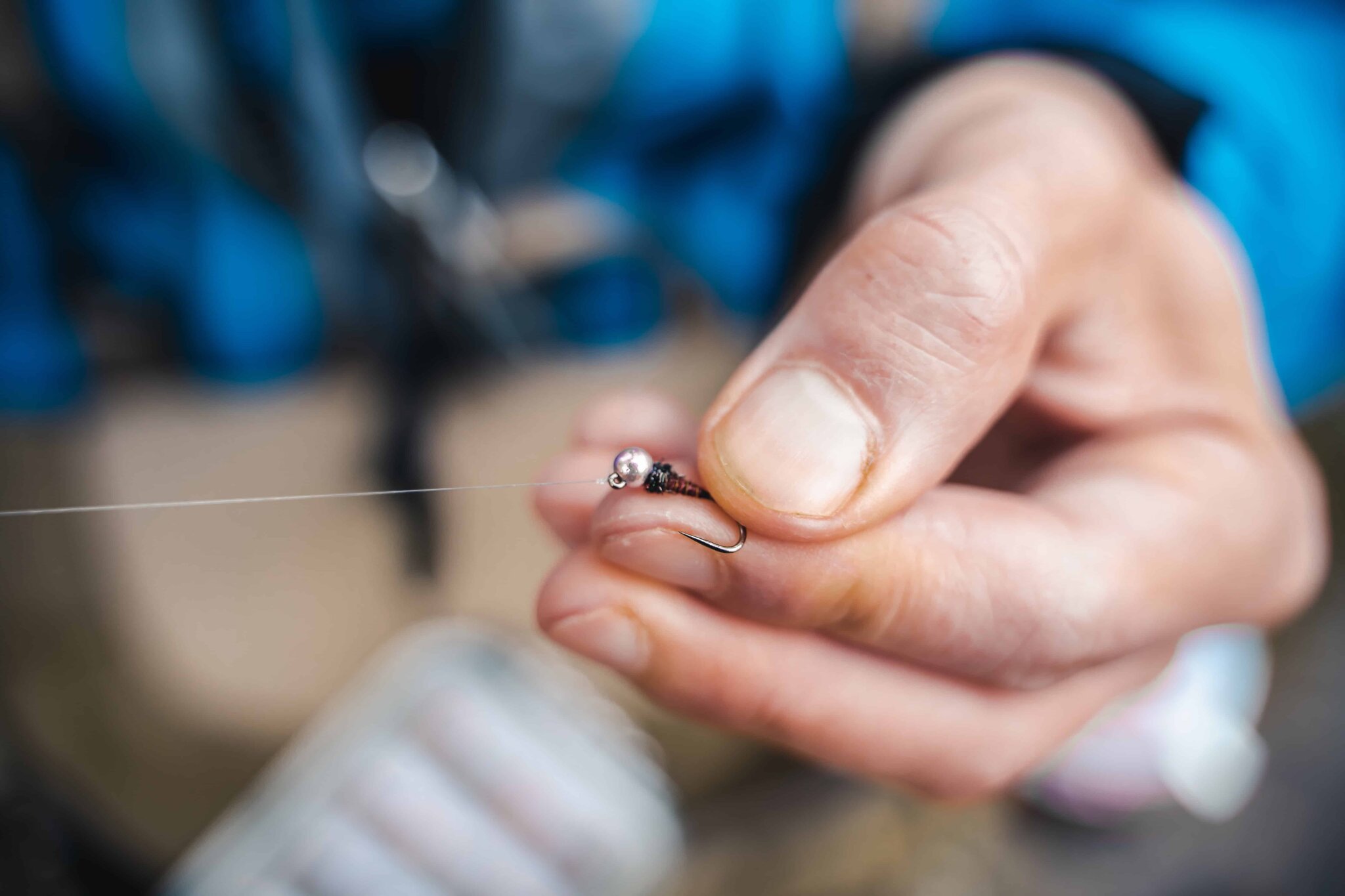
Before tying, run a fingertip or fingernail around the eye. Feel for sharp edges, corrosion, burrs, an open split ring, or a gap where fine line can wedge. On hooks and lures that got bent pulling out of snags, check that the eye is still lined up too.
The rest of the setup works the same way. Follow the full load path instead of treating line strength as the whole answer.
Wet the knot before the final cinch
Line can get damaged by heat and friction while a knot tightens. Wetting it and drawing it down smoothly cuts that friction and lets the wraps settle instead of burning into each other.
Don’t jerk it tight. Build tension steadily, watch the wraps move, and stop if the knot starts seating crooked.
Use a pull test that matches reality
A knot should survive a firm test before the first cast, not just look tidy. Hold the hook or lure safely, load the line gradually, and watch for slipping or anything changing shape.
Don’t wrap thin line around bare fingers and pull hard. Fine braid and monofilament can cut skin. Use a safe grip, a tool, or a protected surface when you’re testing higher loads.
Retie when the line gives you a reason
Retie after obvious abrasion, a bad snag, a fish that dragged the line across cover, a knot that’s run through rough guides over and over, or any time the connection stops looking clean. Line doesn’t have to break to be done, and Gear runs on that same idea of catching wear before it fails.
Practice somewhere warm
Cut several short pieces of cheap practice line and tie each knot five times without rushing. Then tie it five more times in the gloves or cold-weather layers you actually fish in, if that applies. Cold fingers change how well you tie a knot a lot more than people expect, and a warm room is a much nicer place to find that out than a frozen bank.
Your first few double unis will probably look like something a bird built. That’s normal, and nobody’s grading those. Only start timing yourself once the knot comes out the same way every time, because speed before consistency just teaches you to make the same mistake faster.
After that, the habit around the knot matters as much as the knot itself, and the habit is mostly looking before you trust it. The best knot was never the one somebody won an argument about. It’s the one that fits the connection and holds on the line actually in your hand.