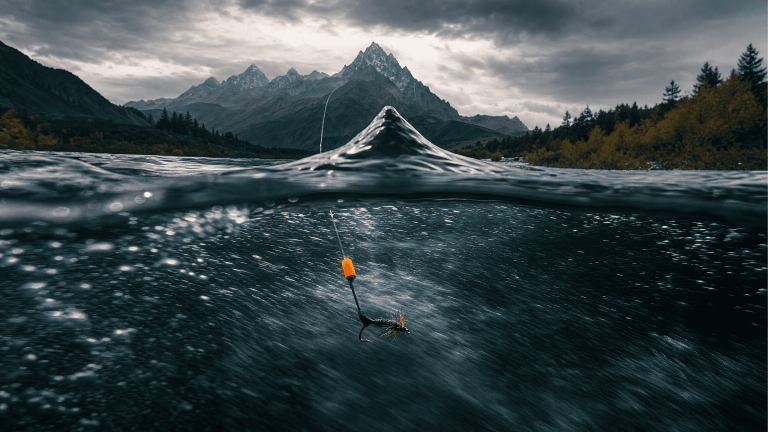
The fixed bobber is where most of us started, and it has one hard limit that you run into about four feet down.
You can’t cast it. A clip-on float set eleven feet above a hook means eleven feet of line hanging off your rod tip, and there’s no version of that which ends in a good cast. So people fish shallow because the rig makes them, and then conclude the fish weren’t there.
The slip float fixes exactly that, and in doing so it turns the bobber from a kid’s tool into one of the more precise things in the box.
How it works, short version
A small stop knot goes on your line at whatever depth you want. Below it, a small bead. Below that, the float, which has a hole through it and slides freely. Then weight, then hook.
On the cast, the float slides down to the weight, so the whole rig is compact and casts like a normal setup. When it lands, the weight pulls line down through the float until the stop knot hits the bead and the float can’t slide any further. The bait settles at exactly the depth you set.
Reel in and it collapses again. You can fish thirty feet down and still cast it across a lake.
Why depth is worth this much trouble
Because it’s the thing that most often decides whether you catch anything.
Fish hold in bands. Crappie suspend over cover at a specific level and ignore anything below them. Walleye sit on a break at a depth that changes through the day, and trout in a lake cruise a thermocline. In every one of those cases you can have exactly the right bait and be four feet out of the conversation.
The value of a slip float is that it turns depth into a number you can write down and come back to. “Eleven feet” is a hypothesis. Testing it takes fifteen seconds — slide the stop knot, cast again. That’s a much better experiment than “somewhere down there.”
Changing one variable at a time is easier to actually do with this rig than with almost anything else.
Setting it up so it works
Match float to weight. This is where most rigs go wrong. A float needs enough weight below it to pull line through and to sit properly in the water — ideally with just the tip showing. An underweighted float rides high and won’t cock, so a fish feels resistance before you see anything. An overweighted one sinks.
Buy floats rated for a weight range and use the weight they’re asking for. The rating on the package isn’t marketing.
Show as little as possible. A float with an inch of tip above the surface telegraphs a bite instantly and gives almost no resistance when a fish pulls down. A float sitting like a cork with half its body out is a warning system that fires late.
Use a small stop knot. It has to pass through the rod guides on every cast, so it can’t be bulky. The pre-tied ones on plastic tubes work fine and take twenty seconds to install. Snug them loose enough to slide when you move them but tight enough to hold on the cast.
Put the weight close enough to matter. Split shot eighteen inches or so above the hook usually cocks the float well and leaves the bait some freedom. Too close and the bait can’t move; too far and the float never sits right.
Fishing it, which is less passive than it looks
A slip float isn’t a set-it-and-forget-it rig, though it does that fine too.
Wind drift is the underrated version. Cast upwind, let the float drift across a flat or along a weed line, and you’ve covered water at a fixed depth without touching the rod. That’s a genuinely good search method, and it’s how a lot of stillwater trout get caught.
A small lift and settle every so often gives the bait motion and often triggers a fish that’s been looking at it. Not a retrieve — just enough to make it move and fall again.
In rivers, the float becomes a drift indicator and the whole thing turns into a controlled drift down a seam. It’s the same current-lane reading as the controlled drift, just with a visible marker.
The bite, and what to do with it
Not every take pulls the float under.
A float that tips sideways is a fish that picked the bait up and moved without pulling down. One that starts traveling against the wind is a fish too. And a float that lifts and lies flat is usually a fish that came up with the bait, which is common with panfish. Every one of those is a take, and every one gets missed by people waiting for the dramatic plunge.
How long to wait depends on the hook. Circle hooks want a steady pull rather than a snap, and how the hookset changes with circle hooks gets into why. A standard hook wants a firmer set, reasonably soon, because a bait left too long gets swallowed and that’s a fish you can’t release well.
Where it earns its keep
Suspended crappie over brush and walleye on a rock point in the evening are the classics. It’s just as good for steelhead and salmon in a river, or trout in a lake at a depth you found with a thermometer. Basically, live bait anywhere fish are holding at a level rather than on the bottom.
And it’s one of the best rigs to hand somebody who’s new, for a reason that has nothing to do with catching: the float makes the bite visible. A kid who can’t yet feel a tick on a jig can absolutely see a float go under, and that’s the moment that decides whether they want to come back.
There’s a snobbery about bobbers that’s worth ignoring. A float is a depth-control device with a visual bite indicator, which is also a fair description of a strike indicator on a fly rod, and nobody sneers at those.
FIELD OBJECT
This one should leave the page.
The article is the long version. These are the pieces worth carrying into the next trip.
The 30-second version
Most bait fishing fails at depth, not at bait. A slip float lets you set an exact depth and still cast it, and moving that number takes about fifteen seconds.
What to watch
- How it works, short version
- Why depth is worth this much trouble
- Setting it up so it works
- Fishing it, which is less passive than it looks
Field card
- How it works, short version
- Why depth is worth this much trouble
- Setting it up so it works
- Fishing it, which is less passive than it looks
- The bite, and what to do with it
RIGHT TOOL, NEXT
Species & Presentation
Carry the species behavior and presentation question into a narrower water-to-fish-to-presentation handoff.