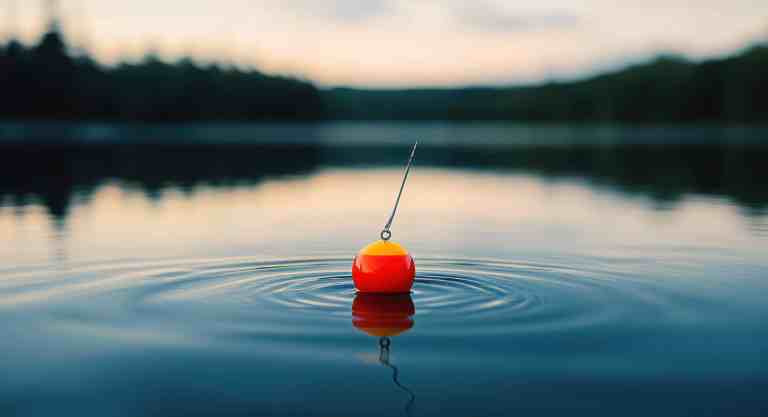
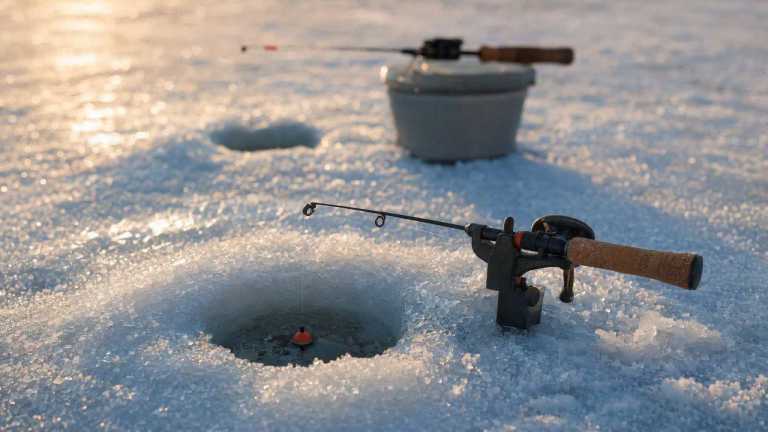
There’s a stretch of the calendar — late fall through early spring on water that doesn’t freeze — where most of a tackle box stops making sense.
Fish won’t chase. A crankbait ripped past them is a lot of commotion for something they’re not going to run down. Topwater is over. Soft plastics dragged slowly work, but slow dragging in forty-degree water is a long day.
What tends to survive is a category most people own one of and rarely tie on.
What a blade bait actually is
A flat piece of metal, roughly fish-shaped, with lead in the nose, a tie point on the back and trebles hanging beneath. That’s it.
The flatness is the whole design. On the lift, water resistance across a flat vertical surface makes it vibrate hard — a fast, tight, high-frequency buzz you can feel through the rod. On the drop, it has almost no resistance and sinks quickly, fluttering slightly as it goes.
So you get two completely different signals in one lure: a sharp attention-getting vibration, then a fast quiet fall. That combination is why it works when fish are inactive. The lift says come look, and the fall says here it is, easy, going away.
The strike comes on the fall, and you may not feel it
This is the whole technique and it’s where people fail.
Lift the rod — not far, twelve to eighteen inches is plenty in cold water — and feel the blade buzz. Then lower the rod tip back down at roughly the speed the bait is falling, keeping a slight tension in the line the whole way.
That controlled fall is everything. Slack line on the drop means the fish takes it and you find out when you lift again and it’s gone. Tension on the drop means you feel a tick, or a weight, or nothing at all except that the expected thump of the bait hitting bottom never arrives.
That last one — the bottom that doesn’t come — is the most common blade bait bite. Watch your line where it enters the water. If it stops early or twitches sideways, set.
Blade baits are about the clearest example there is of not feeling every bite on a tight line.
Smaller lifts than you think
The instinct is to rip it. In summer, sure.
In cold water, a big aggressive lift moves the bait several feet and puts it out of the zone, then the long fall is happening far from where the fish is sitting. A short lift keeps the bait in a tight vertical area right above a fish that isn’t interested in relocating.
There’s also a real argument for just slower everything: slower lift, longer pause at the top, longer pause after it hits bottom before the next lift. Neutral fish frequently take a bait that’s been sitting still for three seconds.
Where to fish it
Cold-water fish concentrate, and they concentrate on structure that gives them access to deeper water without much travel.
Think steep breaks, the deep ends of points, and rip-rap banks, especially rock that holds warmth. Channel edges, bridge pilings and deep humps count too. What they share is a bottom that falls off quickly, because that’s where a fish can sit at a comfortable depth and still be close to a feeding shelf.
The cast is often along the structure rather than across it, so the bait stays in the productive depth for the whole retrieve instead of climbing out of it.
Vertical fishing works too, straight under the boat over deep fish. Same lift-and-controlled-fall, just without the horizontal component.
The gear details that matter
Tie point. Most blade baits have two or three holes along the back. Forward holes give a tighter, faster vibration; rear holes give a wider, slower one. That’s a free adjustment most people never touch.
Use a snap, not a direct knot. A knot tied straight to the hole restricts the action and a blade bait’s action depends on freedom of movement. A small round-bend snap is standard.
Line choice. Fluorocarbon’s low stretch helps you feel the fall, and its sink rate keeps the line from bellying. Braid with a fluoro leader works too. Straight mono absorbs too much of the subtle stuff.
Hooks tangle. Two trebles on a short flat body will foul on the line constantly, particularly on the fall. Swapping the front treble for a smaller one, or running a single hook, cuts that down a lot. Some people run only the rear hook.
Sharp hooks. Cold-water bites are soft and the fish often has the bait barely in its mouth. It’s the tackle as a chain idea again, and the weakest link is usually the point.
What it competes with
Lipless crankbaits do a similar job with more sound and a horizontal retrieve. Jigging spoons do a similar job with more flash and less vibration — there’s more on those in what a spoon does well. A hair jig does it quieter and slower.
Blade baits sit in the middle. They buzz harder than a spoon and fall faster than a jig, and the vibration’s tighter than a lipless. On a given day one of those will be better than the others and there’s no way to know which without trying. Run two rods and find out, rather than picking one and defending it.
Why this one’s worth the trouble
Cold water fishing is where most people quit for the season, and the fish are still there and frequently grouped up in a way they never are in July.
A blade bait is about the least fashionable lure you can own. It’s ugly, it’s noisy in the hand, it hooks your jacket, and it’s been catching winter fish for fifty years while people rotated through more interesting options.
If the water’s forty-five degrees and nothing is working, that’s not a bad thing to have tied on.
FIELD OBJECT
This one should leave the page.
The article is the long version. These are the pieces worth carrying into the next trip.
The 30-second version
When the water drops and fish stop chasing, most of the box gets useless. A thin piece of metal that vibrates hard on the lift and falls fast on a controlled line is the exception.
What to watch
- What a blade bait actually is
- The strike comes on the fall, and you may not feel it
- Smaller lifts than you think
- Where to fish it
Field card
- What a blade bait actually is
- The strike comes on the fall, and you may not feel it
- Smaller lifts than you think
- Where to fish it
- The gear details that matter
RIGHT TOOL, NEXT
Tackle Link Analyst
Follow the load path and find the part of the setup that actually limits the rest.