The story is that somebody dropped a spoon off a boat, watched a fish hit it on the way down, and cut the handle off. Whether or not that happened, it’s an honest description of the object.
There’s nothing to a spoon. No bill, no rattle, no joint, no soft plastic, no scent chamber, no bearings. It’s a bent piece of metal with a hook on it, and it has outlasted a hundred cleverer lures because the thing it does is fundamental.
What the curve is doing
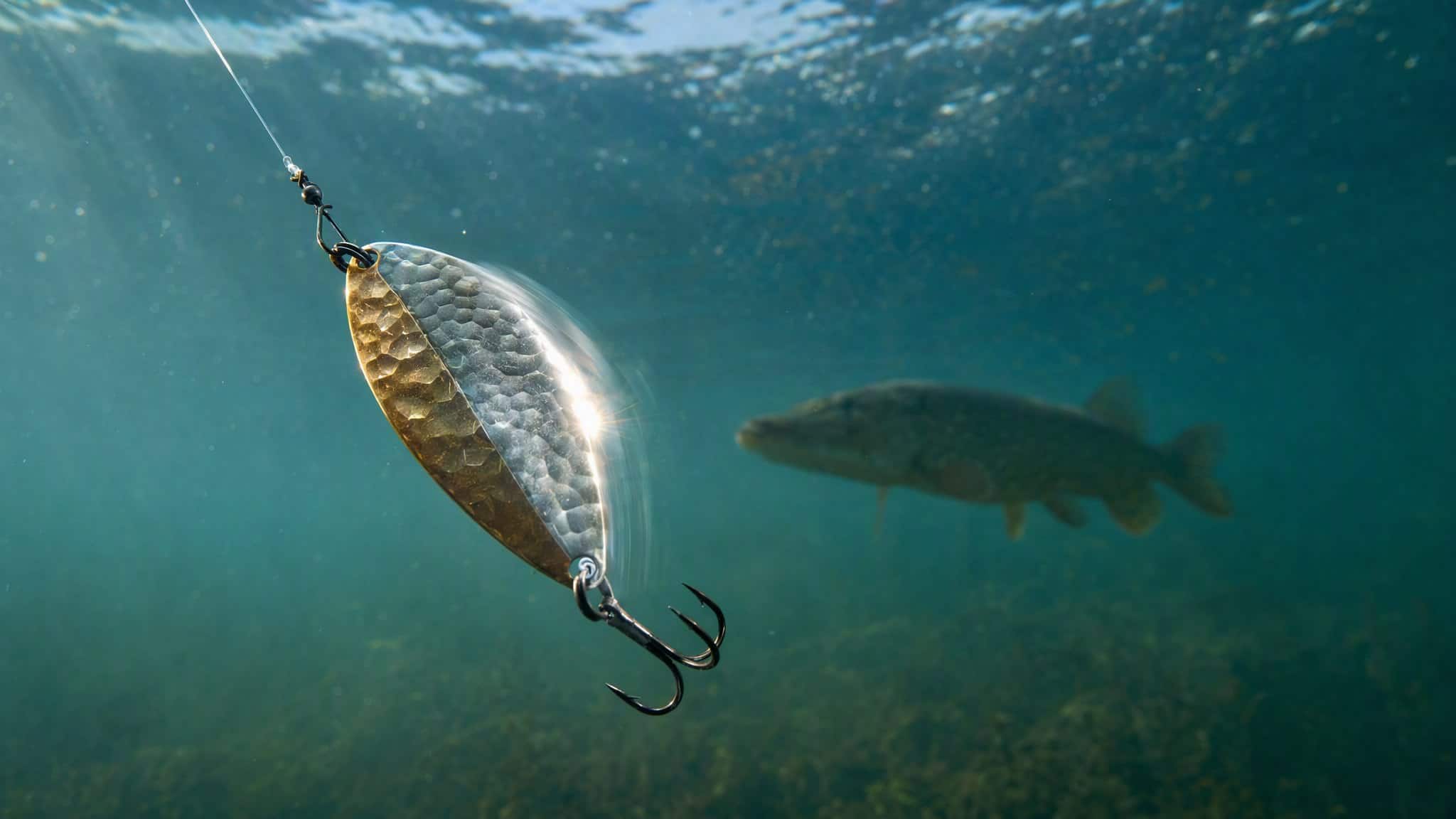
Water hits a curved, asymmetrical piece of metal and pushes it off-axis. It recovers, gets pushed the other way, recovers again. That’s the wobble, and it’s generating two signals at once: a flash that cycles on and off as the reflective surface turns, and a low-frequency pressure disturbance that a fish detects on its lateral line well before it sees anything.
Flash plus thump. That’s the entire product.
The shape controls the character. A wide, deeply cupped spoon has a slow lazy wobble and a lot of water resistance — it stays high, works at slow speeds, and refuses to behave when you speed up. A long, narrow, shallow spoon has a tight quick wobble, sinks faster, and holds together at speed. Everything in the aisle sits on that axis.
Speed isn’t a preference here, it’s a requirement
The failure mode is specific and visible.
Too slow and the spoon doesn’t wobble at all — it sways, or it just hangs there rolling over. Too fast and it stops wobbling and starts spinning, helicoptering on its axis, which twists your line into a mess and looks like nothing that has ever lived.
Every spoon has a window, and that window is narrower than most lures’. This is the thing that makes spoons feel unreliable to people who haven’t found it, and it’s why the same spoon is somebody’s favorite lure and somebody else’s junk drawer.
Find the window by watching it beside the boat. Reel it past you at different speeds and look. Ten seconds of that tells you more than any amount of reading, and it’s a habit worth having with every lure. The opposite failure exists too: a lure can look right beside you and still fish wrong, so it’s worth checking for both.
Not every spoon is built for the same job
Casting spoons. Thicker, heavier for their size, built to fly. These are the ones you throw from a bank when you can’t reach anything and need distance. Steady retrieve with occasional pauses. The pause lets it flutter and drop, which is often when it gets hit.
Trolling spoons. Thin and light. They have almost no casting weight and are designed to be pulled behind a downrigger, a diving device, or a lead core line. All of their design budget went into the action at trolling speed, which is why they’re useless to throw. This is where trolling speed matters most — a thin spoon has a very tight speed window.
Jigging spoons. Heavy, compact, dropped straight down. Lift, then let it fall on a controlled slack line. Nearly every strike comes on the fall, and you often don’t feel it — you feel that the spoon isn’t there anymore, or the line jumps. Vertical spoon fishing is a whole discipline on deep structure and under ice.
Where a spoon beats something more sophisticated
When you need distance from shore. A compact heavy spoon casts further than nearly anything of the same weight, and reaching water nobody else reaches from the bank is a real advantage. Distance isn’t everything from the bank, and there’s a good case for not trying to reach the middle — but when you actually need it, this is the tool.
In the vertical. Nothing falls as usefully. A jigging spoon dropped into a school of suspended fish gets down fast and flutters convincingly.
In wind and chop. The weight punches through wind that would push a lighter lure around.
When fish are on flash. Clear water, bright light, active fish keyed on baitfish — a spoon is doing the exact thing that situation calls for.
Where it doesn’t
Heavy cover, obviously. An exposed treble on a wobbling piece of metal is a snag looking for a home.
Very cold, very neutral fish, where the wobble is more commotion than they want. Something falling quietly usually beats something flashing.
And any situation calling for a specific profile. A spoon looks like a generic flashing thing. When fish are locked on a particular size and shape, generic is exactly the wrong answer, which is why size and silhouette come before color.
Two details that fix most spoon problems
Put a swivel in the system. Spoons twist line. Not always, not badly, but over a couple of hours it adds up into a leader that coils and a lure that fishes badly. A small quality swivel a foot or two up solves it, and the fish don’t care.
Change the hook. The trebles on inexpensive spoons are frequently the cheapest part of the lure, and a spoon gets hit at speed by fish that then have leverage on a thin hook. A quality replacement treble, or a single hook if you’re releasing fish, is the highest-value upgrade available on a five-dollar lure.
Single hooks on spoons deserve more use generally. They hold well and they’re far easier on fish. In some fisheries they’re required.
Why it’s still worth carrying
Because it’s one of the few lures that works everywhere. Trout in a mountain lake, pike in weeds, salmon on a downrigger, bass off a point, walleye vertical over structure, everything that swims in salt water.
That’s unusual. Most lures are specialists that got promoted. A spoon really is general-purpose. It costs almost nothing and doesn’t break, and it was catching fish before anybody had an opinion about it.
Somebody trying to sell a first-time buyer eleven categories of hardbait is selling categories. Three spoons and an afternoon spent finding the speed that makes them wobble will teach more than any of it.
FIELD OBJECT
This one should leave the page.
The article is the long version. These are the pieces worth carrying into the next trip.
The 30-second version
A spoon is a bent piece of metal with a hook on it. It flashes and wobbles beautifully, right up until you get the speed wrong and it starts spinning.
What to watch
- What the curve is doing
- Speed isn't a preference here, it's a requirement
- Not every spoon is built for the same job
- Where a spoon beats something more sophisticated
Field card
- What the curve is doing
- Speed isn't a preference here, it's a requirement
- Not every spoon is built for the same job
- Where a spoon beats something more sophisticated
- Where it doesn't
RIGHT TOOL, NEXT
Species & Presentation
Carry the species behavior and presentation question into a narrower water-to-fish-to-presentation handoff.