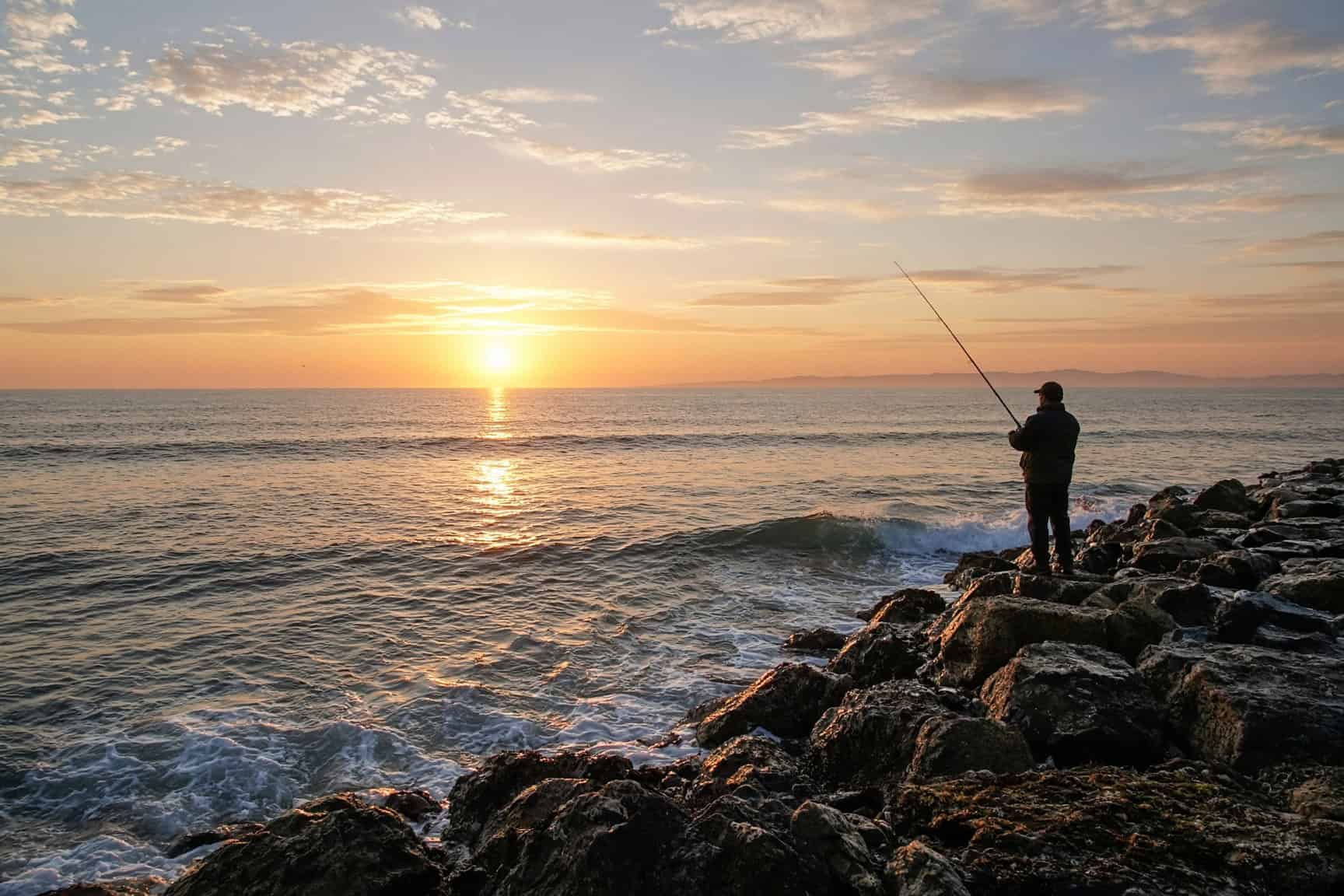
The first cast off the bank is almost always the longest one. Straight at the middle, as far as the rod will send it.
I get why. Open water looks like possibility, and a big cast feels like you’re finally reaching the part the boat people get for free. The trouble is that distance isn’t structure, and the best water you can reach might be twenty feet to your left.
Bank fishing gets easier once you stop treating the shoreline like a bad boat.
Start with what the bank gives you
A boat lets you pick your angle. The bank picks most of yours for you, which sounds like a raw deal until you notice what comes with it: riprap, shade, dock posts, grass lines, culverts, creek mouths, little points, fallen trees, the spot where mud turns to rock, and the first drop into deeper water.
Those aren’t consolation prizes. They’re places where depth, cover, current, temperature, or food changes over a short distance, and fish use changes.
Walk fifty yards before you cast if you can, and look back along the bank instead of straight across the lake. A point that barely shows from the parking lot can split the shoreline into two different ones. Maybe a drainage pipe is putting moving water into the pond, or a patch of reeds ends right against clean gravel. None of that needs a seventy-yard cast.
Getting to the water legally and safely is its own problem, and shore access as part of the fishing system covers it more broadly. This starts after that: once you’re there, what can you actually reach from where your feet are?
Fish sideways before you fish away
One of the stranger things about bank fishing is how many lures fly right over fish.
Where the bank drops fast, fish can travel almost under your rod tip. When vegetation runs parallel to shore, the useful cast might follow that edge for thirty feet instead of crossing it for three. And a rocky point that keeps going underwater holds a lure near the change a lot longer if you cast across it instead of bombing straight off the end.
So fish the close water first and let the shoreline tell you when to change angles. Farther only earns its place when farther reaches different water.
Short casts are one of the first things people get self-conscious about on a crowded bank. On a lot of shorelines it barely matters, because plenty of the fish were never out that far to begin with.
Working close first keeps you quieter, too. Walking up to the edge, dropping a backpack, clacking a tackle tray onto the rocks, and then sending the first cast over the horizon is a pretty efficient way to disturb the water you never bothered to fish.
The cast needs a job
Some bank spots really do call for a long cast. A shallow flat can put the first meaningful depth way out from shore, surf anglers may need to reach a trough or bar, and a reservoir bank can be so gradual that another twenty yards changes the water completely.
Then the long cast has a reason, which is different from casting far because far feels better.
Ask what the extra distance actually reaches — deeper water, the outside weed edge, current, shade, a channel swing, a school of bait. If the answer is more of the same empty-looking water, you haven’t improved the cast. You made it longer.
Let one lure show you the shoreline
Bank anglers can carry an impressive amount of tackle for people who then stand in one place.
For the first pass, tie on something you can fish at a few depths and speeds without rebuilding the whole rig: a small jig, soft plastic, spinner, spoon, or some other general search bait. It’ll tell you whether the bottom’s clean or weedy, where the drop starts, whether current is pulling, and how long the lure takes to hit bottom.
It doesn’t have to be the magic lure. It’s there to learn the water for you.
Say the weeds start grabbing it at the same point in every retrieve; that’s where the cover begins. A jig that suddenly takes twice as long to reach bottom after one step down the bank just told you the depth changed. And when every bluegill bite comes out of one narrow strip of shade, that pattern is probably worth more than the color chart on the package.
It’s the same idea as looking at the water before opening the tackle box, and it matters even more from shore, since you can’t just drive over and see what’s underneath you.
Move before the spot becomes a personality test
Some bank spots deserve patience. A creek mouth can turn on when the current changes, a dock can fill back up with fish, and a point can be worth another look once the light moves.
There’s still a difference between waiting on a reason and refusing to leave because the spot looked good from the parking lot.
Once you’ve covered the depth you can reach, changed your angle, and slowed down at least once with no sign of fish or food, moving fifty yards can teach you more than changing six lure colors.
You don’t need a mile of public shoreline for that. Even a small access has little zones in it — the ramp, the riprap, the dock and the weeds beside it, the outflow and the point next to it. Fish them as separate pieces instead of one spot, because to the fish they probably are.
Some shorelines aren’t worth reaching
This part’s plain. Don’t climb unstable rock, trespass around a fence, wade a drop you can’t see, or put yourself below a steep bank just to get a better casting angle. Water level, current, cold water, surf, slippery algae, and changing weather can turn an ordinary shoreline into a bad place quickly. The National Park Service’s fishing safety guidance makes the same basic point: know the hazards of the water you’re on, and don’t let the fishing decision outrun the safety one.
Check access rules too. A bank you can see isn’t automatically a public bank. The regulation check for the specific water you’re on covers the rule side in more detail.
The bank is smaller than the lake. That helps.
You can’t fish every piece of a lake from shore, and you don’t need to. Finding the handful of changes the bank lets you reach is a much smaller problem than finding every fish in the lake.
And if the best cast really does turn out to be the long one toward the middle, go ahead and make it. At least now it’s going somewhere.


