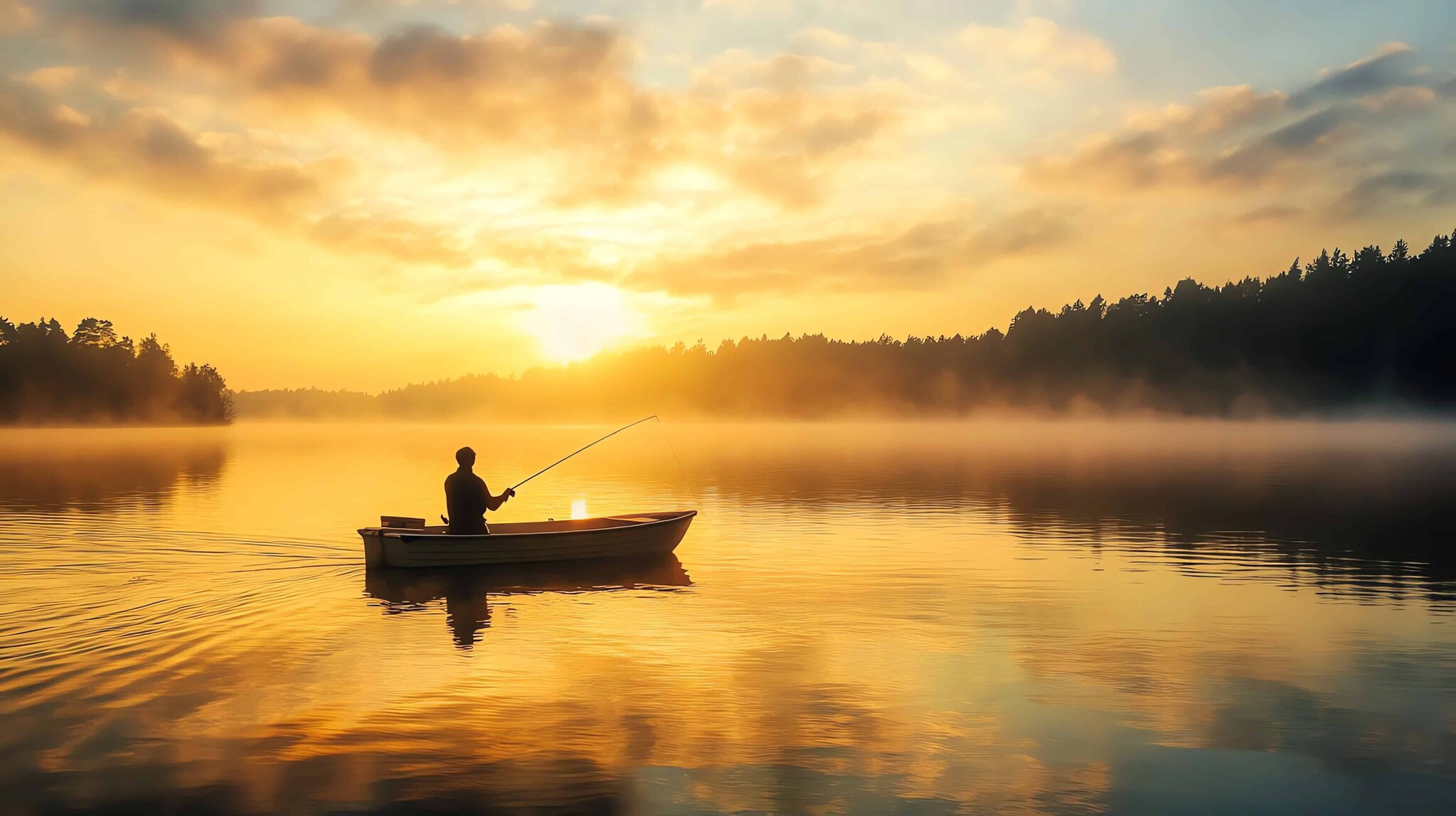
An hour goes fast on water I’ve never seen before. I want to cover the whole shoreline, try four lures, check the map, watch the graph, chase whatever just swirled off the point, and generally make up for not knowing the place. Usually I get to the end of it extremely busy and knowing about what I knew standing at the truck.
So the hour gets one job. Not solving the lake or the river — just cutting down how much I’m guessing, so hour two starts as a decision instead of more of the same scramble.
What am I asking?
The question has to fit the water and whatever I already know walking in. On a reservoir it might be, Are fish using the first major break outside shallow cover? On a river, Are the productive fish holding in current seams or in slower water? From shore, Can I reach useful depth from this access point, or do I need to move?
“Where are the fish” is too big to test in an hour. “Will they bite a spinner” is usually too small, because the answer only applies to the spinner. A question about depth, current or position is about the right size, and the answer still means something after I change baits.
Before the first cast
I run a quick conditions snapshot first, and the access area counts as part of it. Wind, clarity, current, where the weeds and shade are, who else is out there, and whatever safety or property limits are right in front of me. I check the regulations for the exact stretch I’m standing on — seasonal closures, species restrictions, tackle rules, access boundaries. New water isn’t the place to assume I already know the rules.
A map and electronics build context. They don’t build certainty. A contour line shows me a break and stops there — it has no opinion on whether anything’s using it this morning. Sonar shows targets or bait, and what that means still depends on boat speed, transducer setup, depth, and what I do in the next ten minutes.
Find water that can compare itself
The nearest piece of cover is tempting mostly because it’s nearest. I’d rather pick water that lets me test the question. If depth is the question, I want a stretch where shallow water, a defined break and deeper water are all reachable from one position. If current is the question, I look for fast water, a seam and a soft holding area all in range.
One isolated cast tells me almost nothing. A run of controlled casts across different parts of the same feature can show whether the fish or the forage change as the depth or speed changes.
Fish something you can read
I start with a lure familiar enough that I’d notice if it started misbehaving. New water isn’t the moment to also learn a complicated new rig. It needs to reach the likely depth, get through the cover that’s there, and tell me about bottom, weeds and strikes on the way back.
If I can’t tell whether it’s fouled, dragging or running over the zone, it’s a bad test no matter how well it’s worked somewhere else. Confidence in a lure should mean I know what it’s doing down there. Liking it isn’t the same thing.
What changes, and in what order?
I give the first approach long enough to produce something, then change one important variable — top of the break to the bottom of it, maybe, or the same lure retrieved slower.
What I’m trying to avoid is the spiral: no bite, new color; no bite, new lure; no bite, new spot; no bite, new speed. Four changes in, I feel productive and I’ve wrecked any chance of comparing anything. Testing one thing at a time genuinely feels like standing around while good light burns. It’s also the only reason hour three doesn’t look exactly like hour one.
Does a blank stretch prove anything?
Not on its own. Wrong depth, wrong angle, wrong speed, wrong hour — any one of those produces the same nothing. But no response under a controlled test does start to justify moving. I’m not declaring the water empty. I’m deciding this particular test has stopped earning its time.
I try to set the stop condition before frustration sets it for me. Something like: shallow edge, break and first deeper lane all covered with a lure I know was running right, and no bites, follows, bait or sonar marks worth chasing. Then I move. Without that line drawn ahead of time, one good-looking, unproductive bank can eat the whole afternoon, and it’ll look good the entire time it’s doing it.
Writing it down
Not much, and definitely not a lab notebook. I record the few observations that can improve my next decision: rough time, wind, clarity, depth or current position, what I threw and what happened. A photo of the bank, the weed line or the rig usually beats another photo of a fish, because it lets me rebuild the conditions later.
Observation and interpretation go in separate sentences. “Two bites came from the downstream edge of the seam” is an observation. “All the fish are on downstream seams today” is a theory built on two bites, and writing the first one down honestly keeps the second from hardening into something I haven’t earned yet.
One fish
A fish is evidence. It isn’t a pattern. I note where the cast went, where the bite came, roughly how deep, and what cover or current was next to it. Then I repeat that part of the test before changing anything major on the strength of one bite.
If a second or third fish points the same way, now I’ve got something. I expand slowly from there — a similar feature nearby, a comparable depth. What I want to know is whether that catch was tied to a condition I can find again or just happened on a cast I can’t explain.
When the hour stops being about fish
Sometimes the most important information has nothing to do with fishing. Rising wind, lightning, unstable ice, current changing fast, heat, cold, wildfire conditions, poor visibility, unsafe boat traffic, equipment problems, an access issue. New water gets a wider safety margin from me, because I don’t know its exits, its hazards, or how it behaves when things change yet.
Leaving, relocating, or cutting the session short isn’t a failed fishing decision. It’s the right call when conditions have pushed the risk higher than the fishing is worth.
How the hour usually splits
Roughly ten minutes looking around and confirming access and rules. Fifteen or twenty testing one representative feature with a presentation I understand. Another twenty on one or two controlled changes. The last ten deciding whether to stay, move to a similar feature, change the question, or give up on that spot.
The minutes aren’t sacred, but the order mostly is. And if the hour ends and I still can’t say which depth or current or cover the evidence points at, more tackle isn’t the fix. The next test just needs to be smaller — small enough that I’ll still remember what it showed me on the drive home.