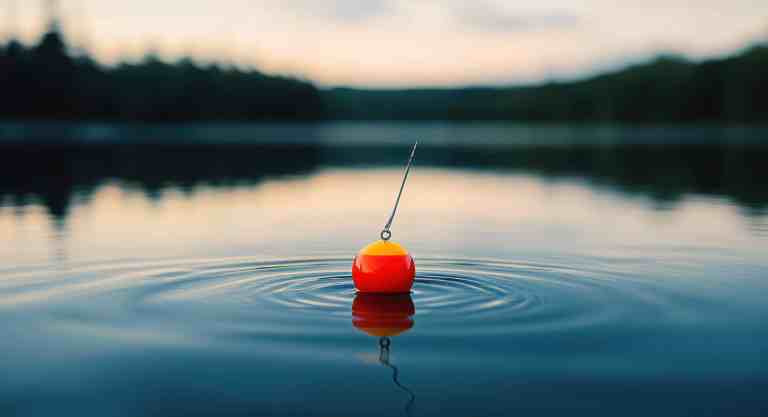
The last three feet of a retrieve are the part I actually watch, and they’re also the least honest three feet of the cast. Right at your boots the line angle is steep, the wind has almost nothing to grab, and the lure is putting on a nice little show where you can see it. Fifty feet out, none of that was true.
FIELD PLATE · DIAGNOSIS
The last three feet of the dashed line are the least honest part of it.
Between the splash and your feet, the line, the depth, the cover and the hardware all get their own turn at the presentation. I try to work that path before I decide the lure is the problem.
Watch the splash
How does it land? A clean entry is one thing. A slap that flips the hook over the leader, or a pile of slack sitting on the surface, is a different presentation from the first second, and nothing it does once it reaches your feet undoes that.
Check a few entries from the casting angle you’re actually fishing, not from whichever one is convenient.
Depth, early enough to count
How deep a lure runs depends on more than the lure. Cast length, line diameter, retrieve speed, current and rod position all push on it. So the question isn’t whether it reaches the right layer. It’s whether it gets there early enough to spend real time in it.
Touching the right depth for the final few feet isn’t the same as fishing that depth through the water you cast at.
The bow you can’t see from here
The line is part of the presentation. A high rod tip, a long cast, a crosswind or a drifting boat all change the angle and pull the lure up or sideways, and dropping or moving the rod can rebuild the path without touching the lure at all.
Wind puts a curve in the line that can speed the bait up, drag it off its track, and slow down how fast a bite reaches your hand. The effect is strongest at distance and nearly gone by the time the lure is beside you, which is exactly why it hides so well. Before adding weight, take some of the line out of the wind. A shorter cast or a different angle gives it less to push on.
Current gets to the line first
Moving water pushes on the line and the lure differently, and the line has a lot more length for it to push on. The bait swings out of the lane, stalls, or suddenly speeds up as the belly crosses faster water. A lure that tracks perfectly in a still pool can need a whole different approach the moment there’s push on it, so compare casts from two angles where you can.
Fouling and tired hardware
One strand of grass or a hook caught over the leader will kill the action outright, and it tells you nothing about whether the fish liked the lure. After a retrieve that felt off, look at the lure and think about where along the path it picked that up. If it’s happening at entry or in one patch of weeds, fix that piece instead of rebuilding everything.
Hardware fails more quietly. A bent hook, a split ring that’s opened up, a clip bigger than the lure wants — compare against a known-good one, or the manufacturer’s guidance where there is some, and replace what’s damaged instead of tuning around it.
Soft plastics rigged crooked will spin, and some hard baits track to one side when they’re damaged or out of tune. Use the tuning guidance for that specific lure. Bending things blind, without knowing which way the adjustment is supposed to go, mostly produces a second broken lure.
Break the retrieve into thirds
The first third often covers the water you cast at in the first place, especially when you threw past cover or across a break. Does the lure reach working depth and start swimming fast enough to matter there? One that takes half the cast to start fishing is badly matched to a short zone.
The middle third is where the bow, the current and your rhythm settle down enough to judge. Notice whether contact holds and whether the lure keeps its action through the pauses. A clean finish doesn’t erase a bad middle.
The final third is the flattering one. The line angle steepens, so crankbaits rise and jigs climb, and the current mostly lets go. That great-looking action at your feet may belong entirely to that last bit of geometry.
Pauses at distance
With a long line out, a pause isn’t the pause you see beside you. The line is still attached at a shallow angle and whatever the wind is doing to it keeps pulling, so a jig that drops straight down at your feet can swing back toward you on the fall at fifty feet. Count the pause and watch the line while you do. If the pause is the whole point of the technique, it deserves as much attention as the retrieve.
What clear shallow water can and can’t tell you
Where it’s safe and legal, I run a few test retrieves in clear water where I can see more of the path. That’s how you catch a spin, a roll, or a lure that runs off to one side.
Just don’t stretch it. Shallow, visible behavior finds mechanical faults. It doesn’t tell you what the same bait does at depth, and it isn’t a substitute for testing it where you’re actually fishing.
Same lane, one change
Once there’s a likely culprit, I change one thing that affects how it fishes — the rod position, say, or the bent hook — and run the same lane again.
Swapping lure, line, weight and retrieve all at once doesn’t fix a diagnosis. It cancels it.
Running right isn’t the same as getting eaten
A lure can do exactly what it was designed to do and still go untouched all afternoon. Getting it mechanically right only proves you tested the presentation you meant to test. Whether the fish want it, in that water, at that hour, is a separate question.
It’s still the step worth doing first. Once the lure is fishing correctly, a refusal is actually the fish talking, instead of fifty feet of unexamined retrieve I decided to blame on a paint color.
FIELD OBJECT
This one should leave the page.
The article is the long version. These are the pieces worth carrying into the next trip.
The 30-second version
A lure putting on a nice show at your feet hasn't proven much. The line angle, the wind and the depth were all different fifty feet out, which is where it was supposed to be fishing.
What to watch
- Watch the splash
- Depth, early enough to count
- The bow you can't see from here
- Current gets to the line first
Field card
- Watch the splash
- Depth, early enough to count
- The bow you can't see from here
- Current gets to the line first
- Fouling and tired hardware
RIGHT TOOL, NEXT
Species & Presentation
Carry the species behavior and presentation question into a narrower water-to-fish-to-presentation handoff.