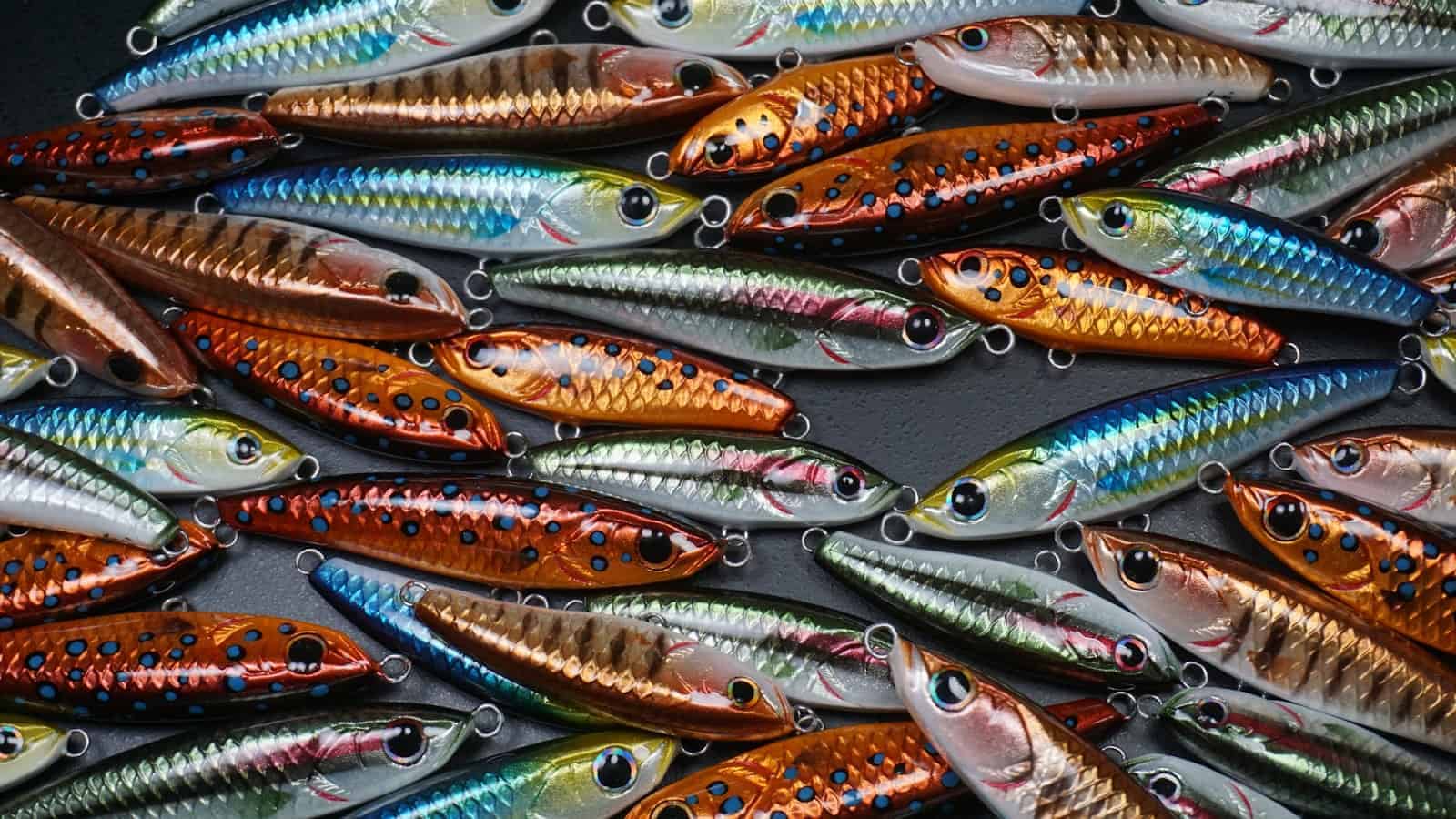
Put seven lures on a workbench and they can look like seven completely different ideas.
Chrome, firetiger, rattles, feathers, different bills, different names. One of them probably has a color somebody spent three meetings naming.
Now take the paint and the packaging off them for a minute.
If most of those lures want to run in the same shallow band, keep moving horizontally, and avoid the same kinds of cover, the box has less variety than the colors suggest. A lure that pauses differently or casts better in wind may still earn its place. What matters is whether it changes the job.
The tray gets a lot less diverse once the water gets involved.
Color is not a capability
Color sometimes matters, and so do profile, sound, action, and how a lure behaves when you stop it. A black bait and a pearl bait aren’t secretly identical just because both have hooks.
My point is that those differences get more attention than the basic job surprisingly often.
Say two lures both fish two to four feet deep, both need a steady retrieve, both hang up badly in the cover you fish, and both are mostly good for covering the same kind of water. Switching from one to the other may be a much smaller change than it feels like in your hand.
You might still prefer one. It might have a tighter action or cast better into wind, or suspend while the other one rises. Those are real differences. The useful question is whether the difference changes what you can ask the lure to do.
The workbench test
If I wanted to know whether a tackle box had real variety, I’d ignore species names and lure categories at first and ask boring questions.
How deep can this fish effectively? Can I keep it high without racing it, or low without hanging bottom every cast? Can it stop and stay near the fish, or does it need forward motion? Does it come through grass, wood, rock, or open water without turning every cast into a rescue mission? Can it work one target slowly? Can it cover fifty yards of bank without taking all afternoon?
Those questions are less exciting than staring at seven paint jobs. They’ll also tell you whether you have seven options or seven versions of the same answer.
What fake variety looks like
Imagine a shallow box with two squarebills, two shallow-running minnow baits, a small spinnerbait, a compact swimbait, and a wake bait.
That isn’t a ridiculous box. Every one of those can catch fish. The problem shows up when the water changes and every lure still wants to solve roughly the same part of it.
If the fishable water is suddenly fifteen feet down, that box may have a depth problem. Thick grass exposes a snag problem. And if fish are sitting on one small piece of structure and you need something that can stay there instead of passing through it, that box may have a positioning problem too.
The box can be full and still have holes.
A real gap changes the job
A real tackle gap isn’t “I don’t own this new shape yet.” It’s “I keep running into a situation my current stuff handles badly.” That’s the same distinction behind diagnosing before you buy.
Maybe nothing in the box can get to bottom efficiently in deeper water, or everything moves too fast for a small target you want to work slowly. Maybe you’ve got plenty of open-hook choices and almost nothing you can drag through vegetation. Or every lure covers water fine, but none of them lets you stop and hold in one place.
Now a new lure has a reason to exist.
It earns its place by adding something the box actually lacks. Price and trendiness can be interesting for other reasons, but they aren’t the job.
Duplicates are not automatically bad
There’s another side to this. Sometimes duplicates make perfect sense.
A lure you trust can get lost. A productive color can matter when visibility changes. Different weights can change running depth or fall rate, and two similar baits rigged differently can save time. If you know why the duplicate is there, it isn’t clutter just because somebody on the internet owns fewer things.
Owning fewer lures doesn’t win anything by itself. I just want to know why two similar baits both deserve a slot before I call the box covered, and whether the box reflects the water you fish or the store aisle you walked through.
Do the jobs first
Before adding another lure, I’d dump the current ones on a table and sort them by what they can actually do: depth, speed, movement, cover tolerance, whether they can pause, whether they work vertically or horizontally, and how much water they can reasonably cover. If a candidate really does add a job, test it on the water without letting it hijack the day.
You may find a real gap. You may also find that the thing you almost bought would’ve been lure number eight doing job number one.
Doing that to the whole tackle box is the bigger version of the same exercise, and The Tackle Box Audit in the Field Shop walks you through it one tray at a time. The fake variety gets obvious fast, and anything new has to earn a job before it earns space. The rest of the gear writing leans the same way.