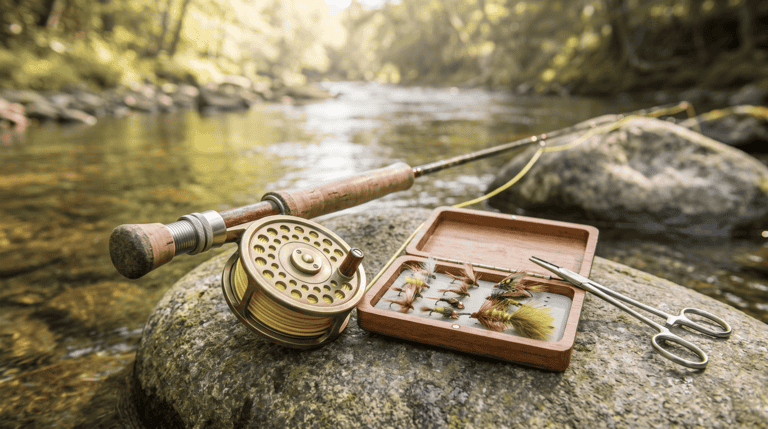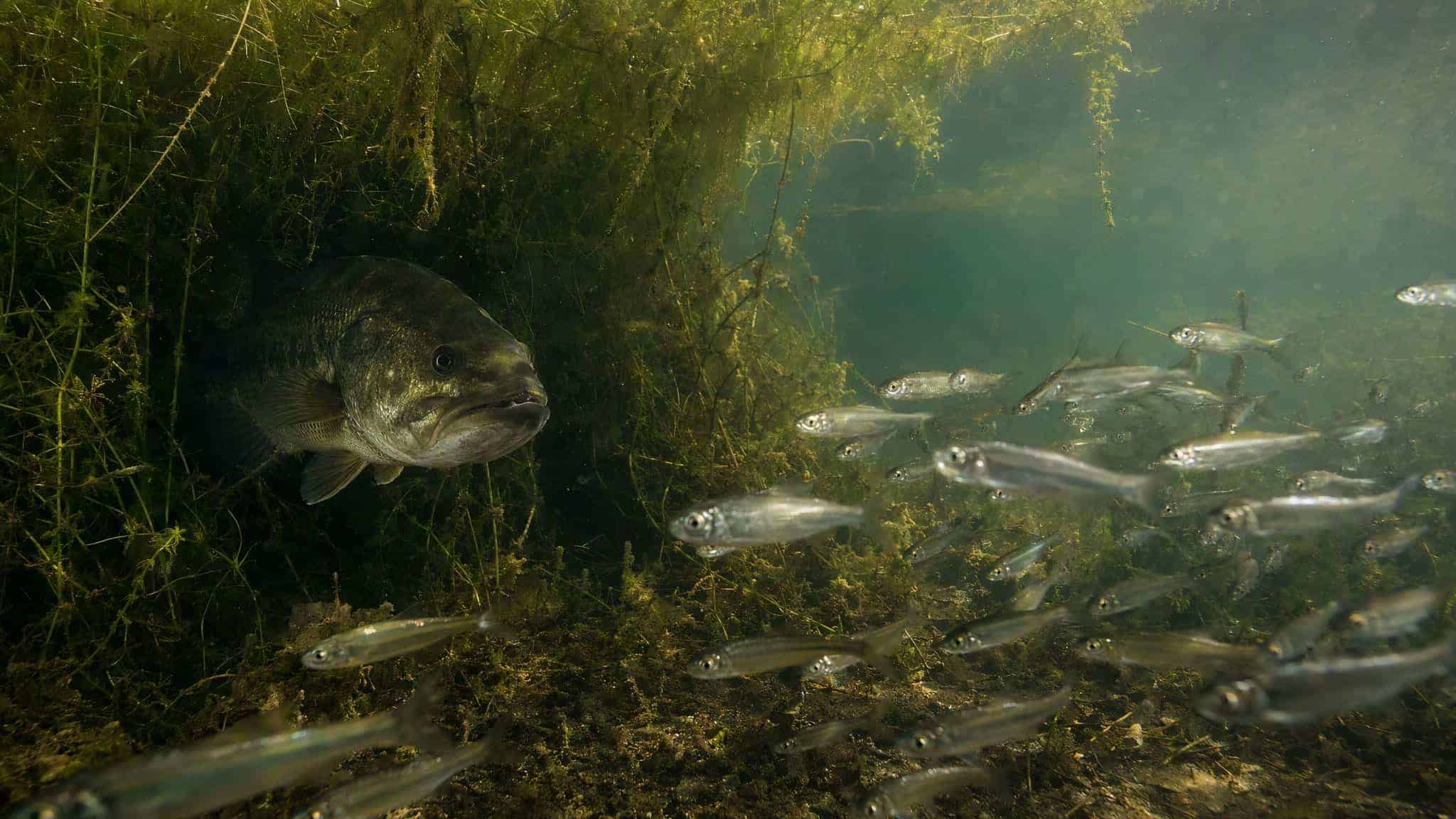
Mayfly. Shad. Sculpin. Perch. Caddis. Minnow. Crayfish. I like names as much as the next angler.
FIELD PLATE · FORAGE
Silhouette and movement beat a confident guess.
Names are useful once I know what I’m looking at. They get a lot less useful when I’m so busy trying to nail the exact identification that I stop noticing what the thing is actually doing.
When fish are feeding, I try to start with what I can actually see: how big the food is, where it is in the water, and how it moves. A decent read on behavior gets me closer to the right presentation than a confident species label I slapped on after a two-second glimpse.
I ask where the food is before I ask what it is
Food near the surface is a different problem than food crawling the bottom, even when it’s technically the same kind of forage.
I watch the layer first. Are fish up top, just under the film, halfway down, or hugging bottom? Are birds or baitfish giving away where the activity is? Is current stacking food into a seam, or is the wind pushing small stuff against one bank?
Depth and position decide which presentations can even get into the feeding zone. A dead-on imitation fished in the wrong layer is still wrong.
Size I can trust faster than identity
I might not know the exact species of a small baitfish, but I can usually tell whether it’s an inch long or four inches long, and that difference matters.
Same with an insect at a distance — I may have no shot at naming it, but its size and how it sits on the surface narrow my choices right away.
I start with proportion. If the food out there is tiny and what I’m throwing is three times the size, that mismatch is probably obvious to the fish. If predators are chasing bigger forage, something too small might not even register as worth the trip.
I don’t need to be exact. I just try not to be dramatically wrong before I worry about being precise.
Movement matters more than color, most days
Something that darts looks different to a fish than something that drifts, and both look different from a crayfish crawling along or a baitfish just hanging there barely moving.
I watch how the real thing moves relative to the water. In current, “moving” can just mean drifting at close to the same speed as the flow around it. A lure racing across that lane under line tension can look more unnatural than one with a slightly off color and a clean drift.
In still water, cadence is usually the tell. Short bursts and pauses, a steady cruise, a slow fall, a bottom crawl — each one points to a different retrieve.
This is part of why frantic lure changes waste a feeding window for me. If I’m retrieving every lure with the same wrong cadence, my box isn’t the problem.
Silhouette holds up when the light doesn’t
Color gets a lot of attention because I can see it so clearly standing there with the lure in my hand. The fish is looking at it under totally different light, depth, clarity and background.
So I pay attention to outline. Is the forage long and thin, or short and deep-bodied? Bulky, sparse, leggy? Does it throw a strong profile against the surface or blend into the bottom?
In low light or stained water, contrast and vibration tend to matter more than a perfect paint job. In clear water, size, posture and natural movement are a lot more exposed.
I don’t ignore color. I just try to put it in the right spot in the decision, which usually isn’t the first spot.
Life stage changes the whole presentation
Bugs are the clearest example. An aquatic insect can be available to fish below the surface, halfway through emerging, sitting on top, or after the adult comes back down to lay eggs. Same bug, several completely different opportunities.
A fish doesn’t care that I correctly identified the bug if I’m fishing the wrong stage of it.
I look at the rise form, where the fish are actually taking food, whether bugs are stuck in the film, and what the current’s doing to them. When I’m not sure, I treat the stage as a guess I still need to test.
Forage behaves differently around structure
Food rarely acts the same way everywhere on a lake or river.
Small fish might hold tight to weeds in bright light and push out farther once the light drops. Crayfish use rock differently than soft silt. Bugs collect where current slows or wind traps them, and baitfish can get pinned against a bank, point or hard edge by predators or weather.
When I see activity, I try to notice what physical feature is helping create it. That relationship between food and structure has been more repeatable for me than nailing the exact species.
I use one presentation as a probe
When I’m not sure what I’m looking at, I pick a presentation that matches the strongest behavioral clues and use it to gather information: roughly the right size, in the right layer, moving as close to the real thing as I can get it, run through the same productive zone a handful of times with control.
Then I read what comes back. Are fish following but not eating? Ignoring it outright? Only biting on the fall or the pause? Is the presentation leaving the feeding layer too fast?
I change one thing at a time. A smaller profile, a different depth, a slower fall, a cleaner drift — any one of those tells me more than changing size, color, lure type and location all at once ever could.
Exact identification still earns its keep sometimes
There are moments when knowing the exact insect, forage species or seasonal event actually matters. It can sharpen pattern selection and help me get ahead of the timing.
I’ll use field guides, local fisheries info, hatch charts when they’re reliable, or a clear photo when the ID would actually change a decision. Hatch Match is built for that food clue when it’s what the fish are really keying on. What I try not to do is guess with more confidence than the evidence gives me.
Not being able to name a bug from twenty feet away isn’t a test you have to pass before you’re allowed to fish the hatch. Being able to say “I’m not sure what that is yet, but it’s small, olive, just under the surface, drifting slow along the inside seam” is already enough to fish off of.
Behavior is the fastest common language
Species names change by region, lure names change by brand, and fishing jargon multiplies the second two anglers get left alone near a catalog.
Behavior stays simple. How big is it? Where is it? How does it move, and what’s its outline against the background? What structure or current is shaping where it sits?
I answer those first. The name can narrow the next question later instead of replacing the first ones, and the habitat side of it is what Species Intelligence is for. If I do learn the exact name, great — by then I’ll also know which part of it the fish were actually responding to.