Forward-facing sonar lets you watch a bass swim up to your jig, look it over, and leave. That’s honestly amazing the first time you see it. By the fifth time it’s mostly a very clear picture of a fish saying no.
WHAT THE BEAM CAN SEE
The display is only as useful as the water the beam actually covered.
The screen shows fish and structure moving in real time. It can’t tell you whether a fish will eat, why it’s sitting there, or whether owning one makes anybody better at fishing. People argue about it loudly anyway — some treat it as a search tool, some think it puts too much screen between the angler and the water. The smaller question is more useful: what does it actually change, and what happened when somebody tested it properly?
What’s actually on the screen
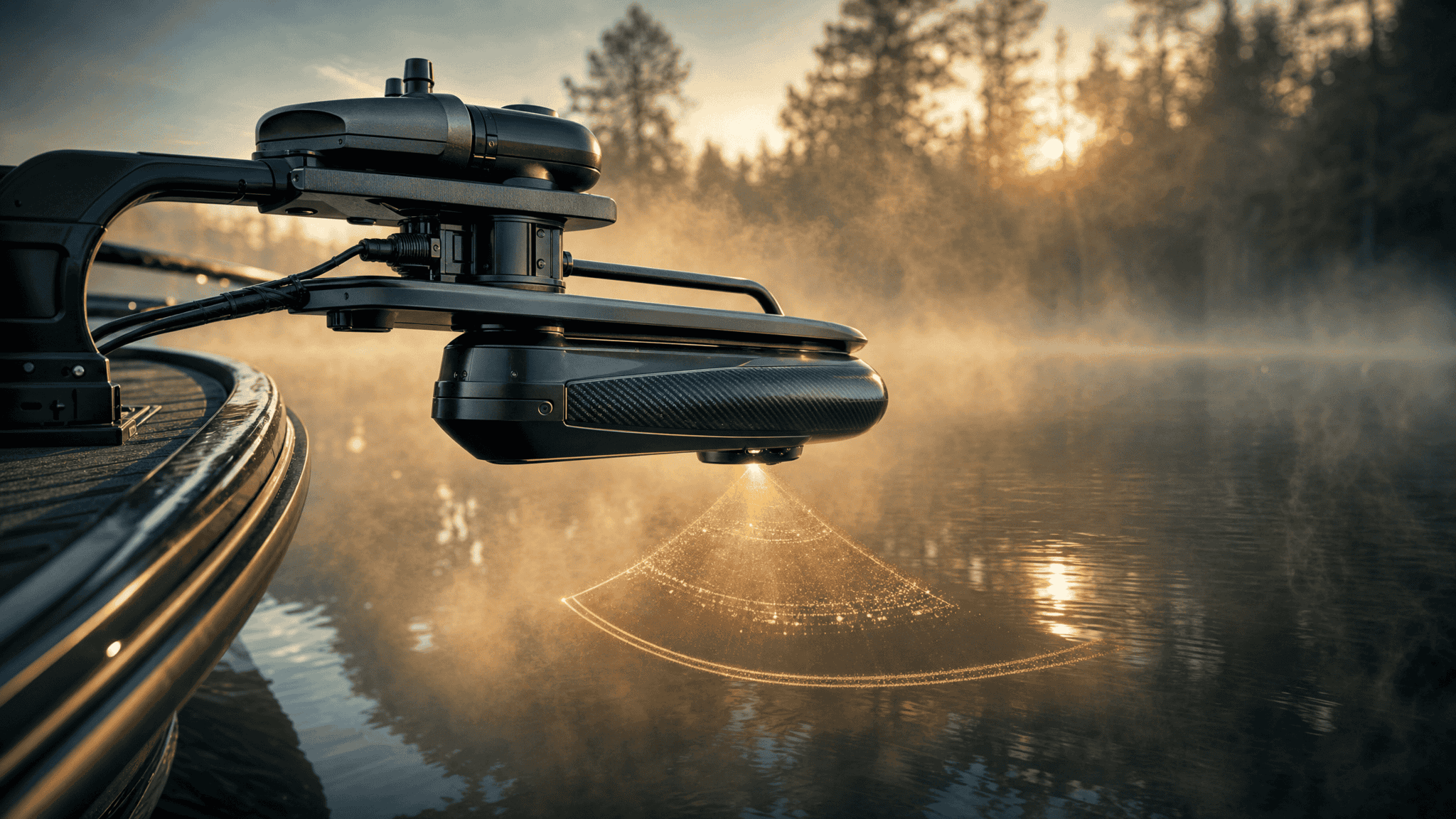
Regular scrolling sonar draws a history of what already passed under the boat. Forward-facing units work differently. A transducer built from many small elements scans a thin fan of sound and redraws it constantly, so you’re looking at what’s inside that fan right now. You aim it, usually from the trolling motor or a pole mount, and the picture changes every time the transducer turns, the boat drifts, a fish moves, or you change the range.
Garmin describes LiveScope Forward as a live feed of fish and structure ahead of the boat. Other brands use other names and hardware, but you end up asking the same things: what’s inside the beam, how far out is it, how deep, and which way is it moving?
One thing worth knowing early: that fan has some thickness, and the screen flattens it into a flat picture. A fish sitting a little to one side of where you’re pointing can look like it’s dead center. “It’s right there” usually means “it’s somewhere close to right there,” which matters more than it sounds like when you’re trying to put a lure on its nose.
It changes searching before it changes catching
The first real advantage is time. You can scan ahead instead of idling over every piece of cover or waiting for traditional sonar to scroll a history past you. That changes where you set the boat, what angle you cast from, which targets you bother with, and how fast empty water gets crossed off.
It also invents a brand-new way to waste a day: following one gorgeous mark around for two hours while it never once acts like a fish that’s going to bite.
The 2026 Wisconsin experiment didn’t hand either side a win
Wisconsin Department of Natural Resources researchers ran a randomized controlled experiment on smallmouth bass fishing with forward-facing sonar. The DNR reports that anglers using it had lower catch rates, while the smallmouth they did catch had a mean length about 25 millimeters longer — roughly an inch. Anglers with the technology also spent more of their time searching.
I like that result because it’s a little annoying to everybody. It doesn’t support the idea that the technology automatically puts more fish in the boat. It doesn’t show the technology does nothing, either. In that experiment it changed how people fished, and the fish that came in ran a different size.
One species, one experiment
A controlled smallmouth result isn’t an answer for crappie, walleye, largemouth bass, suspended trout, tournament fisheries or every lake. Species move differently. Water clarity changes how much the screen can show you, and some anglers have run these units for years while others unboxed one last week. Pressure, regulations and fish behavior shift from one water to the next too.
So it’s real evidence about one piece of the argument. It isn’t a permission slip to turn one result into a law of fishing.
Ask the screen smaller questions
The unit is at its best when the question is narrow. Are those targets suspended over the break, or sitting on bottom? Are they tracking a bait school around? Does one turn toward the lure, away from it, or not react at all? How far off the cover are they? If you change one thing about the presentation, does the response change the same way more than once? Answers like that make the next decision better even on a day nothing bites.
A fish-shaped return isn’t a species
Shape, movement, depth, schooling and habitat can support a guess. They can’t identify a fish. A big single target hanging beside bait is a target until something else narrows it down. Catch one species out of that spot and the guess gets better, but it still doesn’t make every similar mark the same fish. That’s the same line drawn in what counts as evidence.
The geometry still has to work
If a fish sits 45 feet out and 12 feet down, your cast, sink time, retrieve speed and line angle all have to get the lure through that exact space. A long cast at the wrong angle is still wrong, just farther away. The screen turns “fish are out there somewhere” into a lane and a depth you can test. It can’t make the lure swim there.
Don’t let the live picture wreck the test
Watching a fish follow your lure in real time feels like a video game, and the urge is to change something after every twitch. One follow isn’t a pattern. One refusal doesn’t prove the lure’s wrong. Pick a baseline, make several clean presentations, and change one thing only when a response actually repeats. You’re collecting evidence, not a highlight reel.
The other cost is attention. That screen pulls your eyes into a very small window while wind, waves, current, other boats, your distance from shore, the weather, floating debris and the route back keep happening whether you’re watching or not. When the unit starts making your boat control or your awareness worse, the screen has become part of the problem.
Rules and the conservation argument both need current evidence
Electronics rules can differ by tournament organization, waterbody, jurisdiction and season, so gear that’s fine on an ordinary day of fishing isn’t automatically allowed in every event. Check the current rules before the trip. If something changed this year, an old forum answer doesn’t outrank the organizer or the agency.
Concerns about technology and fishing pressure are fair management questions. Answering them takes population data, harvest data, catch-and-release mortality information, angler-effort data, species-specific research and monitoring over time — not gut feeling. Wisconsin DNR is still studying what forward-facing sonar does to recreational fisheries, which is the right way to settle it: measure what people do and what happens to the fish, instead of judging by how loud the debate gets.
Using it like a test instrument
Pick the search area with something else first — a map, regular sonar, side imaging, or what you can see on the water. Then use the forward view to find targets and pin down their depth and position, and choose one presentation that can actually reach them under control. Make clean, repeated presentations and keep track of follows, refusals, depth changes and catches, and change one thing when that record gives you a reason.
Give yourself a reason to leave, too. A target that’s eating your time without teaching you anything isn’t a spot anymore. It’s a screensaver.
The Wisconsin result is one controlled smallmouth experiment. Where it repeats, and for which fisheries, is still open, and that’s a more interesting argument than whether the screen counts as cheating.