LARGEMOUTH BASS · FISHING PROFILE
FIELD PLATE · HOLDING WATER
Look for the place that pays the fish back.
The river fish that usually wants the part of the river acting least like a river.
In moving water, largemouth bass make more sense once you stop looking at the strongest current and start looking for where that current loses. Backwaters, sloughs, flooded cover, weed edges, shade, wood and soft pockets give a fish somewhere to hold without paying for it all day. Those are not interchangeable spots so much as a sequence a fish moves through.
Profile basis: Missouri Department of Conservation · Iowa DNR · Furse, Davis & Bull 1996

IDENTIFICATION
Use the jaw and dorsal fin before you trust the color.
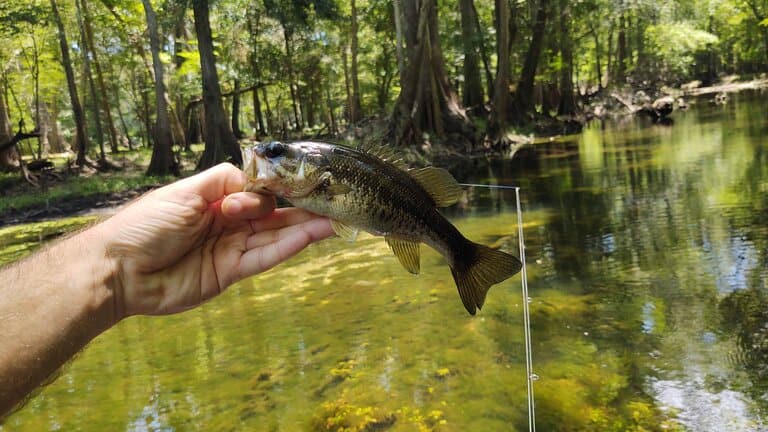
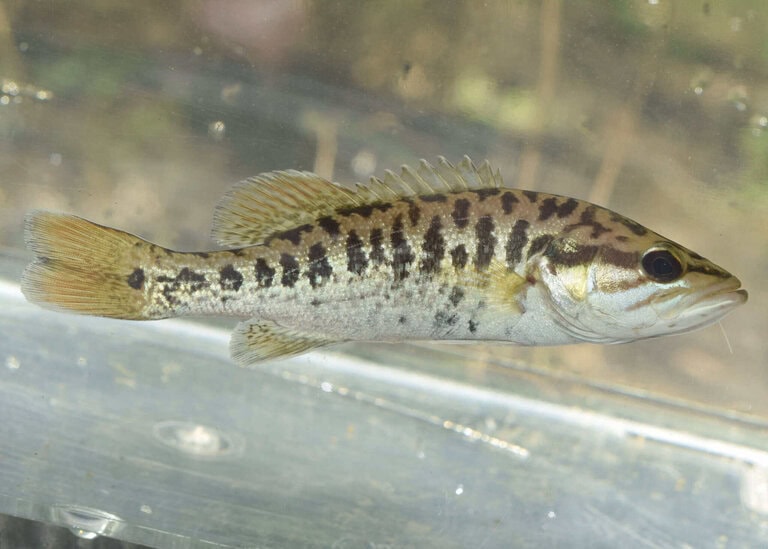
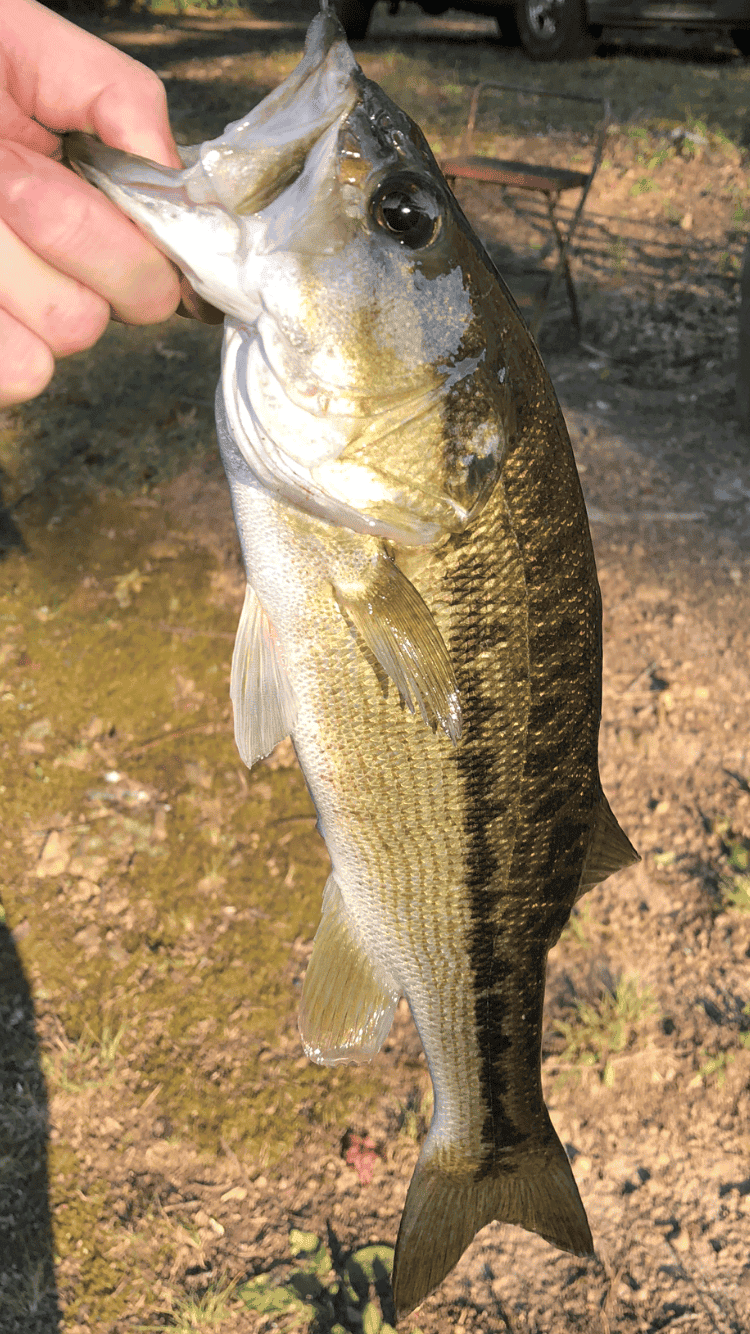
Green is not an identification system. Largemouth can run silvery, brassy, green or brownish depending on the water and the fish. The better field checks are structural: on an adult, the upper jaw normally reaches well behind the rear of the eye; the two dorsal sections are separated by a deep notch; and the side usually carries a broad horizontal band rather than the vertical bars of a smallmouth.
Spotted bass can carry a similar horizontal band, but typically add rows of dark spots below it and a rough tooth patch on the tongue. Largemouth have a smooth tongue. Juveniles make the jaw check less reliable because the jaw does not project as far yet.
The scientific name is in the middle of a mess right now. Following the American Fisheries Society‘s 2023 treatment, several agencies now use Micropterus nigricans for northern largemouth and reserve Micropterus salmoides for Florida Bass. Older references and some current databases still use M. salmoides for largemouth. If two good sources appear to disagree on the name, that is probably why.
Sources: Missouri Department of Conservation · Maryland DNR · Florida FWC
RIVER WATER
Find the current break big enough to become habitat.
Largemouth are not built around living in the hardest part of a river. In Kissimmee River telemetry, current was below 6 cm/s at at least 92.2% of bass locations in every season studied. Iowa likewise describes them as preferring standing or impounded water and avoiding strong current.
That changes what “river bass” means. Look at the backwater behind the point, the flooded brush out of the main push, the downstream side of a laydown, an oxbow, a slough, a protected pocket beside vegetation, or a channel-stabilization structure that creates a usable soft side. The target is not simply the object. It is the cheap water the object creates.
Vegetation and wood are especially important because both conceal the fish and concentrate prey. Shade can matter for the same reason. A gorgeous stump standing in fast exposed water can be worse largemouth habitat than an ugly patch of weeds in a quiet pocket twenty yards away.
Sources: Furse, Davis & Bull 1996 · Iowa DNR · Fisheries and Oceans Canada
SEASON & LIGHT
There is no single summer depth rule worth carving into the dock.
Spring is the easy part to generalize: warming water and spawning pull fish shallower, with nests commonly built in shallow protected water. Summer is where the sources stop agreeing. Iowa, Minnesota and Oregon point anglers toward deeper, cooler water in the heat. New Hampshire reports largemouth remaining shallow well into summer in its waters. Fisheries and Oceans Canada describes a daily pattern that helps explain why both can be true: fish can rest around vegetation and shade by day and move shallower at night to feed.
So “summer means deep” is too blunt. Check whether shallow water still has healthy vegetation, oxygen, shade and forage. If it does, it can keep fish. If it has turned hot, depleted or empty, the nearest deeper or cooler relationship becomes more interesting.
I’d trust New Hampshire’s shallow summer fish over a blanket depth rule. Their water probably keeps the vegetation, oxygen and shade that Iowa’s loses once August really sets in. Minnesota and Oregon aren’t wrong either — they’re describing a different lake. The lake decides which agency’s advice applies here, not the season on a calendar.
Dawn, dusk and shade deserve attention without becoming a magic clock. Missouri and Florida sources both describe strong low-light feeding activity, while Canadian sources also document shallow feeding at night. The useful part is the change in light and usable cover, not the number on a watch.
Sources: Iowa DNR · New Hampshire Fish and Game · Fisheries and Oceans Canada
FOOD & PRESENTATION
The lure list is less useful than the job.
Adult largemouth eat fish, crayfish and frogs, with insects and other available animals mixed in. Young bass start much smaller and shift toward fish as they grow. That broad diet is why so many completely different baits can catch one.
The better first question is what the presentation has to do in this piece of water. In living weeds, it may need to stay clean and move through holes or along the outside edge. Around wood, it needs enough control that you can put it close without spending the afternoon breaking off. On a clean depth break, the job may simply be staying in the depth band long enough to compare one cast with the next.
State agencies list soft plastics, jigs, spinnerbaits, crankbaits, topwater, swimbaits and live bait because largemouth are caught on all of them. That list is true and still not much of a decision. Pick the family that can do the physical job the water requires.
Sources: Missouri Department of Conservation · New York DEC · Minnesota DNR
WHAT A RESPONSE CAN TELL YOU
A follow from one edge is more interesting than five random lure changes.
A boil, bump, follow, short strike or repeated contact from the same kind of cover is useful because it keeps pointing back to the same water. It does not automatically prove color, scent or one magic bait. It tells you the location or presentation is close enough to deserve a cleaner second look.
When that happens, smaller changes are easier to read: angle, depth, speed, pause or how tightly the lure tracks the cover. When two or three comparable edges stay completely quiet with a presentation you can control, moving to a different cover/depth relationship usually teaches more than defending the first stump because it looked excellent from the truck.
SPAWN & HANDLING
The guarding male is doing more than sitting shallow.
Males build and guard nests in shallow water and continue guarding eggs and fry after spawning. Research and agency management plans note that temporarily removing a guarding male can expose the nest to more predation, although population-level effects vary with the fishery. If spring fishing is legal where you are, return a nest-guarding fish promptly and to the water it came from.
Warm water deserves even more practical attention. Experimental work on largemouth found survival remained high under moderate temperatures and oxygen, but degraded sharply when high temperature, low dissolved oxygen, longer fight time and tournament-style holding stacked together. The point is not to memorize a laboratory threshold. When the water is hot and the fish is already stressed, fight it efficiently, handle it less and get it back sooner.
Sources: Pennsylvania Fish & Boat Commission · Keretz et al. 2018
RANGE & CONSERVATION
A prized sport fish in one drainage can be the unwanted predator in the next.
Largemouth have been moved far beyond parts of their native range and are now established widely. USGS documents predation impacts on native fishes and amphibians in introduced systems, and the National Park Service has removed them from sensitive habitat where they threatened native species. That is worth keeping beside the sport-fish story: “good bass water” and “good ecosystem outcome” are not automatically the same thing.
The opposite management problem also exists in bass ponds, where agencies sometimes recommend harvesting smaller bass to correct overcrowding. There is no universal conservation instruction for largemouth. The water’s management objective matters.
Harvest rules and consumption advisories are local. Check the current agency for the exact water before keeping one; largemouth also appear in mercury advisories in some systems because they are long-lived predators.
Sources: USGS NAS · National Park Service · Missouri Department of Conservation
DEEP REFERENCE · IF YOU NEED IT
Where the research gets more interesting than the rules of thumb.
Why the scientific name looks inconsistent
Current AFS-aligned agency treatment separates Florida Bass as Micropterus salmoides and uses Micropterus nigricans for northern largemouth. Many older references and some current databases still use M. salmoides for largemouth. Both names will remain visible in source material for years.
Why the summer-depth advice conflicts
Iowa, Minnesota and Oregon describe movement toward deeper, cooler water during summer heat; New Hampshire reports largemouth staying shallow well into summer. The disagreement is useful because it blocks a bad universal rule. Vegetation condition, oxygen, shade, depth and forage have to be checked in the actual water.
Angling vulnerability is partly heritable
Philipp et al. selectively bred high- and low-vulnerability largemouth through three generations and found the lines diverged, supporting a heritable component to capture vulnerability. That does not tell you whether today’s fish are “pressured.” It does show that catchability is not purely a lure-choice problem.
The bred lines pulled apart over three generations. That’s a heritable piece of catchability, not a one-summer lesson, so a lake full of cautious bass isn’t automatically proof those fish learned anything from anglers. It doesn’t tell you how much of your lake’s caution is inherited, either.
Temperature, oxygen and handling interact
The Keretz et al. experiments are most useful as an interaction, not a pile of thresholds: warmer water, lower oxygen, longer fights and extra holding stress compound. That is why the release guidance above stays behavioral instead of pretending one temperature number applies to every fish and fishery.
Barometers, clouds and cold fronts
No reliable research I could find sets a universal largemouth response to barometric pressure, cloud cover, wind direction or cold fronts. Those can change the water around a fish without being a switch that turns the bite on or off.
In the Kissimmee telemetry, at least 92.2 percent of bass locations sat in current under 6 cm/s, in every season researchers checked. That doesn’t mean a largemouth never parks in the push. It means the push is a lousy place to spend your first hour.
FEEDING ECOLOGY · STANDARDIZED
How this fish gets fed.
Only documented feeding biology is summarized; lure categories remain separate from diet.
SOURCES
The shorter source shelf.
- Missouri Department of Conservation — Largemouth Bass
- Iowa DNR — Largemouth Bass
- Fisheries and Oceans Canada — Biological Synopsis of Largemouth Bass
- Furse, Davis & Bull 1996 — Kissimmee River habitat use and movement
- Huenemann, Dibble & Fleming 2012 — Turbidity and foraging
- Keretz et al. 2018 — Temperature, angling time, oxygen and survival
- Philipp et al. 2009 — Selection for angling vulnerability
- USGS NAS — Largemouth Bass
- Maryland DNR — Scientific renaming
- Florida FWC — Bass naming update
Profile reviewed 2026-09-02. Regulations, harvest rules and consumption advisories belong to the exact water and current agency, not to a static species profile.