SAUGER · SPECIES PROFILE
If my jig isn’t ticking bottom every few feet, it’s probably above the fish.
Sauger live in big, dirty rivers and sit in the softer water right beside the hard current, usually close to bottom. They also travel a lot farther than you’d guess, and they see well enough in murk that the brown water is often the reason they’re there, not something to wait out.
Profile basis: Missouri Department of Conservation · Kentucky Department of Fish and Wildlife Resources · New York DEC
SAUGER, WALLEYE OR SAUGEYE?
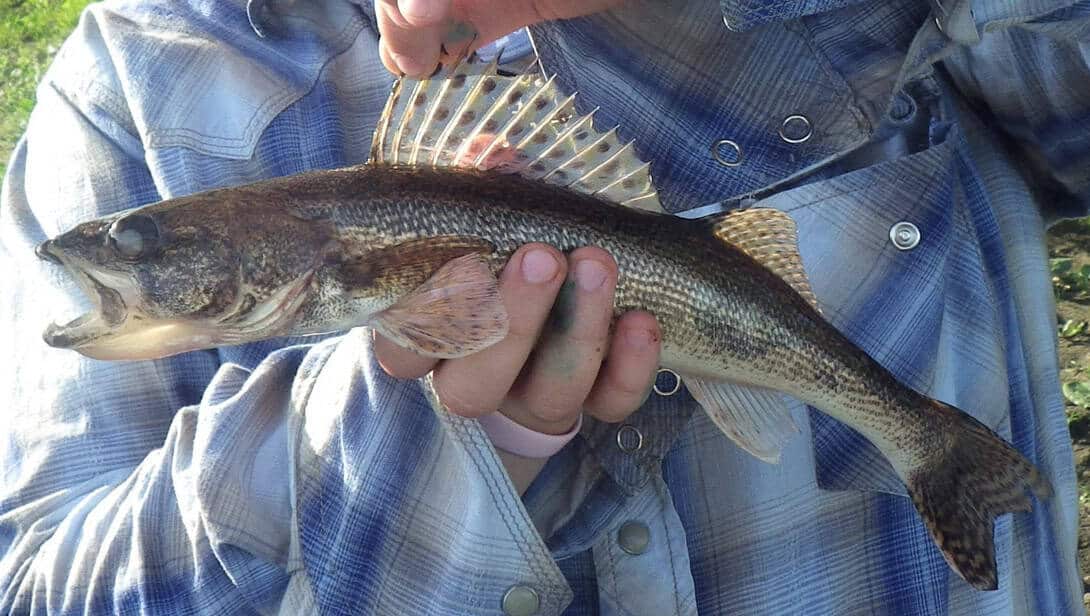
The first dorsal fin is the fastest three-way test.
Sauger and walleye share the large canine teeth, reflective eyes, two separate dorsal fins and a deeply forked tail. Those traits only tell you that you are in the Sander group.
Sauger: rows of distinct small dark spots across the first dorsal fin, dark saddle-shaped body blotches, scaled cheeks and no bold white patch on the lower tail.
Walleye: first dorsal lacks the rows of small spots and instead carries a dark blotch at the rear base; cheeks are more sparsely scaled; lower tail usually has a strong chalk-white tip.
Saugeye: the hybrid can carry both parental signals at once—spots or bars in the first dorsal plus the walleye-style rear-base blotch. The tail mark can be intermediate, which is why the fin pattern matters more.
A faint pale or yellowish edge on a sauger’s lower tail is not enough to call it a walleye. Several agencies describe that edge differently. The useful distinction is a bold white block versus a thin pale margin.
Sources: Ohio DNR · Kansas Wildlife and Parks identification guide
MUDDY WATER IS PART OF THE ADVANTAGE
A sauger does not need the river to clear up for the fishing to make sense.
Sauger are big-river fish with an unusually strong association with turbidity. Missouri says they tolerate murk better than walleye. Ohio says they prefer less-clear water. New York goes farther and treats turbidity as a key habitat component because the sauger’s low-light visual system allows it to operate where other sight-feeding predators lose some of their advantage.
Minnesota describes the reflective layer in the sauger eye as even more developed than in walleye. That fits the behavior: dusk, dawn, night and dirty water can all make useful feeding windows.
There are southern populations in clearer rivers, so “sauger need mud” is too absolute. The version that travels better: sauger handle lower-light water extremely well, and where they share a system with walleye they often end up on the murkier river side of the split.
So stained water doesn’t automatically mean you need a brighter lure or a new spot. Ask first whether the murk is exactly why the sauger are there.
CURRENT-ASSOCIATED, NOT CURRENT-LOVING
The fish can live in a big river without sitting in its hardest water.
This is one of the places the sources sound like they’re arguing until you look at the shape of the river. Missouri says sauger prefer flowing water and often swift current. Wyoming and New York describe deep low-velocity pools and runs.
Both can be true on the same bend. Sauger live in current-driven systems, then use the softer lanes inside them: the pool below a rapid, the seam behind a current break, the eddy beside a dam discharge, the channel edge where the main push relaxes.
Kentucky’s tailwater fishing guidance makes that relationship visible. In heavy current, hold the boat or position and jig vertically. In more manageable flow, work the lure along bottom and across current seams. The fish hangs around current because current moves water, fish and food—not because it wants to spend the day in the fastest lane on the river.
Bottom matters too. Sauger use sand, mud, gravel and rocky runs depending on season, with spawning fish shifting toward firmer rubble, gravel and rock.
THE WINTER TAILWATER
A dam turns a long migration into a short piece of fishable river.
Sauger can move astonishing distances. Wyoming documents spawning migrations of hundreds of miles. Montana accounts describe annual movements up to roughly 600 kilometers and larval drift that can continue hundreds of kilometers downstream before the young fish gain directional control.
Put a dam in that route and the adult migration stops at a wall. Kentucky fisheries biologists call tailwaters a concentrating mechanism: without the barrier, the fish would be spread throughout the river; with it, the run stacks in the reach below the dam.
The migration begins as autumn water cools. Smaller males tend to arrive first. Larger females build later, with Kentucky seeing them in stronger numbers by late winter. That is why sauger can be one of the most reliable cold-water fisheries in rivers where many warm-water species have slowed down.
Night and low light can improve the opportunity further. Kentucky and Oklahoma both describe strong low-light or overnight activity during these fisheries.
The useful trip question is therefore not “what lure catches winter sauger?” It is whether the fish have moved into the tailwater yet, how much water the dam is releasing, and where the softer bottom lane exists inside that flow.
BOTTOM CONTACT
Close enough to know where the jig is. Not so much that every cast is archaeology.
Agency guidance is unusually consistent about presentation. Jigs and soft plastics dominate. Blade baits, spoons, live minnows and bottom-bouncing rigs also appear, especially in tailwater and reservoir fisheries.
The common job is keeping a compact presentation close to bottom in moving water. Kentucky works curly-tail grubs, hair jigs and live minnows near bottom; Oklahoma’s walleye/saugeye/sauger guidance warns that once the bait is several feet above bottom, catch chances fall sharply.
Short taps, weight changes and contacts concentrated at one depth are useful responses. Constant snagging means too much bottom. Never touching means too little weight, too much line belly or fish that are not where you assumed.
FOOD
Small fish turn piscivorous early.
Young sauger begin on zooplankton, small crustaceans and aquatic insects. They shift toward fish early enough that Montana reports young-of-year sauger in the Missouri River already feeding largely on fish.
Adults are primarily fish eaters. Agency diets repeatedly name gizzard shad, emerald shiners and other minnows, with crayfish and large insect larvae supplementing the menu.
That makes knowing where the forage is more useful than one universal lure color. A tailwater full of shad, a muddy river carrying shiners and a reservoir with young-of-year bait can all be good sauger water for different reasons.
It also helps explain why sauger often overlap with walleye and why stocked saugeye can thrive in turbid reservoirs: all three are working the same predator job with slightly different tolerance for dirty water.
CONSERVATION
The biggest threat to some sauger populations is a river that stopped behaving like a river.
Globally, sauger remain secure. Locally, the losses can be severe. Montana reports major contraction from historical distribution; Michigan lists the species as endangered; New York has lost it from most waters where it once occurred; North Carolina considers it extirpated.
What keeps coming up is connectivity. Adults need to reach spawning tributaries and rocky mainstem runs. Newly hatched larvae need long free-flowing stretches downstream and off-channel rearing habitat. Dams, channelization, low flow, irrigation diversions and altered banks can break those pieces apart.
The second problem looks almost backwards: introduced walleye and deliberately stocked saugeye can hybridize with native sauger. Montana fisheries accounts identify walleye introgression as a major long-term threat. Wyoming and USGS work shows hybridization concentrating in impounded waters where reservoir habitat favors the introduced walleye side of the family.
So saugeye end up as a management contradiction. In reservoirs outside sensitive native-sauger systems, agencies stock the hybrid because it grows fast and tolerates turbidity. In a native sauger drainage, that same ability to hybridize can erode the genetic identity managers are trying to protect.
The drainage decides which story you’re in.
Sources: Montana Chapter AFS · Rosenthal et al. 2024 / USGS
KEEPING ONE
Good eating isn’t a regulation.
Minnesota and Kentucky both rate sauger highly as table fish, often putting them beside walleye. That popularity is also why many states regulate sauger together with walleye and saugeye.
Combined daily limits, minimum lengths and water-specific exceptions are common. Missouri, South Dakota and other states use different rules on different waters, so there’s no safe “sauger limit” to memorize from a species profile.
Consumption advisories matter too. Kentucky groups sauger with walleye as predatory fish for mercury guidance and has water-specific advisories on parts of the Ohio River. If you plan to keep fish regularly, the local advisory belongs in the plan before the cooler does.
DEEP REFERENCE · WHERE THE SOURCES DISAGREE
The messy details are worth keeping. They just do not need to block the fishing profile.
Does a sauger have any pale mark on the lower tail?
Some identification keys say no white tip; Missouri allows a reduced white blotch; Ohio describes a thin pale, often yellowish edge; Minnesota calls it a pale streak. The field distinction is therefore not strict presence/absence. Look for the bold chalk-white block of a walleye versus the weak pale margin possible on a sauger.
Does sauger require turbidity?
New York treats turbidity as a key habitat component; Missouri and Ohio treat it as a preference or tolerance relative to walleye; USFWS notes sauger can occur in clear southern waters. “Low-light specialist that handles turbid rivers unusually well” survives the conflict better than “must live in mud.”
Swift current or low-velocity pools?
Missouri says often swift current; Wyoming and New York say deep low-velocity pools and runs. The profile interprets this as current-system fish using lower-energy holding water beside flow. That interpretation fits tailwater angling but remains an interpretation.
How big is a typical sauger?
Length estimates cluster reasonably well around 9–15 inches for ordinary adults, but agency weight descriptions vary from under one pound to roughly 2.5 pounds. Water, sample and whether the page is describing a population mean or an angler-sized fish probably matter. No single “typical weight” is asserted here.
What this profile deliberately does not claim
The original research did not establish universal sauger responses to barometric pressure, cold fronts, angling pressure, one exact preferred feeding temperature or one lure color system. The fish has not published its position on barometric pressure, and neither have the sources.
SOURCES
FEEDING ECOLOGY · STANDARDIZED
How this fish gets fed.
Spawning temperature is not relabeled as a feeding optimum.
The source shelf.
- Missouri Department of Conservation — Sauger
- Ohio DNR — Sauger
- Minnesota DNR — Sauger profile
- New York DEC — Sauger Status Assessment
- Kentucky DFW — winter tailwater sauger
- Kentucky DFW — Sauger
- Oklahoma DWC — Walleye/Saugeye/Sauger Angler Guide
- Wyoming Game and Fish — Sauger
- Montana Chapter AFS — Sauger status
- U.S. Fish & Wildlife Service — Sauger risk screening
- USGS / Rosenthal et al. 2024 — dams and hybridisation
- South Dakota GFP — Sauger
- Kentucky DFW — Fish Consumption Advisories
Profile reviewed 2026-09-02. Sauger, walleye and saugeye are frequently regulated as a combined group, with water-specific length and harvest rules. Check the current managing agency for the exact water.