Suwannee bass (Micropterus notius) are small river black bass of a few Florida and Georgia limestone rivers, living on crayfish beside the current. The jaw and dorsal notch tell you what you’re holding; the color mostly gets the photos.
By HunterUpdated September 12, 2026Read 7 min
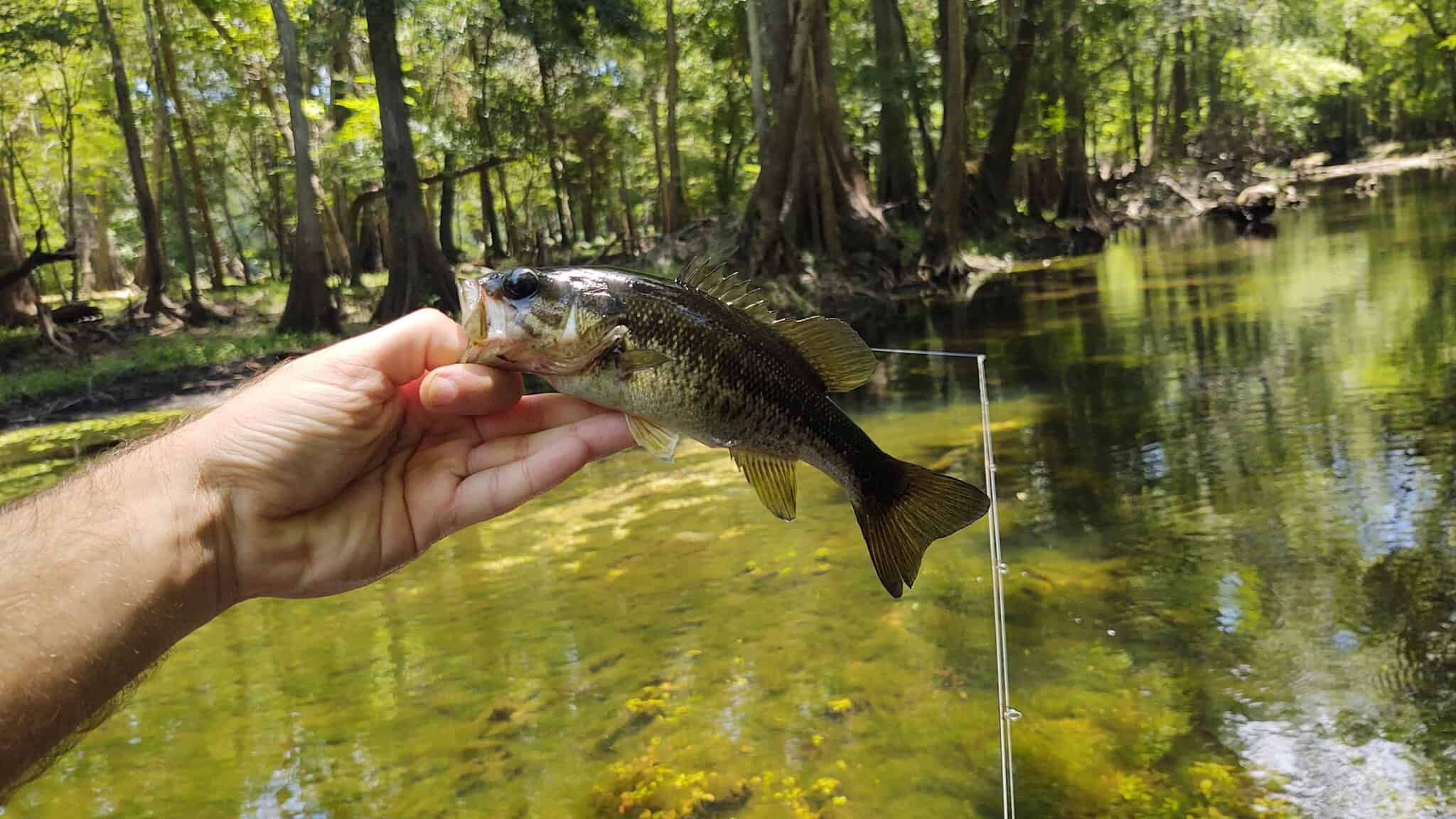
Suwannee Bass (Micropterus notius), Santa Fe River, Florida. Photo: Thefishingnomad youtube / Wikimedia Commons, CC BY-SA 4.0.
Most bass advice quietly assumes a lake. Micropterus notius doesn’t live in one. It’s a river black bass of Florida and Georgia, built around current, limestone and crayfish, and it seldom gets past a foot long. The turquoise on a mature fish’s cheek and belly gets the photographs, but the water is the better clue: moderate to swift current, something hard breaking it, and a softer spot right beside the push. They live in a handful of rivers and nowhere else, so most of what’s below is agency measurement, with the fishing reasoning tagged as inference — and that pile is bigger than I’d like.
At a glance · The short version
Scientific name
Micropterus notius
Core native range
Suwannee and Ochlockonee river systems in Florida and Georgia.
Adult size
Usually small; Florida FWC notes the species seldom exceeds about 12 in.
Habitat
Moderate-to-swift river current around limestone, rock, woody cover, and current breaks.
Spawning window
Florida FWC reports spawning from February through June.
Primary forage
Crayfish are especially important; fish and aquatic insects also contribute.
What fish is this?
Identification
Jaw
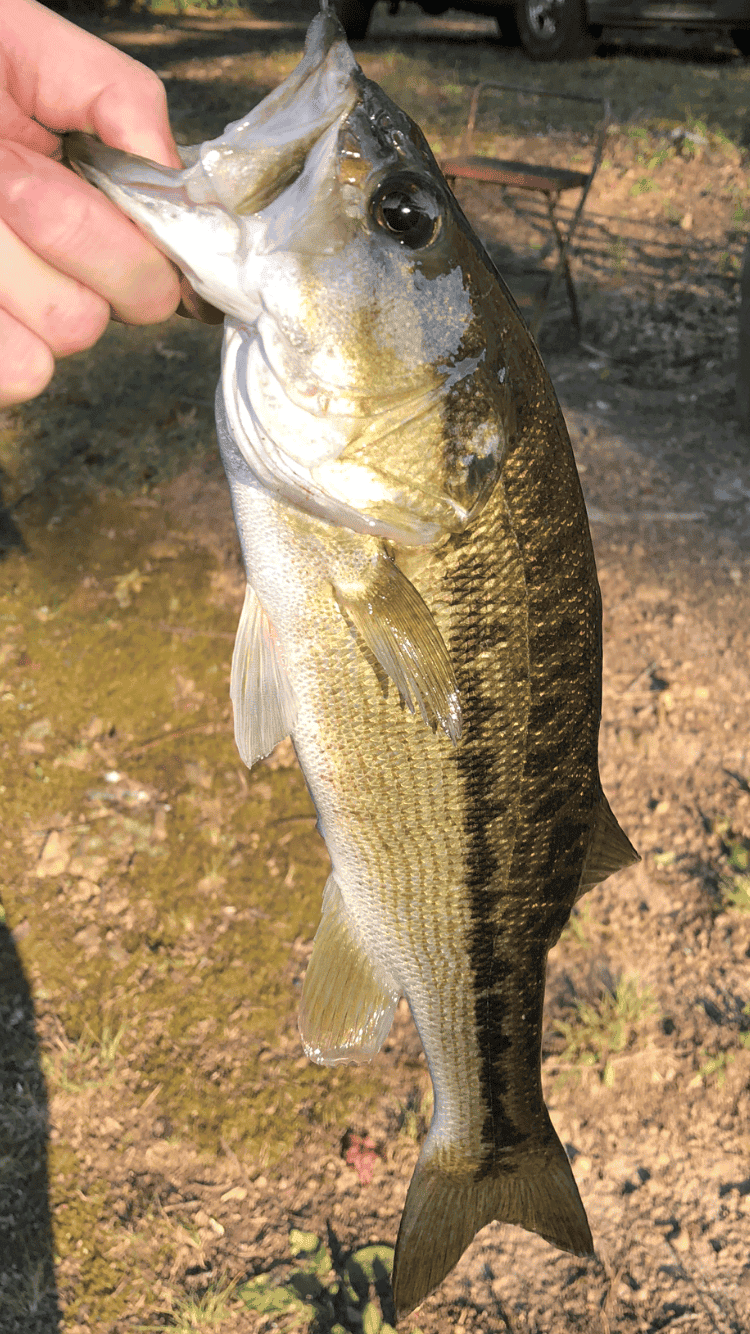
The upper jaw does not extend beyond the rear margin of the eye, helping separate Suwannee bass from largemouth bass.
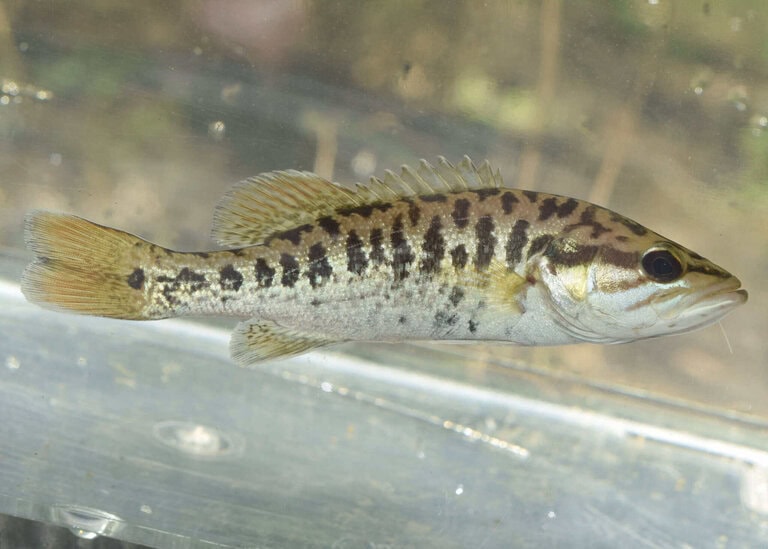
A dark blotch at the base of the tail is another useful structural-pattern clue. Use it with jaw, dorsal shape, drainage, and adult coloration rather than as a one-trait test.
Mature fish can develop striking turquoise-blue coloration on the cheek, breast, and belly, especially around the spawning period. That color is memorable but not a reliable trait for every age, season, or individual.
FWC says Suwannee bass seldom exceed 12 inches. The Florida state record listed by the agency is 3.89 pounds, which is exceptional enough that it should not distort the picture of an ordinarily small river bass.
Florida’s black-bass guidance identifies the Suwannee and Ochlockonee watersheds as the natural range, with additional populations established in nearby systems including the Aucilla, St. Marks, Wacissa, and Wakulla. The distinction matters when describing a fish as native versus simply present.
FWC describes the species as riverine and associated with moderate to swift current. That immediately pushes the search away from dead backwaters and toward current breaks that still keep the fish connected to moving water.
Limestone shelves, rocky bottom, woody cover, and deeper pockets beside current are core habitat clues. In Florida spring rivers, hard limestone can create ledges and cavities that function like boulders do in mountain water: current hits them, separates, and leaves a cheaper feeding position immediately beside the delivery lane.
FWC reports spawning from February through June. That broad window is a reminder that north Florida and south Georgia river temperatures and flows do not line up with a generic national bass calendar.
Crayfish are the major forage item in FWC’s description, with fish and aquatic insects also taken. That makes the limestone-and-rock habitat doubly important: it is shelter for the bass and habitat for the food the bass is built to exploit.
How to read this section. Habitat and diet are agency-sourced. Positioning and presentation translate those facts into a starting plan and remain marked as inference until a broader angling-source pass is complete.
First water to checkinference
Cast to the soft edge created by hard structure: behind a limestone shelf, beside submerged wood, along the downstream corner of a rock face, or where a deeper pocket touches a faster run. The fish can use current without living in the absolute hardest water available.
Luresconvention
FWC lists small crankbaits, spinnerbaits, plastic worms, jigs, and crayfish imitations among effective choices. The important pattern is compact tackle that can be controlled around current and hard cover rather than oversized trophy-bass hardware.
A crayfish imitation should spend time where a crayfish actually lives: touching rock, sliding across limestone, and falling into the seam behind structure. If it is racing high through the water column, the color may match the forage while the behavior does not.
Scaleinference
The species seldom exceeds a foot, so accuracy and current control are likely to matter more than raw casting distance. Light or medium tackle should still have enough abrasion resistance for limestone and wood.
What can change the answer?
Conservation
Narrow distribution
The natural range is limited to a small group of Gulf-drainage rivers. That makes river connectivity, spring flow, water quality, and habitat alteration proportionally more important than they would be for a continent-wide species.
What the measurements add
Spawning, Growth & Habitat Selection
Spawning temperature and nest hydraulics
The species synthesis in Black Bass Diversity places annual spawning broadly between March and June at about 18-22 C. Nest sites in a spring-fed Florida river were associated with very low local velocity (at or below about 0.04 m/s), often along stream margins or where structure diverted current and allowed sediment to settle. That sharpens the field map: adults can live beside substantial current while the nest itself occupies a hydraulic refuge.
The same synthesis reports juvenile selection for slower, shallower water while adults select intermediate velocities and depths. That means a single phrase such as ‘moderate-to-swift current’ is too coarse by itself; life stage changes which part of the current field is actually habitat.
A four-river Florida study found females grew faster and attained larger sizes than males. Across the sampled rivers, total annual mortality averaged about 40%, with population estimates ranging roughly 28-46%. The study also warned that a minimum-length harvest rule could concentrate fishing mortality on females because they are the sex most likely to reach legal size.
age at maturity and maximum longevity from native-river populations
fecundity and male-guarding duration from native-river studies
temperature and dissolved-oxygen tolerances
seasonal diet proportions and prey-size shifts
handling and release evidence in warm spring-fed rivers
Georgia-specific distribution
verified photos of juveniles for identification (the photo up top is an adult Suwannee bass from the Santa Fe River)
— · Sources
FEEDING ECOLOGY · STANDARDIZED
How this fish gets fed.
Primary prey
Crayfish are especially important, with fishes and aquatic insects also taken.
Feeding mode / location
A river predator using moderate-to-swift current around limestone, rock, woody cover, deeper pockets and the softer seams created by hard structure. The same rock that shelters the bass also supports crayfish prey.
Diel / seasonal pattern
The profile does not establish one universal daily feeding window. Flow, spring-river temperature, spawning season and prey delivery provide stronger context than a fixed clock.
Ontogenetic diet shift
Not established in this profile’s cited source set; seasonal diet proportions and prey-size shifts remain explicitly listed as evidence gaps.
The documented spawning-temperature range remains a reproductive value, not a feeding-temperature band.
Compiled 2026-09-11. Limits and advisories are set per water and per state and change between seasons — the managing agency for wherever you are fishing has the current answer.
Size is the least interesting thing about a Suwannee bass. The limestone, the crayfish and that nearly still pocket where a nest sits — that’s the fish. Nobody gets the ID from color alone, so there’s nothing slow about checking the jaw against the eye and looking for the shallow dorsal notch before you call it one. And if you’re keeping fish, know who a length limit lands on: the growth study says females grow faster and get bigger, so they’re the ones most likely to cross the line. A bass that lives in a handful of rivers and nowhere else doesn’t leave much room for guessing, which is why the gaps above stay blank.
River FishRiver-fish species profiles covering habitat, behavior, seasonal movement, fishing approaches, conservation status, and regional variation across the United States.49 articles
Species & BehaviorFish behavior, habitat, depth, forage relationships, and species-specific field decisions. Start with the Freshwater Fish Species field guide.159 articles
Cookie Consent
We use cookies to improve your experience on our site. By using our site, you consent to cookies.
Contains information related to marketing campaigns of the user. These are shared with Google AdWords / Google Ads when the Google Ads and Google Analytics accounts are linked together.
90 days
__utma
ID used to identify users and sessions
2 years after last activity
__utmt
Used to monitor number of Google Analytics server requests
10 minutes
__utmb
Used to distinguish new sessions and visits. This cookie is set when the GA.js javascript library is loaded and there is no existing __utmb cookie. The cookie is updated every time data is sent to the Google Analytics server.
30 minutes after last activity
__utmc
Used only with old Urchin versions of Google Analytics and not with GA.js. Was used to distinguish between new sessions and visits at the end of a session.
End of session (browser)
__utmz
Contains information about the traffic source or campaign that directed user to the website. The cookie is set when the GA.js javascript is loaded and updated when data is sent to the Google Anaytics server
6 months after last activity
__utmv
Contains custom information set by the web developer via the _setCustomVar method in Google Analytics. This cookie is updated every time new data is sent to the Google Analytics server.
2 years after last activity
__utmx
Used to determine whether a user is included in an A / B or Multivariate test.
18 months
_ga
ID used to identify users
2 years
_gali
Used by Google Analytics to determine which links on a page are being clicked
30 seconds
_ga_
ID used to identify users
2 years
_gid
ID used to identify users for 24 hours after last activity
24 hours
_gat
Used to monitor number of Google Analytics server requests when using Google Tag Manager
1 minute
Jetpack's built-in visitor analytics. It records page views, referring sites, search terms, and outbound link clicks, and also carries the shared visitor-tracking library used by Jetpack Instant Search and WooCommerce Analytics.