WHITE CRAPPIE · SPECIES PROFILE
The fish that keeps feeding on the day you were about to drive home.
Give a reservoir two days of wind and the water ends up looking like tea with milk in it. Black crappie like it clear, and they go quiet. White crappie mostly don’t, which is the whole reason to know which one you’re fishing for. The fishing advice further down leans on Oklahoma and Missouri, not on a crappie season of my own, and both of those guides write about crappie in general rather than this one.
Profile basis: USFWS Habitat Suitability Index — White Crappie · Missouri Department of Conservation · Oklahoma Department of Wildlife Conservation
TELLING IT FROM THE OTHER ONE
Spines first, color last.
White crappie run five or six dorsal spines. Black crappie run seven or eight. Count them and you’re done — on a wet fish, in bad light, in November.
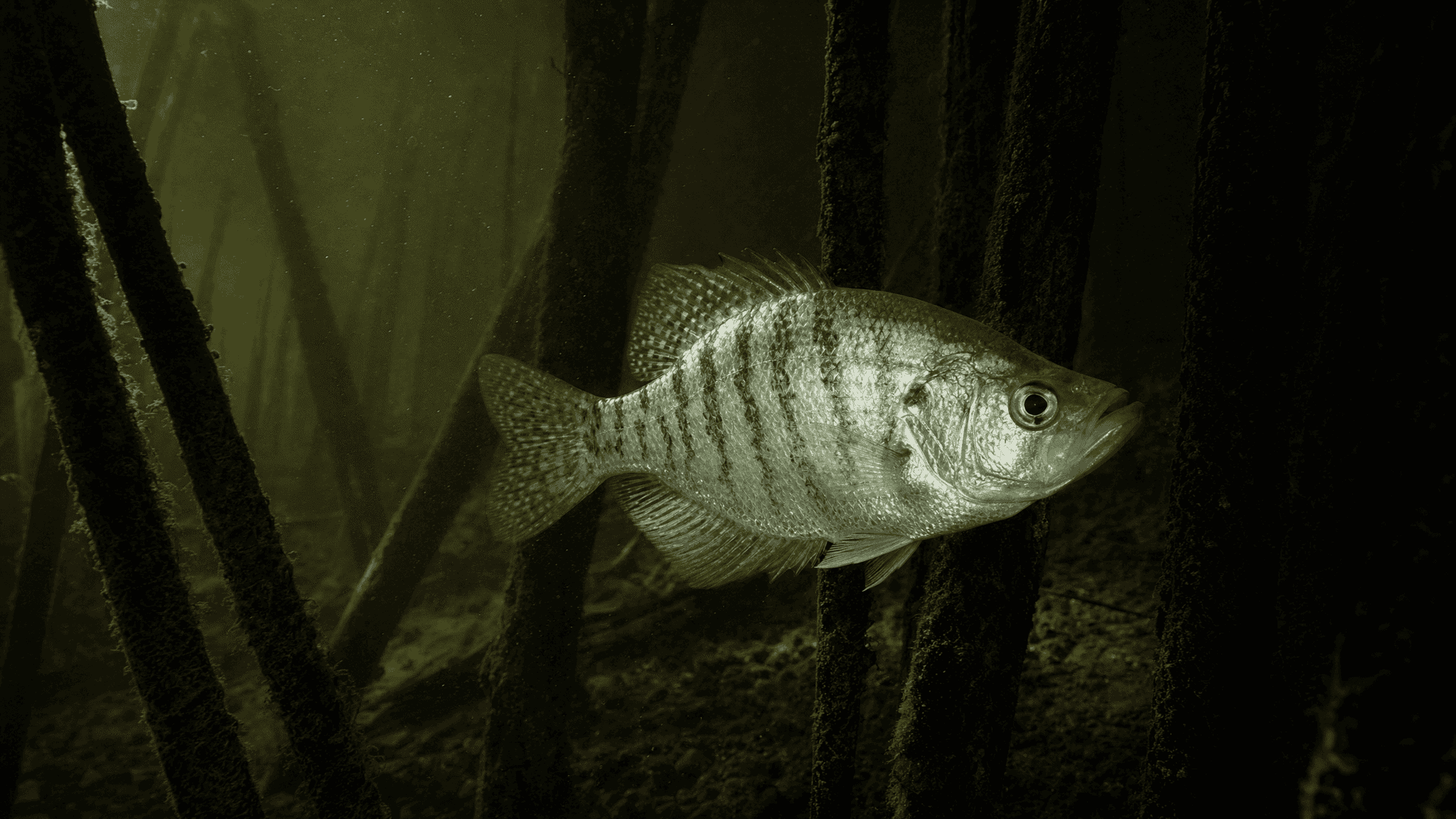
The flank helps too, when it is showing. White crappie carry their dark pigment in vertical bars, regularly spaced down the side. Black crappie scatter theirs into speckle with no order to it. Count the bars if you want, but the sources give five to ten and seven to nine and six to nine, so what you are really checking is whether there is a bar pattern at all. On a stressed or dark fish the bars go faint and sometimes vanish, which is when the spines earn their keep.
Color does nothing for you. Both fish run silver to green to brown depending on spawning and on whatever water they came out of, which makes it the trait most likely to confirm whatever you already believed.
There is one trap worth knowing. The two species hybridize, and a first-generation hybrid carries seven dorsal spines and a spotted flank — so it keys out as a black crappie and nothing you can do on the bank will tell them apart. That leaves you with a rule that is honest rather than complete: a barred fish with five or six spines is a white crappie. A spotted fish with seven or eight is either a black crappie or a hybrid, and you cannot tell which.
Sources: Ohio DNR · Southern Regional Aquaculture Center
THE PART EVERYBODY GETS BACKWARDS
Tolerating dirty water is not the same as wanting it.
Here is the number that reframes this fish. Growth peaks somewhere around 40 to 50 JTU of turbidity, and the tolerance ceiling sits three or four times murkier than that. The habitat work puts it plainly: white crappie can tolerate severe turbidity and appear to avoid it.
So a white crappie holding in chocolate water is putting up with something, not thriving in it. That matters because it changes what you are looking for. If the fish were choosing the murk you would fish the murkiest arm of the lake. It isn’t. It’s staying in water it can still work while the black crappie have quit, and it is doing that next to structure, because structure is what replaces visibility.
Which is why the creek channel and the standing timber carry more weight here than clarity ever will. Let the stain be the reason you are out there rather than the thing you’re apologizing for.
DEPTH
The school hangs. That is the whole problem.
Michigan names it directly, and it’s the most useful sentence I found about this fish: white crappie are harder to catch than other panfish because they are not on the bottom and not on the bank. They suspend — sitting at some depth over deeper water, which means you can float straight across a school and never know.
Two things put a floor under how deep they will go. Temperature is the obvious one. Oxygen is the one people forget: five milligrams per liter is about the lower limit for decent growth, they have turned up as low as 3.3, and they are rarely found at 2.0. In a reservoir that has stratified over summer, the dead layer down low is off the table no matter how cold and inviting it looks on a graph. The school is sitting above it.
That is a real gift to anyone fishing blind. It means the answer is bounded. You’re not searching a whole water column. You’re searching the part of it that still has air in it.
Source: USFWS Habitat Suitability Index. The suspension point is Michigan DNR angler guidance.
THROUGH THE YEAR
Spawning depth follows the water clarity, which is the tidiest thing this fish does.
Somewhere between 45 and 55 degrees the fish start staging — off the deep wintering water, not yet into the coves. Then they spawn shallow, and how shallow depends entirely on how far light gets.
Missouri gives the version worth memorizing: one to two feet in murky water, and up to twenty feet in clear. Same fish, same behavior, an eighteen-foot spread, and the only variable is how much cover the water itself is providing. Nests go on clay or dirt or gravel near flooded vegetation, in colonies rather than scattered, and the male fans the nest and then guards eggs and fry for about a week after they hatch.
The trigger temperature is genuinely argued over. The habitat model says spawning starts at 55 to 57 and peaks between 61 and 68, with embryos doing best right around 19 degrees Celsius. Washington calls it the earliest sunfish spawner, active near 55. The aquaculture people say 65 to 70. Those do not reconcile, so treat 55 to 68 as a working band and not a threshold.
After that it gets simpler. Summer pushes them out over the channels and down — Missouri describes fifteen to twenty feet of water with fish holding about ten to fifteen feet down, over timber and brush. Autumn is the good one: October and November on docks and boat slips in the top ten feet, and Missouri calls them very predictable and aggressive, which is the most generous thing any agency says about any fish. Winter drops them to twenty or forty feet, and they will come shallower on a warm afternoon but they will not chase anything.
Sources: Missouri Department of Conservation · Washington Department of Fish & Wildlife
WHAT THEY EAT, AND WHEN THAT CHANGES
At six inches it is still eating bugs. At six and a bit it has started eating fish.
The ladder is unusually well quantified for a panfish. Fry take copepods and rotifers, then zooplankton, and around 120 millimetres insects take over. Past about 150 millimetres — call it six inches — feeding is almost exclusively small fish. Minnows and young shad, mostly.
Iowa classes it a top carnivore and the trophic level lands at 4.4, which is higher than most people would guess for something you catch on a jig the size of a fingernail. It also explains why a fish-shaped thing works on the bigger ones and why the small ones will still take an insect imitation happily.
They school at every stage past larval, so finding one usually means finding a lot. That cuts both ways: it is why a good spot is very good, and why an empty-feeling lake can have every fish in it standing in one piece of timber you have not found yet.
PAPERMOUTH
The float goes up, not down.
Oklahoma has the detail that makes this fish make sense: crappie rarely submerge a bobber, because they tend to bite upward. They come up under the bait and lift it, and a round float sitting flat on the surface has no way to show you that. A stick float does — it rises and lies over. If you’ve been waiting for a bobber to go under and wondering why nothing’s happening, that is very likely the whole story.
The name is the other half. Papermouth is a description of the membrane around the jaw, and it tears. Washington is blunt that a gentle hook-set is essential. Nobody rates this fish for fighting strength, and that is not an insult — the limiting factor is pressure rather than power, and a hard set or a heavy hand loses fish that a bass would have held.
Jigs run an eighth to a sixteenth of an ounce for most work, a thirty-second when you want it slower or shallower, and weedless when the brush means business. Four to eight pound line. Soft plastics and hair jigs from an inch and a half to three inches. Chartreuse gets called universally tried and true by more than one agency, which is either a real thing about stained water or the fishing equivalent of everyone copying the same homework. Bobber-jigging beats casting and retrieving in most agency guidance, which is a rare case of the lazy-looking method also being the recommended one.
Sources: Oklahoma Department of Wildlife Conservation · Washington Department of Fish & Wildlife
THE ONE HABIT WORTH BUILDING
When a fish comes, write down how deep it was.
Missouri’s vertical-jigging routine fits in one sentence, and it’s the one technique here that’ll make you better at other fish too. Drop into the brush, reel slowly up, and note the depth that produced. Then fish that depth.
That is it. On a suspended fish, depth is the single variable that matters most and the one you are most likely to be guessing at. Everything else — color, profile, how fast you move it — is worth changing only after you know you were in the right part of the water. A whole afternoon can disappear into fly changes thirty inches above a school that never saw any of them.
Suspended fish sound like the advanced class. Mostly it’s one number. You can stumble onto it by accident, and once you’ve got it the day usually opens up. The people who seem to have a sixth sense for crappie aren’t seeing something you can’t. They wrote the depth down.
WHY THE LAKE IS BRILLIANT FOR THREE YEARS AND THEN IS NOT
A crappie reputation is usually one year class getting old enough.
This fish reproduces enormously and unevenly. A single strong year class can dominate a lake, which is why Minnesota notes that crappie in a given water often look like they’re all the same size — because they are. The lake gets a reputation when that cohort reaches a size worth catching, and quietly loses it when the cohort ages out and nothing behind it came through. Where food runs short against that reproduction rate you get stunting instead: plenty of fish, none of them growing.
Which is the real reason crappie rules move around so much. Missouri runs a statewide limit and then overrides it on thirteen separate reservoirs, each with its own minimum length and daily number, because the fishery in one impoundment has almost nothing to do with the fishery in the next one. That isn’t bureaucracy for its own sake. It’s a fish whose population swings hard enough that one statewide number would be wrong nearly everywhere.
Worth knowing too that this fish travels. It is established in 48 states now, and in the Pacific Northwest it turns up eating juvenile salmon that are already in trouble. The same stocking that built a loved fishery in one basin created a problem in another — and nobody involved in 1917, when California’s entire population apparently descended from sixteen fish, was thinking about it.
Sources: USGS Nonindigenous Aquatic Species · Southern Regional Aquaculture Center · Missouri special-area crappie regulations
WHERE THE SOURCES ARGUE
Two fish counted together, then separated on paper.
Most of the disagreement about white crappie comes from one place: they get counted alongside black crappie in the field and split apart afterwards in the write-up. So when the sources fall out over spine counts or growth rates or where the fish sits in a given season, some of that is real regional difference and some of it is two species averaged into one figure by somebody who did not have the fish in hand.
The lifespan numbers are the clearest example. One source gives an average of seven to nine years. Another says usually no more than three or four, occasionally eight. Those cannot both be describing the same fished population, and the gap is wide enough to change how you read any claim built on fish age.
None of the sources say which of those two things is going on. That is why it is printed here rather than tidied away.
THE TRADE
You give up seeing anything, and you get a day.
That is what this fish offers, and it is worth taking on purpose rather than settling for. It keeps feeding in water that has stopped being pleasant to fish. In exchange you lose your eyes, and most of the rest follows from that — it’s why the channel edge beats the weed line, and why depth is the number you end up chasing.
Take the trade seriously and a blown-out reservoir stops being the reason you went home.