Florida bass and northern largemouth can’t be reliably told apart by eye, and the Latin just moved: Florida bass is now Micropterus salmoides, the northern fish M. nigricans. That changes how you read every older bass study.
By HunterUpdated September 12, 2026Read 7 min
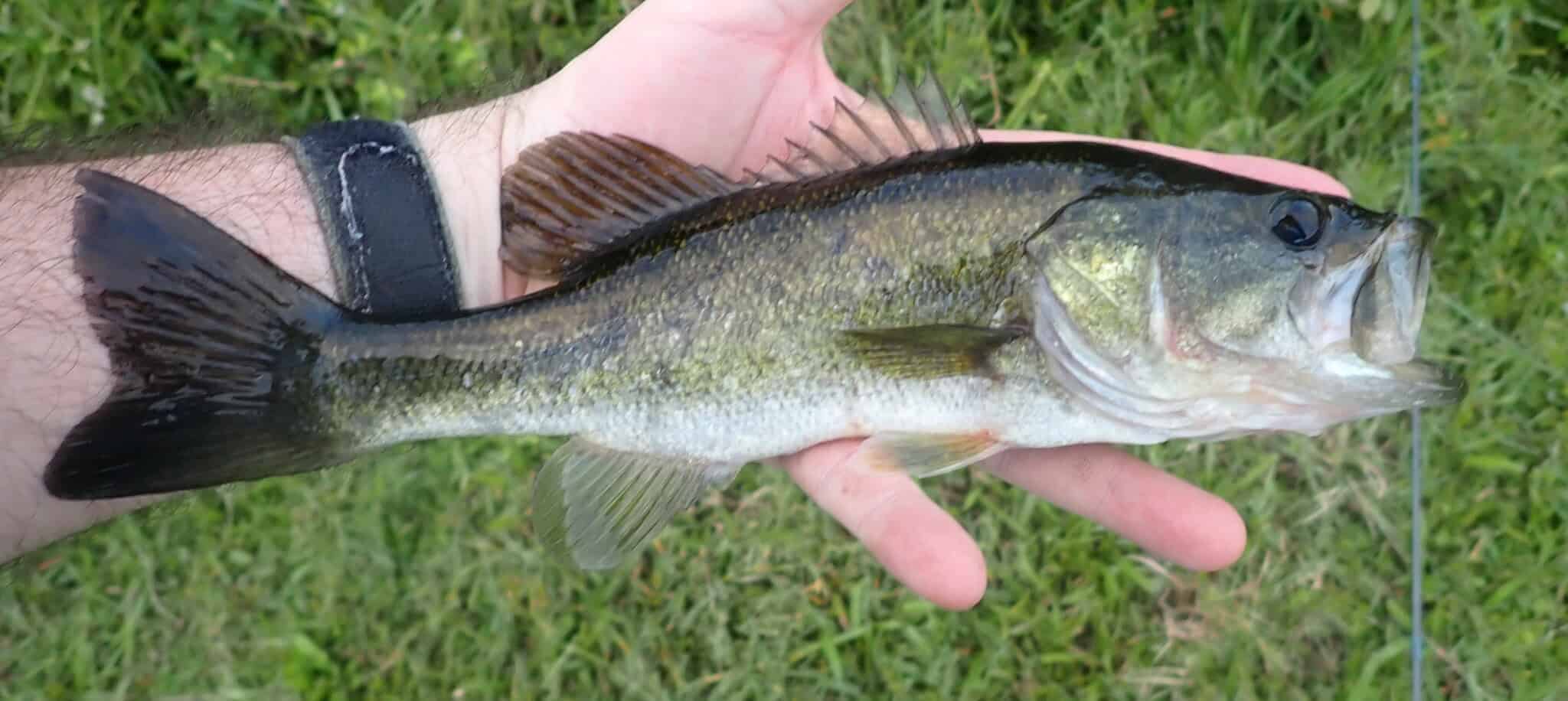
Florida Bass (Micropterus salmoides). Photo: sisor / iNaturalist via Wikimedia Commons, CC BY 4.0.
You can hold a Florida bass in your hands and still not know what you’re holding. Florida FWC says it can’t be reliably told apart from a northern largemouth by eye, and the scientific names got shuffled on top of that: current taxonomic work gives Micropterus salmoides to the Florida lineage and moves the northern largemouth to Micropterus nigricans. Plenty of agency pages, databases and older books still use the old convention. So the name gets sorted out first — otherwise it’s way too easy to read a largemouth study from Minnesota and walk away thinking you learned something about Florida fish.
At a glance · The short version
Current scientific name
Micropterus salmoides under the revised black-bass taxonomy adopted by current Florida guidance.
Northern largemouth name
Micropterus nigricans under the same revision.
Field identification
Florida FWC says Florida and northern largemouth are visually indistinguishable in ordinary field use; genetics and range history matter.
Habitat
Warm lakes, ponds, reservoirs, and slower rivers with vegetation, wood, edges, and other ambush structure.
Growth
Florida genetics are associated with greater trophy-size potential in warm southern systems, but habitat and productivity still control whether that potential is realized.
First solve the name
Taxonomy
What changed
Genomic work on black bass supported treating Florida bass as a full species rather than a subspecies of largemouth bass. Under the revised naming convention, Micropterus salmoides belongs to Florida bass and the northern largemouth becomes Micropterus nigricans. Florida FWC has adopted the change in public guidance.
For decades, M. salmoides was used broadly for largemouth bass and Florida fish were often called M. salmoides floridanus. Older biological studies can still be perfectly useful, but the reader has to know which lineage the authors actually studied before importing a value into this profile.
Editorial rule
Every source on this profile is checked for geography and population, not just species name. A paper titled largemouth bass from Minnesota should not silently become Florida-bass physiology because the scientific name printed in 1998 now points somewhere else under the new nomenclature.
Can I tell one from a northern largemouth?
Identification
Visual identification
FWC says Florida bass and northern largemouth bass are so similar that anglers cannot reliably distinguish them by appearance. That means jaw reach, lateral stripe, and dorsal-fin shape identify the largemouth-type black bass, but they do not reliably resolve Florida versus northern lineage.
Stocking and natural contact have created mixed populations in parts of the range. A fish can carry Florida ancestry without looking different at the boat. For management and trophy research, genetic assignment is therefore more useful than a color-based field rule.
The revised species boundary is broader than the old shorthand that Florida bass were simply the peninsula form. FWC notes native Florida-bass range extends beyond Florida into portions of Georgia, South Carolina, and North Carolina. The exact contact zone with northern largemouth is a genetics question rather than a line that can be drawn from a tackle map.
Florida bass occupy warm lakes, ponds, reservoirs, canals, and slower river habitat. Vegetation, submerged wood, docks, edges, drop-offs, and other ambush structure all matter, but open-water schooling can matter too when forage pulls fish away from shoreline cover.
Healthy aquatic vegetation creates concealment, nursery habitat, prey production, shade, and ambush edges. Trophy potential is therefore not a simple warm-water equation; productive habitat still has to grow prey and give large fish usable cover.
How does this fish operate?
Feeding, Growth & Spawning
Diet
Like other largemouth-type black bass, adults are opportunistic predators of fish, crayfish, and large aquatic prey, while young fish begin on zooplankton and progressively shift toward larger invertebrates and fish. Florida-population diet percentages are not imported here from northern or mixed populations; the defensible species-level statement is the broader shift from small invertebrates toward fish, crayfish, and other larger prey as bass grow.
Black bass in Florida generally spawn in the cooler-to-warming portion of the year, with timing shifting by latitude and weather. Males build and guard nests. This profile deliberately does not copy the national largemouth temperature table into the Florida-bass field because many older studies predate the current species split or sampled admixed populations. Where lineage is unresolved, the number stays out rather than acquiring false precision.
Florida-bass genetics are central to trophy-bass programs because the lineage has exceptional growth potential in warm systems. FWC’s research also makes the less glamorous point: genetics alone do not produce a giant bass. Food supply, lake productivity, habitat, survival, and age all have to line up long enough for the genetic ceiling to matter.
Evidence level. This profile intentionally does not duplicate the entire Largemouth Bass methods section. Until lineage-specific field differences are supported, the useful distinction is habitat context and thermal geography, not inventing a separate Florida-bass lure system.
First questioninference
What is the forage doing in this warm system right now? Vegetation edges and shade matter when prey is using them. Offshore structure matters when baitfish leave the bank. A Florida bass is still solving an energy-and-food problem rather than obeying a state-shaped habitat stereotype.
Heatinference
Warm-adapted does not mean immune to hot-water stress. In midsummer, oxygen, shade, depth, handling time, and the temperature of the water a fish is released into still matter. Florida-specific catch-and-release evidence is not strong enough here to assign a lineage-only hot-water threshold, so the profile keeps the handling advice qualitative instead of borrowing a precise number from northern or mixed-population work.
Technique overlapconvention
Until evidence shows a lineage-specific technique difference, standard largemouth presentations remain the honest baseline: vegetation and cover presentations, moving baits, bottom-contact baits, topwater in appropriate light, and offshore methods when forage and structure pull fish away from shore.
Where the sources disagree
Open Questions
The scientific name
Current FWC guidance and recent phylogenomic work use M. salmoides for Florida bass and M. nigricans for northern largemouth. Many older and some current databases still use M. salmoides for the combined largemouth concept. The page therefore dates the convention instead of declaring older literature wrong. The companion Largemouth Bass dossier keeps older nomenclature attached to the historical sources that actually used it.
Pure versus admixed fish
Much of the recreational range contains fish with mixed ancestry. A population can have substantial Florida genetics without being a pure native Florida-bass population, which affects how research results should be interpreted.
Evidence gaps worth keeping visible
Open Questions & Lineage-Specific Gaps
Florida-lineage temperature, dissolved-oxygen, pH, and turbidity tolerances
age and growth curves from genetically assigned populations
spawning thresholds and fecundity separated from northern or admixed populations
measured seasonal movement and depth
catch-and-release handling evidence in very warm water
range map tied to the revised taxonomy
— · Sources
FEEDING ECOLOGY · STANDARDIZED
How this fish gets fed.
Primary prey
Adults are opportunistic predators of fishes, crayfish, and other large aquatic prey. Florida-population diet percentages are not borrowed from northern or mixed largemouth populations.
Feeding mode / location
An ambush-oriented black bass using vegetation, wood, shade, edges, points, drop-offs and other cover or structure that brings prey within a short attack lane. The exact habitat shifts by Florida waterbody rather than following one universal cover rule.
Diel / seasonal pattern
The profile does not establish a Florida-lineage-specific universal feeding clock. Light, prey, water temperature, spawning season and habitat can shift position, but lineage-specific thermal and dissolved-oxygen feeding limits remain evidence gaps.
Ontogenetic diet shift
Young fish begin on zooplankton, then progressively add larger invertebrates and fishes as body size and gape increase.
The standardized summary keeps Florida-lineage evidence separate from values borrowed from generic or northern largemouth-bass populations.
Primary References
Scientific Reports — genomic black-bass phylogeny and species delimitation.
Compiled 2026-09-11. Limits and advisories are set per water and per state and change between seasons — the managing agency for wherever you are fishing has the current answer.
The Latin moved and not one fin ray or spawning date moved with it. I’ve never held a bass I could honestly call pure Florida, and nobody standing on a dock with one can say it either — only a genetics result from that population settles the ancestry. A jaw length or a stripe pattern won’t.
Lake FishPredominantly lake- and reservoir-centered U.S. fish profiles covering habitat, behavior, seasonal movement, fishing approaches, regional variation, and memorable biology without duplicating the River Fish cluster unless the lake fish is a distinct species, hybrid, or landlocked form. Start with Lake Fish of the United States: Species Profiles.27 articles
Species & BehaviorFish behavior, habitat, depth, forage relationships, and species-specific field decisions. Start with the Freshwater Fish Species field guide.159 articles
Cookie Consent
We use cookies to improve your experience on our site. By using our site, you consent to cookies.
Contains information related to marketing campaigns of the user. These are shared with Google AdWords / Google Ads when the Google Ads and Google Analytics accounts are linked together.
90 days
__utma
ID used to identify users and sessions
2 years after last activity
__utmt
Used to monitor number of Google Analytics server requests
10 minutes
__utmb
Used to distinguish new sessions and visits. This cookie is set when the GA.js javascript library is loaded and there is no existing __utmb cookie. The cookie is updated every time data is sent to the Google Analytics server.
30 minutes after last activity
__utmc
Used only with old Urchin versions of Google Analytics and not with GA.js. Was used to distinguish between new sessions and visits at the end of a session.
End of session (browser)
__utmz
Contains information about the traffic source or campaign that directed user to the website. The cookie is set when the GA.js javascript is loaded and updated when data is sent to the Google Anaytics server
6 months after last activity
__utmv
Contains custom information set by the web developer via the _setCustomVar method in Google Analytics. This cookie is updated every time new data is sent to the Google Analytics server.
2 years after last activity
__utmx
Used to determine whether a user is included in an A / B or Multivariate test.
18 months
_ga
ID used to identify users
2 years
_gali
Used by Google Analytics to determine which links on a page are being clicked
30 seconds
_ga_
ID used to identify users
2 years
_gid
ID used to identify users for 24 hours after last activity
24 hours
_gat
Used to monitor number of Google Analytics server requests when using Google Tag Manager
1 minute
Jetpack's built-in visitor analytics. It records page views, referring sites, search terms, and outbound link clicks, and also carries the shared visitor-tracking library used by Jetpack Instant Search and WooCommerce Analytics.