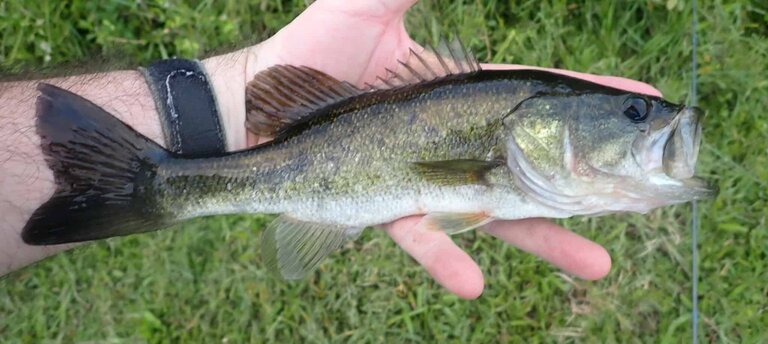
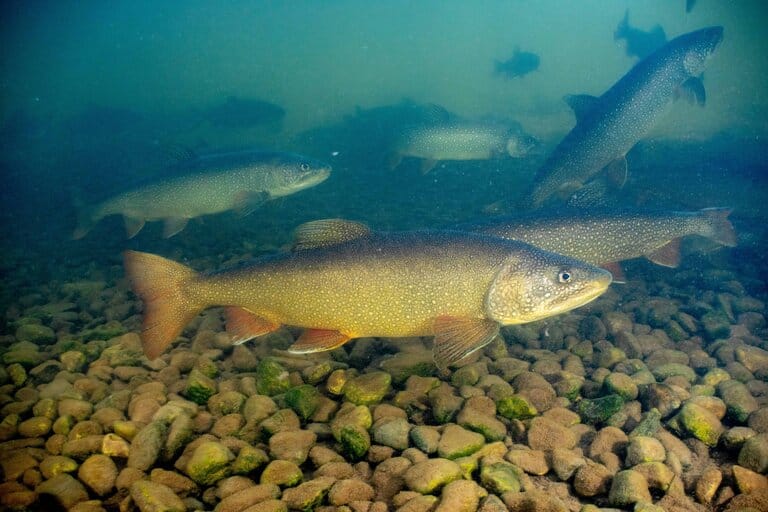
BLACK CRAPPIE · SPECIES PROFILE
You can sit right on top of them and fish thirty inches too low all afternoon.
Crappie teach you the difference between the right place and the right depth, mostly by letting you get one without the other. A slow afternoon won’t tell you which one you missed. I haven’t built a crappie season — in Montana they’re a long drive east, not something you do after school — so the fishing here is compiled, not earned. One thing the sources don’t say about themselves: nearly all of it is lake and reservoir guidance. It was written for still water, and it quietly stops describing this fish the moment you carry it to a river.
Profile basis: Missouri Department of Conservation, crappie fishing · Florida FWC · Minnesota DNR
LIGHT, NOT FEET
Two feet in stained water, twenty in clear, and it’s the same behavior both times.
Missouri’s angler guidance contains the fact that makes this whole page work. Black crappie spawn at one to two feet in stained water, and at twenty feet or deeper in very clear water. Same species, same spawning urge, same time of year, and an order of magnitude between the two numbers.
The fish isn’t choosing a depth. It’s choosing a light level, and the depth is whatever it takes to get there. That one observation turns a pile of scattered advice into something you can reason about, because it means every depth number anybody gives you is really a statement about how clear their water was.
Which is why clarity comes before season. Black crappie are markedly less tolerant of silt and turbidity than the other crappie — five agencies say so independently, and it is one of only two habitat traits that reliably separate the two species — but the useful consequence for a day on the water is not that they avoid dirty water. It is that a stain moves them up and clear water pushes them down, before the calendar gets a say.
The temperature that gets them shallow in the first place sits somewhere around fifty-five to fifty-six Fahrenheit in Missouri’s version, and the various agencies together give a spawning band of about thirteen to twenty-one degrees Celsius with most clustering at fifteen to eighteen. That spread is not sloppiness. It is latitude, and the sources do not distinguish between when spawning starts and when it peaks, so the extremes are real ends rather than errors.
Sources: Missouri Department of Conservation · Ohio DNR · North Carolina Wildlife Resources Commission
WHAT THAT DOES TO A YEAR
Shallow in spring and fall, deep in summer and winter, and the numbers are specific.
Missouri compresses the whole calendar into one line: fish shallow in spring and fall, deep in summer and winter. Underneath that, the working depths are worth memorizing, because they’re the only part of this fish that stays roughly put.
In summer, brush in fifteen to twenty feet of water with the fish holding ten to fifteen feet down. Note what that means — they are suspended well above the bottom and well above the brush that put them there. Bridge piers work in twenty feet or more. In fall they move onto docks and sit in the upper ten feet, and on warm days they will come shallower still and go back to the same brush piles they spawned around. In winter it is twenty to forty feet, shallower after a warm spell, and the schools pack in tighter than at any other time of year.
Two things follow. The first is that after a warm stretch in February you will have to find the school again, because it moved and the lake did not tell you. The second is that a fish holding ten feet down over twenty feet of water is invisible to almost every instinct you have about where fish live.
Sources: Missouri Department of Conservation · Florida FWC
SEVEN OR EIGHT
Count for what it is, not for what it isn’t.
Count the spines before you trust the color. Black crappie carry seven or eight on the dorsal fin; the fish they get confused with carries five or six. Color in this species answers to spawning, mood and whatever water it just came out of, which makes it the trait most likely to agree with whatever you already decided.
There is a wrinkle in that rule worth understanding, because it is a nice lesson in how field marks actually work. Every source agrees black crappie carry seven or eight spines. They do not all agree on the number for the white crappie you are comparing against — some say six, some say five or six.
So a six-spine fish is a white crappie under every version of the rule. But if you learned it as “seven or eight against six” and you are holding a five-spine fish, the rule you memorized has nothing to say. The fix is to run it as a positive test: count to seven or eight and call it a black crappie, rather than counting to six and calling it the other one. Same information, and one of those two directions fails at the edge.
The markings help when they help. Black crappie carry irregular scattered speckles and blotches with no vertical bars at all; white crappie organize theirs into five to ten often-faint vertical bars. That is reliable on a clean fish in clear water and ambiguous on a stressed, dark or spawning one — and since males darken markedly at spawning, the moment the color is most dramatic is exactly the moment it is least trustworthy.
One last note on what is not here. The old rule about the distance from the eye to the start of the dorsal fin does not appear on any authoritative page I could find, so it is not in this piece. It may well work. Nobody official has said so.
Sources: North Carolina WRC · Michigan DNR · US Fish and Wildlife Service · Animal Diversity Web
THE SCHOOL IS ONE OBJECT
And nobody has managed to explain why it hangs where it hangs.
Black crappie school at every stage of life, and Michigan puts it as well as anyone: found one, found a bunch. Florida adds the part that matters most — the school holds at a consistent depth. It is not a loose scatter of fish at assorted heights. It is one object, at one level, moving together.
After the spawn they drop into deeper water and suspend in the column, which Michigan notes makes them harder to catch than other panfish. That is the whole difficulty in one sentence: a bluegill is somewhere you can picture, and a post-spawn crappie is at a number.
Here’s the part I can’t leave alone. The standard explanation for summer suspension is that the fish are stacked above a thermocline because the water below has run out of oxygen. It is repeated everywhere. I could not confirm it from a single agency page, from FishBase, or from any peer-reviewed source I could reach — none of them mentions a thermocline in connection with this species, and there is no published dissolved-oxygen requirement for black crappie at all.
So the behavior is documented and the mechanism isn’t. The fish suspend, reliably, and the reason everyone gives for it is an explanation that nobody has actually checked. That is worth knowing, partly because it is a good story and partly because if the thermocline explanation is wrong then the depth you found last August might have been about something else entirely.
Feeding runs to low light — night, dawn and dusk. Two sources record a peak between midnight and two in the morning, which I would treat as a real observation rather than a species-wide rule. Missouri turns the low-light habit into the best trick on this page: fish at night in summer around artificial light, dock floodlights included, and let the lights do the gathering for you.
Sources: Michigan DNR · Florida FWC · Minnesota DNR · Missouri Department of Conservation
DEPTH FIRST, THEN THE JIG
Everything below works in that order and works badly in reverse.
The jig sizes and rigs below are mostly Missouri’s, and agency advice is built for typical water on a typical day. It can’t tell you what the school in front of you did this morning. Hang onto the order more than the details: settle the depth, then pick the presentation.
Jigs of a thirty-second to a sixteenth of an ounce for shallow spring fish, and something brighter at a sixteenth to an eighth during the spawn. Weedless jigs if you are working brush, because you will be working brush. A small jigging spoon is the usual alternative to live bait, raised and lowered a foot or two rather than swung.
For bait, Florida’s rig is a number four hook with a small split shot under a float, carrying a minnow or a grass shrimp. Michigan makes the point most people get wrong: use a bigger hook than you would for bluegill, because a crappie’s mouth is large and the fish is not the delicate thing its nickname suggests. Delicate is the membrane, not the gape.
Retrieve slowly, and in cold water slowly enough that it stops being a retrieve. When they will only take a jig hovering nearly motionless, a bobber is what holds it there, and that is a real technique rather than an admission of defeat. The exception is the spawn, when short erratic jerks close to cover work better than patience does. Vertically, in brush: drop to the bottom and reel slowly up through the school until something happens, and then you know the number.
Sources: Missouri Department of Conservation · Florida FWC · Michigan DNR
THEY NEST IN COLONIES
Territorial only about reproduction, and even then, next door to each other.
This is an odd combination and it took me a moment to accept it. Black crappie are not territorial in daily life — they school, which is close to the opposite — but at spawning the males build and defend nests, and they do it packed tightly together in colonies. Aggressive about a few square feet of gravel, and completely social about everything else.
Nests go on firm clay or sand, up to six feet down in Minnesota and three to eight feet in Florida, with the bigger fish nesting deeper. Which is the light rule again, wearing different clothes.
The rest of the arithmetic is generous. Females spawn with several males and more than once a season. A big female carries well over a hundred thousand eggs; the published fecundity figures run from a few thousand up to a hundred and eighty-eight thousand depending on who counted and how big the fish was. Eggs hatch in three to eight days and the male guards the nest for about five to seven after that, and then it is over.
Sources: Minnesota DNR · Florida FWC · Animal Diversity Web · Illinois DNR
WHY SOME YEARS ARE BRILLIANT
A lake gets one enormous year class and then spends four years using it up.
Crappie reproduce early and prolifically, and Minnesota adds the other half of that sentence: they are prone to stunting. Put those together and you get the boom-and-bust pattern that is the dominant fact about managing this species.
What happens is that conditions line up in one particular spring and a lake produces an enormous year class. Three or four years later those fish are all a good size at the same time and the lake is spectacular. Then they age out, and the cohorts behind them were suppressed by the crowding, and the lake is ordinary again for a while. It is not that the fishing got worse. It is that you were fishing one very good year and it ended.
Minnesota’s management response is the interesting part, because it is not what you would guess. They protect habitat and try to keep the predator-prey balance right — that is, they manage the fish that eat juvenile crappie — rather than restricting how many anglers take out. Which tells you where they think the bottleneck actually is.
It also explains why the limits are as generous as they are. Missouri’s are thirty a day and sixty in possession, with no length limit and no closed season, outside waters with their own special rules. That number is not carelessness; it is an agency saying that angler harvest is not what decides this population, and this is one of the few fish where they can say that honestly. On the eating side, Wisconsin puts crappie in its least-restricted consumption tier, the most permissive of the three, which makes them about as easy a fish to take home as freshwater offers.
Black crappie also grow more slowly in length than white crappie while being the heavier fish at any given length, which is a nice detail with a practical edge: a crowded year class takes longer to reach a size worth keeping.
Sources: Minnesota DNR · Missouri Department of Conservation · Wisconsin DNR · Texas Parks and Wildlife
WHERE THE SOURCES ARGUE
Cool-water fish or warm-water fish, depending on what you are comparing it to.
Minnesota, Virginia and Animal Diversity Web all describe black crappie as preferring cooler, deeper, clearer water. The Fish and Wildlife Service describes the species as living in quiet, warm temperate waters, and FishBase files it as subtropical. Both are right and they are answering different questions: in absolute terms this is a warm-water sunfish, and relative to the white crappie it is the cooler-water one of the pair. The conflict is about the reference point, and it is easy to misread in either direction.
The size figures argue too, and here the record beats the reference book. FishBase gives a maximum of 2.7 kilograms and the Fish and Wildlife Service gives six pounds — the same number twice. The heaviest rod-caught fish anybody has verified is the five pound seven ounce Tennessee fish, which is lighter than both. Published maxima in compilations are not always traceable to a real specimen that somebody weighed, and when they are not, the sport record is the better-evidenced number.
On diet the sources genuinely disagree about degree. Everyone agrees there is a shift toward eating fish once the crappie passes about sixteen centimeters. How complete that shift is depends on who you ask: the Fish and Wildlife Service says large individuals are basically piscivorous, Minnesota says adults take plankton and small fish, Texas says black crappie eat fewer fish and more insects and crustaceans than white crappie do, and Ohio leads its list with planktonic crustaceans. No quantified diet study turned up to settle it.
None of these arguments change what happens over a brush pile. The school still moves as one piece, so when a spot that was loaded goes quiet, check the depth before you write off the spot. Crappie are strange enough without anybody inventing a mystery for them.
Sources: FishBase · US Fish and Wildlife Service · Texas Parks and Wildlife · Tennessee Wildlife Resources Agency records
WHERE THIS CAME FROM
Sources
- Missouri Department of Conservation — Crappie Fishing Tips
- Missouri Department of Conservation — Black Crappie
- Missouri Department of Conservation — Crappie
- Minnesota DNR — Crappie Biology
- Florida Fish and Wildlife Conservation Commission — Black Crappie
- Michigan DNR — Crappie
- North Carolina Wildlife Resources Commission — Black Crappie
- Ohio DNR — Black Crappie
- Virginia Department of Wildlife Resources — Black Crappie
- West Virginia DNR — Black Crappie
- Illinois DNR — Black Crappie
- Texas Parks and Wildlife — Crappie
- US Fish and Wildlife Service — Black Crappie
- FishBase — Pomoxis nigromaculatus
- Animal Diversity Web — Pomoxis nigromaculatus
- USGS Nonindigenous Aquatic Species — Pomoxis nigromaculatus
- Smithsonian NEMESIS — species summary
- Wisconsin DNR — Fish Consumption Advice
- Tennessee Wildlife Resources Agency — records
Compiled 2026-09-11. Creel limits and consumption advice are set per water and per state and change between seasons — the managing agency for wherever you are fishing has the current answer.