Rainbow Smelt: Forage Fish in One Lake, Invader in the Next
Smelt can decide where lake trout and walleye sit in a lake. In the Great Lakes they’re also an introduced fish that eats native larvae, and both things are true at the same time.
By HunterUpdated September 13, 2026Read 5 min
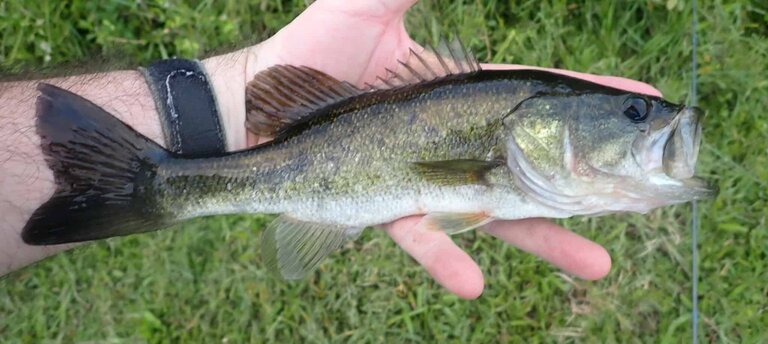
A small fish caught during a fishing trip, showcasing the thrill of Hook the Horizon adventures.
Most of why smelt matter is what eats them. A lake trout or a walleye can be where it is because the smelt are. The other half is less friendly: in the wrong lake they’re an introduced problem, and the same spring run that makes them catchable is often how they arrived. I’ve never dipped for smelt, so both halves come from the sources, and the two don’t sit comfortably together.
At a glance · A cold-water forage fish that can also become a predator, competitor, and invader
Scientific name
Osmerus mordax
Adult size
USGS: roughly 100-350 mm (4-14 in) across populations.
Vertical habitat
Young fish use warmer shoreline water; yearlings shift pelagic; adults can make diel vertical movements through deep cold layers.
Spawn
Early spring after ice-out; begins around 4.4 C and peaks near 10 C in Great Lakes summaries, usually in tributaries or on shorelines.
Diet shift
Small smelt are primarily zooplanktivorous; larger fish add benthic crustaceans, larval fish, and small fish.
Great Lakes status
Widespread established nonnative fish with both major forage value and documented ecological costs.
Teeth separate a smelt from the silver fish it resembles
Identification
Body
USGS describes a slender silver fish with a pale green back, iridescent purple-blue-pink sides, an adipose fin, and a deeply forked tail. Scales are easily shed.
Rainbow smelt have a pointed snout and developed canine-like teeth on the tongue and roof of the mouth. Cisco and lake whitefish have adipose fins too but lack that roof-and-tongue dentition. Minnows lack the adipose fin.
Yearlings shift toward cooler pelagic habitat. Adults undertake diel vertical movements and have been recorded from about 18 to 91 m in Lakes Superior and Michigan depending on season. “Smelt are deep” is therefore incomplete: depth changes with age, light, season, and prey.
USGS summarizes occupancy from below freezing in marine-influenced settings to roughly 20 C, with strong cold-water adaptations. That is a physiological range, not a claim that every lake’s best smelt layer spans all those temperatures.
A sonar mark is a photograph, not a fact: smelt sitting at forty feet by afternoon light can be twenty feet shallower after dark. Trust what you are marking right now over what you found an hour ago.
Spring collapses the vertical problem into a shoreline run
Spawning
Timing
In the Great Lakes literature summarized by USGS, spawning begins after ice-out around 4.4 C and peaks near 10 C. Fish enter tributaries and also spawn along suitable shorelines.
Eggs are adhesive and negatively buoyant, sticking to substrate for roughly two to three weeks before hatching in the summarized Great Lakes literature. That makes nearshore substrate and tributary condition part of recruitment even for a fish that spends much of adulthood offshore.
Age at maturity varies broadly from about one to four years among populations; maximum life expectancy can reach around eight years. Females generally become larger and live longer.
Smelt below roughly 150 mm standard length are primarily zooplanktivorous in the USGS synthesis. Larger fish add benthic crustaceans and larval or small fishes. A big smelt is therefore not simply a larger plankton eater.
Lake trout, walleye, salmon, burbot, northern pike, and many other predators consume rainbow smelt. Their abundance can materially improve growth of piscivores in some systems.
Introduced smelt also consume larval fishes and have been implicated in competition with cisco and yellow perch, reduced recruitment of lake whitefish in some invaded lakes, and other native-fish effects. The same smelt can be valuable prey for an adult lake trout and a problem for a larval native fish.
When local regulations allow dip-net or hook-and-line harvest, tributary mouths and shorelines during the brief spawning window concentrate fish that are otherwise dispersed through deep pelagic habitat. Temperature and current run reports matter more than an annual calendar date.
Open-water school
For anglers targeting predators, smelt location can be more important than catching the smelt themselves. Find the temperature layer and forage school; then ask which predators can occupy the same oxygen and temperature band.
Diel movement
Because adults can shift vertically with light, a sonar school found at one depth in afternoon may be in a different part of the water column after dark. Record time and depth together.
Those are two different jobs wearing one species name. Once the spring run shows, dipping smelt for the pan can go quick. Finding the predators smelt pull around open water is the slow half, and just proving a school exists out there can eat an afternoon before anything decides to bite. Pick which job you came for before the first cast — a dip net and a temperature gauge don’t do each other’s work.
The invasion history is part of the fish
Native Versus Introduced
Great Lakes
Rainbow smelt were introduced into Crystal Lake, Michigan, in 1912, escaped into Lake Michigan, and spread through the Great Lakes. USGS now classifies them as widespread, reproducing, established nonnative fish in all five Great Lakes with high environmental impact.
The species is native to Atlantic, Arctic, and Pacific drainages across parts of North America. “Invasive smelt” is therefore correct in the Great Lakes and many inland lakes but not a universal species label.
The more interesting smelt question isn’t how to catch them. It’s whether they belong in the lake you’re standing on, and unlike most fishing questions, that one has an answer you can look up before you leave the house.
FEEDING ECOLOGY · STANDARDIZED
How this fish gets fed.
Primary prey
Small rainbow smelt are primarily zooplanktivorous. Larger fish add benthic crustaceans, larval fishes, and small fishes.
Feeding mode / location
Feeding location changes with life stage: young-of-year use warmer nearshore water, yearlings become pelagic, and adults feed through deep cold-water layers while making vertical movements with prey and light.
Diel / seasonal pattern
Adults can shift vertically with light, so a school’s depth can change between afternoon and darkness. Spring spawning briefly concentrates fish in tributaries and along shorelines after ice-out.
Ontogenetic diet shift
Below roughly 150 mm standard length, smelt are mainly zooplanktivorous; larger fish broaden the diet to benthic crustaceans and larval or small fishes.
Only documented feeding biology is summarized here; unsupported bite windows are left out.
Lake FishPredominantly lake- and reservoir-centered U.S. fish profiles covering habitat, behavior, seasonal movement, fishing approaches, regional variation, and memorable biology without duplicating the River Fish cluster unless the lake fish is a distinct species, hybrid, or landlocked form. Start with Lake Fish of the United States: Species Profiles.27 articles
Species & BehaviorFish behavior, habitat, depth, forage relationships, and species-specific field decisions. Start with the Freshwater Fish Species field guide.159 articles
Cookie Consent
We use cookies to improve your experience on our site. By using our site, you consent to cookies.
Contains information related to marketing campaigns of the user. These are shared with Google AdWords / Google Ads when the Google Ads and Google Analytics accounts are linked together.
90 days
__utma
ID used to identify users and sessions
2 years after last activity
__utmt
Used to monitor number of Google Analytics server requests
10 minutes
__utmb
Used to distinguish new sessions and visits. This cookie is set when the GA.js javascript library is loaded and there is no existing __utmb cookie. The cookie is updated every time data is sent to the Google Analytics server.
30 minutes after last activity
__utmc
Used only with old Urchin versions of Google Analytics and not with GA.js. Was used to distinguish between new sessions and visits at the end of a session.
End of session (browser)
__utmz
Contains information about the traffic source or campaign that directed user to the website. The cookie is set when the GA.js javascript is loaded and updated when data is sent to the Google Anaytics server
6 months after last activity
__utmv
Contains custom information set by the web developer via the _setCustomVar method in Google Analytics. This cookie is updated every time new data is sent to the Google Analytics server.
2 years after last activity
__utmx
Used to determine whether a user is included in an A / B or Multivariate test.
18 months
_ga
ID used to identify users
2 years
_gali
Used by Google Analytics to determine which links on a page are being clicked
30 seconds
_ga_
ID used to identify users
2 years
_gid
ID used to identify users for 24 hours after last activity
24 hours
_gat
Used to monitor number of Google Analytics server requests when using Google Tag Manager
1 minute
Jetpack's built-in visitor analytics. It records page views, referring sites, search terms, and outbound link clicks, and also carries the shared visitor-tracking library used by Jetpack Instant Search and WooCommerce Analytics.