The point still looks perfect.
Rock, a little wind, good depth nearby. You caught fish there last week.
Nothing’s happening.
Then fifty yards out, the surface dimples and flashes for about three seconds. Tiny fish scatter, and a gull changes direction.
The point didn’t stop being structure. The food just left it.
Some lakes move on bait, not addresses
Predators that feed heavily on schooling baitfish can spend a lot of time following food that doesn’t stay attached to one stump, dock, or rock pile.
Shad are the obvious reservoir example. A USGS species profile lists gizzard shad in the diets of numerous game fish, including walleye, bass, crappie, catfish, and others. Texas Parks and Wildlife describes threadfin shad as common reservoir forage that often hangs in the upper part of the water column.
Other lakes may run on shiners, smelt, alewives, cisco, perch, or young-of-year fish. The baitfish and forage page has more on those.
The species changes. The problem doesn’t: the groceries can move.
Bait gives itself away in small ways
You don’t need a sonar screen full of cartoon arches to find bait.
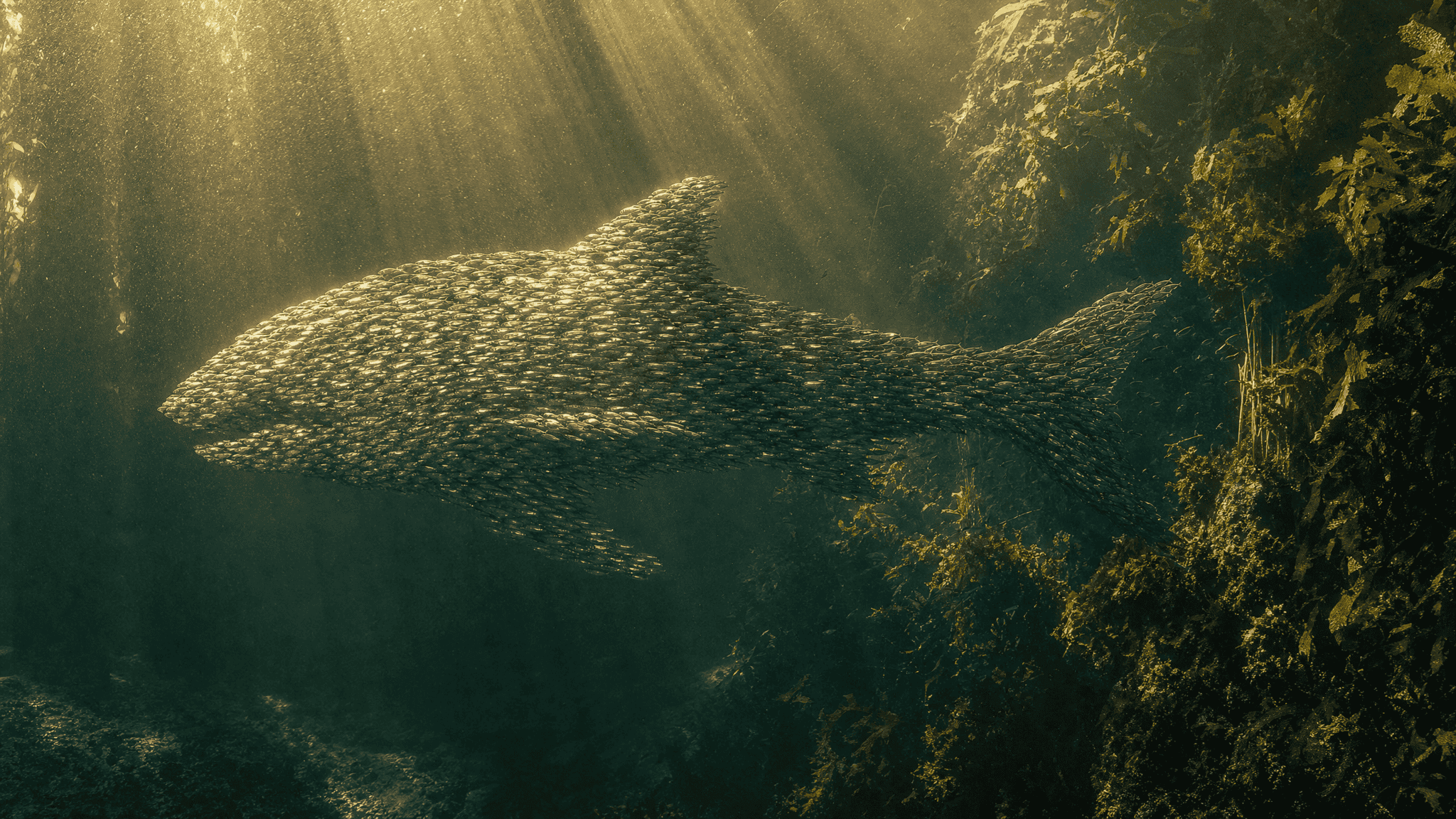
Watch for flickers at the surface, or dimples moving together instead of one random rise. Birds that keep circling one patch are worth a look. So is a dark cloud of small fish beside a dock, or tiny fish pushed up against riprap. Sometimes the water boils for two seconds and then goes blank.
On electronics, bait may show up as a dense cloud or band rather than a few separate marks. The fish-finder basics help here, because the point isn’t chasing every mark. It’s spotting the bigger pattern.
If you don’t have electronics, your eyes are still allowed to work.
Depth matters before color
Once you find bait, ask where it is in the water column.
Is the school dimpling the surface, hanging halfway down, hugging the bottom, suspended over deep water, or pinned against a bank? That matters before lure color does.
A lure can look exactly like a shad and still be useless if it spends the whole retrieve six feet above or below the food.
Pick something you can keep near the bait. That might be a swimbait, spoon, crankbait, jerkbait, jig, small streamer, or something else entirely. What kind of lure it is matters less than whether it can live at that depth.
The forage-clue piece comes at the same idea from another direction: match the obvious behavior and shape before you chase an exact name.
Don’t cast into the middle of the panic forever
When predators push bait to the surface, the obvious target is the explosion.
Cast there once.
Then notice which way the bait is moving and where the deeper escape route is. Predators may work the edges or underneath the school instead of spending the whole time in the visible center.
If the surface activity stops, count your lure down and check below it. If it starts up again twenty yards away, the school may be moving, not disappearing.
The loudest water isn’t always the only useful water.
Fall can make the movement easier to see
Fall can rearrange forage, but not in one direction everywhere. Cooling water, changing light, turnover, water level, and the forage species itself can all change where bait is easiest to find. A creek arm may fill with visible bait on one lake while another lake keeps most of its forage offshore.
So don’t turn that into “all bait moves shallow in fall.” It depends on the lake and the weather as much as the calendar.
Use the season to ask the question, not answer it. Where’s the bait today?
If the back half of a creek is empty but the first secondary point is full of flickering bait, fish the point. The calendar doesn’t need to be offended.
Size can matter when the lake is full of one year class
A school of two-inch young shad is a different target than six-inch adults.
Predators feeding on very small forage can get strangely picky about profile. A much bigger lure may still catch fish, but if you’re getting follows or misses around obvious small bait, downsizing is a clean test.
Start with the rough size you can see. Don’t measure a fleeing shad with a ruler in your imagination.
Close is enough to begin.
One bait school isn’t the lake
Finding forage is useful. It isn’t proof every predator is with it.
Some fish may still be eating off the bottom, in the weeds, or somewhere else entirely. A lake can support several feeding patterns at once.
That matters when you find a giant school of bait and no sign of predators. Don’t spend three hours underneath it because “there have to be fish here.”
There don’t.
Give the school a fair test. Check its edge, underneath it, and nearby structure. Then move if nothing ties the food to a predator.
Let the food make the map smaller
Good structure still matters, and so do depth, weeds, current, temperature, and light.
Baitfish just add a layer that moves.
Once you find the food, you can stop asking which of twenty beautiful spots deserves your next hour and start asking which one the food is actually using.
That’s a smaller problem.
And smaller fishing problems are usually the ones you can test.