SMALLMOUTH BASS · SPECIES PROFILE
FIELD PLATE · HOLDING WATER
Look for the place that pays the fish back.
The current matters most where the fish does not have to fight all of it.
Smallmouth bass are river fish in a way largemouth usually are not, but that does not mean they want the fastest water. The useful places are the transitions: the soft side of a boulder, the head or tail of a pool, the edge of a riffle, a run beside broken rock, or a current seam where food keeps arriving and the fish can hold without spending everything.
Profile basis: Missouri Department of Conservation · Minnesota DNR telemetry · Oklahoma Department of Wildlife Conservation

IDENTIFICATION
The jaw is useful. The side pattern is usually faster.
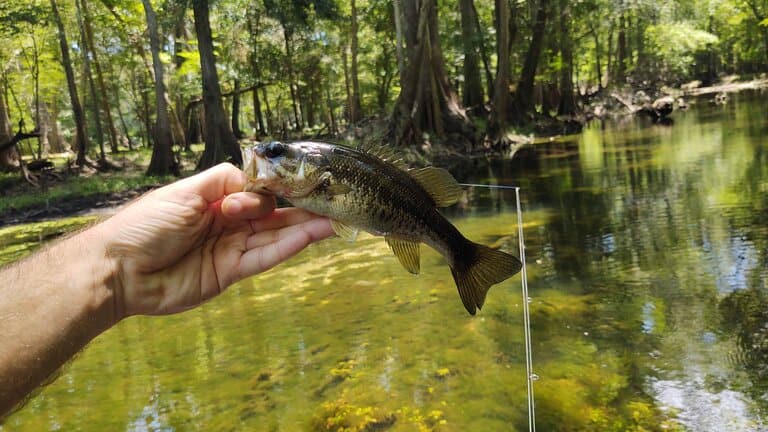
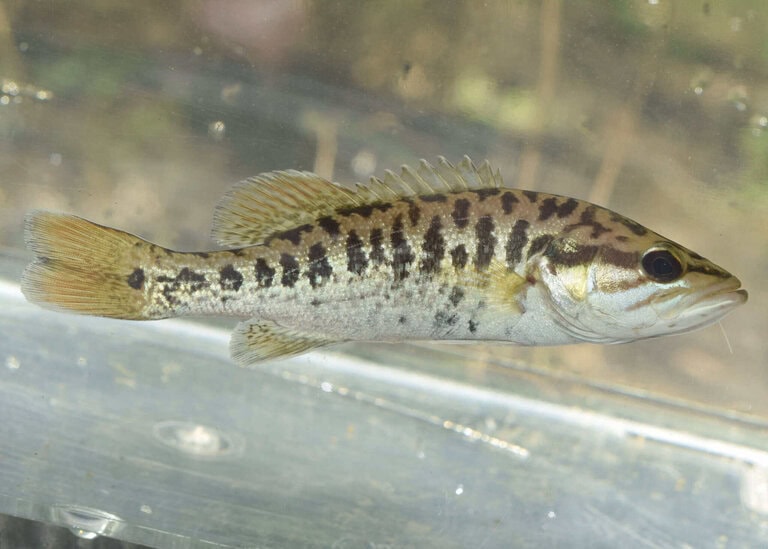
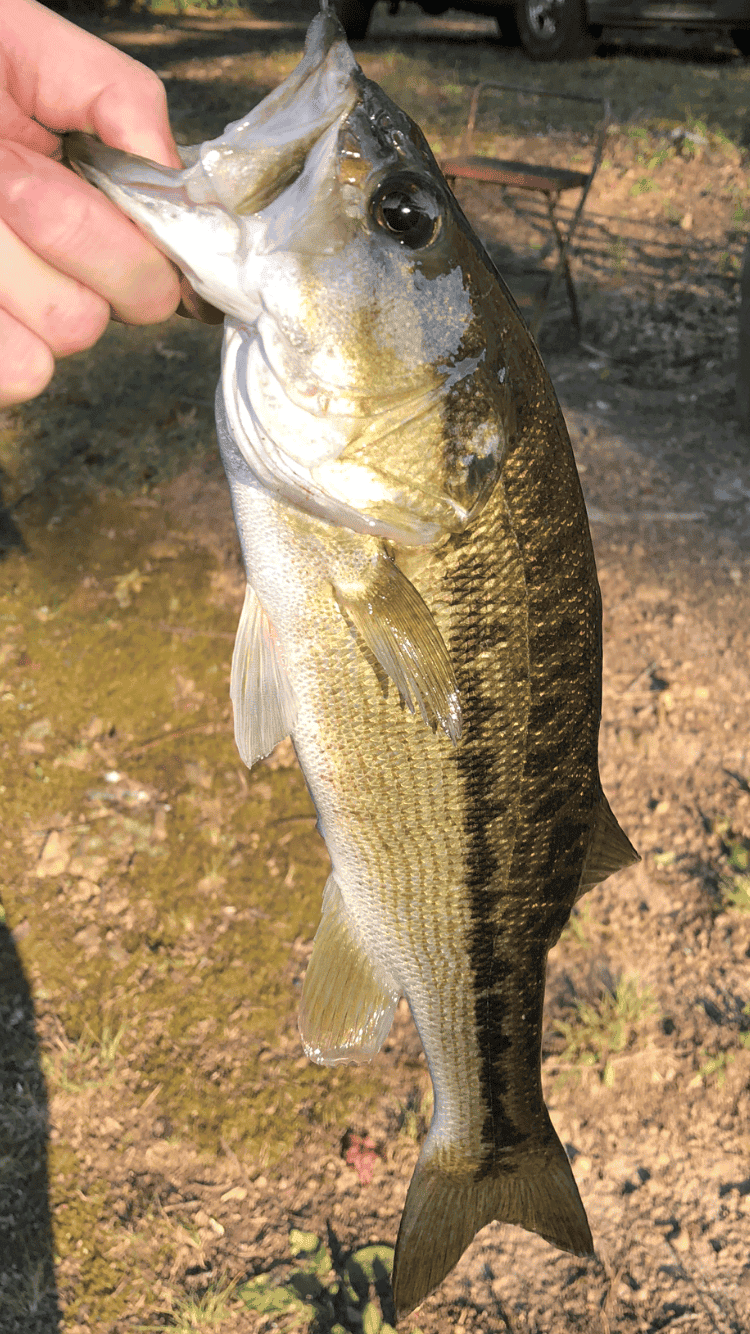
Smallmouth bass are more streamlined than largemouth and commonly run olive, brown, bronze or gold. The side usually carries a series of dark vertical bars rather than the broad horizontal stripe of a largemouth or the lower-side rows of spots seen on a spotted bass.
The jaw helps: on an adult smallmouth, the upper jaw generally reaches about to the rear margin of the eye rather than well behind it. The two dorsal sections are connected rather than nearly separated by the deep notch typical of a largemouth.
Spotted bass are the more annoying comparison. Their jaw can end in nearly the same place and their dorsal fins are also connected. Look at the side instead: spotted bass usually carry a dark horizontal stripe plus rows of dark spots below it. They also have a rough tooth patch on the tongue.
Young smallmouth can show orange in the center of the tail, while juvenile largemouth don’t. That’s handy when the fish is too small for the adult jaw check to be reliable.
Color is the trait everyone reaches for, and it’s also the one most willing to change with water, stress and light. Structure first.
Sources: Missouri Department of Conservation · Missouri Department of Conservation — Spotted Bass · Ohio DNR
CURRENT ECONOMY
A river smallmouth uses current. It doesn’t pay full price for it all day.
One source calls smallmouth current fish. Another measured almost no current at a lot of the spots where fish were actually located. That sounds like an argument until you quit thinking about the river’s average speed and start thinking about the seam.
Smallmouth live in current-driven systems, then hold where the energy cost drops: behind boulders, along eddies, beside wood, in pools and runs, at riffle margins and in softer lanes touching faster delivery water. Arkansas telemetry found boulder substrate used disproportionately and summer velocities at fish locations often extremely low.
Oklahoma’s angler guidance points at the same geometry from the bank: approach runs, riffles, boulders and wood from downstream, cast upstream or cross-current, and let the presentation travel through the lane more like natural food.
The seam itself is not automatically the target. Ask which side gives the fish a place to hold and which side still brings food close enough to intercept. That trade is the whole reason these fish sit where they sit.
A cast that crosses five current speeds without ever settling into one lane may cover a lot of river and test almost none of it.
Sources: Hafs 2007 — stream telemetry · Oklahoma DWC
ROCK IS THE MAP
The useful rock is the one that changes depth, current or the prey field.
Smallmouth are strongly associated with gravel, cobble, broken rock, boulders and hard-bottom transitions. In rivers, that material creates current breaks, feeding seams and deeper pocket water. In lakes and reservoirs, the same preference shows up as rocky points, reefs, shoals, humps, steep breaks and hard-bottom edges.
That is why “fish rock” can be both correct and useless. A football-field-sized rock flat is not one spot. The edge where gravel turns to chunk rock, the boulder beside deeper water, the tip of the point exposed to wind, or the reef crest dropping into a basin all create more specific relationships.
Wood still matters. Root wads, laydowns and downed trees can create current refuge and overhead security, especially in rivers. New Hampshire and Oklahoma both include boulders and fallen timber in productive smallmouth water.
Vegetation can hold smallmouth too, especially in lakes, but they generally fit clean rocky water far better than the soft, vegetated backwater largemouth profile.
CRAYFISH, FISH, AND THE GOBY TAKEOVER
Smallmouth eat crayfish until the lake gives them something better.
Across agency profiles, adult smallmouth repeatedly show the same broad diet: crayfish, fish and large aquatic insects. Wisconsin calls crayfish the preferred food. Ohio puts crayfish and other large invertebrates at the center, supplemented by fish and surface insects.
Then Lake Erie shows why a species profile should not turn that tendency into a rule. Before round gobies became established, crayfish were a major smallmouth prey there. After gobies spread, diet studies found gobies in most stomachs and, in a 2023 eastern Lake Erie sample, making up the clear majority of stomach volume.
The fish did not become a different species. The prey field changed enough that the feeding relationship changed with it.
Young smallmouth start on microcrustaceans and insects, then add fish surprisingly early. Missouri notes fry under an inch long can already eat small fish.
For the angler, the useful categories are therefore broad: bottom-oriented crustacean, small fish, or large drifting insect. Match the size and movement to what the water supports before getting too attached to the exact marketing color.
Sources: New York DEC — Lake Erie diet analysis · Wisconsin DNR · Ohio DNR
PRESENTATION
Bottom contact is useful right up until “bottom” is not where the fish is.
Tubes, grubs, jigs, crayfish imitations, minnows, crankbaits, jerkbaits, spinners, streamers, topwater and natural bait all appear in state guidance. Smallmouth eat enough different things that the lure list becomes huge faster than it becomes helpful.
Smallmouth often telegraph useful information before a landed fish: a follow, flash, swipe, bump or repeated contact from the same seam. Keep the water and depth attached to that response before changing the lure family.
A tube pinned between two rocks has already stopped fishing, whether or not a bass ever looked at it.
CLARITY
Dirty water shrinks the distance at which the fish can solve the problem.
Smallmouth are strongly associated with clear water, and controlled work gives a useful mechanism rather than just a preference label. Sweka and Hartman found reactive distance dropping sharply as turbidity increased—from roughly 65 cm in clear water to around 10 cm at the highest turbidity tested.
The interesting part is what did not change: once a smallmouth detected the prey, capture success did not decline the same way. The main cost was finding the prey in the first place.
That suggests a more precise stained-water adjustment than “use a brighter color.” You may need to put the presentation closer, keep it in the strike window longer, increase displacement or contrast where appropriate, or move toward structure that concentrates fish and prey into a smaller search area.
Oklahoma angler guidance goes further and says clarity is one of the biggest factors in stream success. That may reflect catchability in those particular streams rather than a universal biological shutdown. The mechanism above is stronger: turbidity shortens the visual search distance.
THE FISH CAN MOVE A LOT FARTHER THAN THE SPOT NAME SUGGESTS
A home rock can still belong to a fish with a seasonal commute.
Minnesota DNR radio-tracked smallmouth across a 96-kilometer reach of the upper Mississippi and recorded seasonal migrations up to 27 km in autumn toward wintering areas and 29 km in spring toward spawning areas. Total individual travel distances reached more than 50 km.
Not every fish is running thirty kilometres a season, but a pool holding a smallmouth in July can turn up empty for reasons that have nothing to do with what you tied on.
Missouri’s Current River work adds a thermal version. Tagged smallmouth used the warmer water around Big Spring in late winter, moved back into the river as temperatures matched in spring, and began returning toward the spring refuge as the river cooled again in autumn.
Low water can force movement too. In Arkansas streams with seasonal drying, fish moved away from disappearing habitat and concentrated in remnant pools, sometimes using poorer bedrock habitat simply because the preferred run and riffle water was gone.
Seasonal position is therefore a habitat problem—temperature, flow, depth and refuge—not just a calendar entry.
Sources: Minnesota DNR telemetry · Missouri Department of Conservation
SPRING NESTS
The aggressive fish on the gravel may be guarding more than the spot.
Male smallmouth build clean circular nests in gravel or broken rock, usually in quiet or protected water near enough to deeper refuge that the fish can escape. Females deposit eggs and leave; the male guards the nest, then continues guarding the newly emerged fry for roughly another week.
That guarding behavior makes nest fish easy to target. Missouri notes spring males readily attack lures around nesting areas.
The population-level effect of catch-and-release fishing during the spawn is more complicated than the moral argument often sounds. Pennsylvania’s black-bass plan says field studies have not conclusively linked spring catch-and-release fishing with reduced adult bass density in healthy self-sustaining populations, while also acknowledging that temporarily removing a guarding male can increase egg predation.
Those two things can both be true. A population may remain healthy while one nest pays a local cost.
If you choose to fish nesting smallmouth where legal, land the fish quickly and put it back immediately. If the water has a seasonal closure, the closure answers the question for you.
THE FIGHT & RELEASE
They jump because that is what smallmouth do. The photo still does not need four minutes.
State and federal sources consistently describe smallmouth as hard, acrobatic fighters with strong runs and frequent jumps. That is part of why a two-pound fish can feel bigger than the scale eventually says.
Catch-and-release physiology work on smallmouth boils down to a pretty simple handling lesson. Air exposure delayed cardiac recovery in a dose-like way: no-air fish recovered fastest; 30 seconds was intermediate; 120 and 240 seconds took substantially longer.
Fight duration adds to the disturbance. The practical response is not complicated: use tackle appropriate to the fish and current, land it efficiently, wet your hands, keep the air exposure short and get the fish back before the photograph becomes the event.
Temperature matters, but the original smallmouth physiology work did not support one simple “warmer always equals linearly worse” rule across every tested condition. Local warm-water guidance and fish behavior should outrank one laboratory graph.
NATIVE SPORT FISH, INVASIVE PREDATOR
The drainage changes the moral of the exact same fish.
Inside its native Great Lakes, St. Lawrence and Mississippi-basin range, smallmouth bass are a prized sport fish managed with seasons, size limits and trophy programs. Outside that range, they can become one of the most damaging introduced predators in a river.
The Colorado River Basin is the sharpest example. National Park Service calls smallmouth a major predatory threat to native fish, including humpback chub, and management below Glen Canyon Dam has included electrofishing removal, barriers, habitat modification and cooler dam releases intended to prevent reproduction.
USGS also documents predation on Pacific salmon smolts and hybridization with native bass species in other introduced systems.
This is not a reason to make the profile anti-smallmouth. It is a reason to stop treating “good gamefish” as a universal ecological category. The same fish can be exactly what one fishery is trying to grow and exactly what another is trying to remove.
Check the drainage before turning catch-and-release into an automatic virtue.
Sources: National Park Service — Colorado River threat · USGS NAS
KEEPING ONE
The bass is edible. The reservoir may change the health answer.
Smallmouth are widely regarded as good table fish where harvest is legal. That still leaves the regulation and contaminant questions attached to the exact water.
A USGS study covering 530 miles of the Snake River found smallmouth mercury concentrations about twice as high in reservoir-influenced habitat as in free-flowing river sections. Stratification and low-oxygen conditions in reservoirs can increase methylmercury production, which then moves through the food web into predatory fish.
The lesson is not “never eat reservoir smallmouth.” It is that a species-wide food-value sentence cannot replace a local consumption advisory.
Source: USGS — Snake River mercury study
DEEP REFERENCE · WHERE THE TIDY RULES BREAK
The research disagreements are useful precisely because they stop easy slogans.
Preferred temperature versus best growth temperature
One set of sources places preferred adult water around 21–26°C while the USFWS habitat model places optimal growth around 26–29°C. Those answer different questions—where a fish chooses to sit versus where growth is maximized under particular conditions. Mash them together and you get an “ideal temperature” nobody actually measured.
Summer smallmouth always go deep
Not reliably. One Tennessee reservoir telemetry study found tagged fish staying within three meters of the surface and often in the top 1.5 meters, even in water above 28°C. Northern lake fish can use much deeper water, and river fish solve a current problem instead. Summer depth is water-body specific.
Dawn/dusk versus afternoon activity
Several angler-facing agency pages recommend dawn, dusk and shaded water. Reservoir telemetry found peak fish movement in the afternoon and little night movement. Fish activity and angler catchability are not the same measurement; the source set does not reconcile them into one “best time.”
Spring flow and year-class strength
Virginia river work found the strongest young-of-year year classes under moderate June flows, with both very high and very low flows producing poorer recruitment. Pennsylvania similarly points toward low-to-modest spring flow and gradual warming. The relationship is nonlinear, which is exactly why “high water is bad” is too crude.
Record age, length and trophy numbers
The record numbers, 26 years and 27.2 inches plus the all-tackle weight record, are all sourceable. They’re also almost no help figuring out where a smallmouth is holding today.
Pressure, fronts and the one perfect temperature
Nothing solid in the research establishes a universal smallmouth response to barometric pressure, cold fronts, cloud cover, one wind direction or one exact feeding-temperature range. The fish hasn’t published its position on barometric pressure, and I’m not going to publish one for it.
Whether your evening trip lines up with a reservoir’s after-dark drop in movement or the opposite isn’t something I can settle from here for your water. That takes an afternoon spent counting your own strikes against the clock, not one more telemetry study.
FEEDING ECOLOGY · STANDARDIZED
How this fish gets fed.
No universal feeding-temperature band or best clock time is asserted.
SOURCES
The source shelf.
- Missouri Department of Conservation — Smallmouth Bass
- Michigan DNR — Smallmouth Bass
- Minnesota DNR — Upper Mississippi telemetry
- Missouri Department of Conservation — Tracking River Smallmouth
- Oklahoma DWC — Stream Angler Guide
- Hafs 2007 — Stream habitat and seasonal drying
- Sweka & Hartman — Turbidity and reactive distance
- New York DEC — Lake Erie Smallmouth Diet
- Smith, Orth et al. — Streamflow and recruitment
- Pennsylvania Fish & Boat Commission — Black Bass Management Plan
- Cooke et al. — Catch-and-release physiology
- Bevelhimer — Reservoir habitat use and movement
- National Park Service — Smallmouth Bass Threat
- USGS NAS — Smallmouth Bass
- USGS — Snake River mercury study
Profile reviewed 2026-09-02. Bass seasons, spawning closures, size limits and harvest rules vary by state and water; introduced-population rules can point in the opposite direction from native sport-fish rules. Check the current managing agency before the trip.