A crayfish doesn’t look fast enough to be important.
It walks around under rocks with two claws up front and the general confidence of something that has misunderstood its size.
Then you look at what eats it.
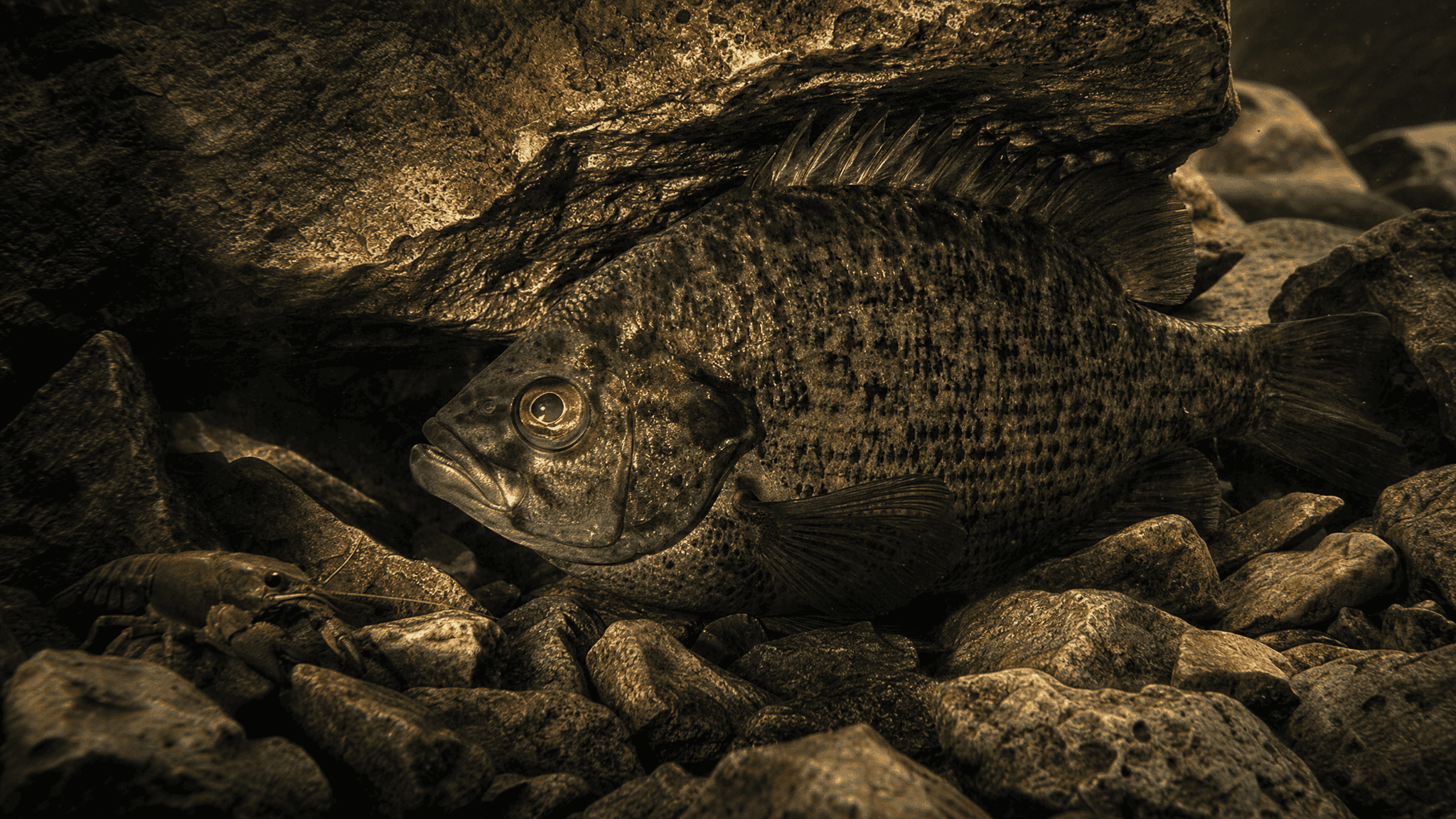
Bass, trout, sunfish, catfish, and a long list of other fish and wildlife. In some systems crayfish aren’t an occasional snack. They’re part of the plumbing.
The bottom matters before the imitation does
Crayfish need places to hide.
Depending on species and water, that can mean cobble, boulders, woody debris, vegetation, bank cover, or burrows. A featureless soft bottom and a rocky shoreline don’t offer the same crayfish habitat.
So before you tie on a craw-colored jig because the package says craw, look down.
Can you see rocks with gaps underneath, or broken riprap? Wood lying on the bottom, or vegetation with hard edges? If you carefully lift a loose shoreline rock where that won’t damage habitat, is anything living under it?
The National Park Service notes that crayfish use places like banks and woody debris and are important food for bass and other animals. Missouri’s conservation department has an even sharper example from its own research: one study found crayfish made up 80 percent of rock bass diets and 75 percent of smallmouth bass diets.
Those numbers belong to that study and won’t carry over to every river. The habitat clue will.
A craw isn’t supposed to hover five feet off bottom
If you’re imitating a crayfish, the presentation starts with where the animal lives.
Jigs, tubes, craw-style soft plastics, and flies can all work. None of them turn into crayfish because they’re brown.
Keep the bait on the bottom, or close enough to it that the movement makes sense. Crawl or hop it, and let it sit around rock. If there’s current, let the current move it instead of making it sprint upstream like it remembered an appointment.
That doesn’t mean slow is automatically right. A frightened crayfish can shoot backward with a tail flip. The movement just needs to belong to the bottom you’re fishing.
Crayfish are almost unfairly good examples of matching the behavior before you match the species.
Rock tells you where the bait can disappear
Smallmouth anglers talk about rock so much that eventually rock starts sounding like a personality trait.
What matters is the gaps.
Cobble and broken rock make hiding spaces for crayfish and other bottom life, and they break up the current too. A fish working that area can get cover and food without traveling very far.
Instead of casting at “the rocky bank,” find the change inside it: big boulders turning to fist-size cobble, rock meeting sand, the downstream side of a riprap point, a shallow shelf dropping into deeper water.
Those edges give predator and prey both something different to do.
Color is real, but it is not the first decision
Crayfish colors vary. Water, species, age, molt stage, and the bottom itself can all change what you see.
That makes exact color matching tempting.
Start simpler. Pick a general natural tone, then worry about whether the bait’s actually down where crayfish live and moving like something a fish could catch. Rough size matters too, but no detail rescues an imitation that’s fishing the wrong part of the water.
Adjust color once the fish give you a reason.
A perfectly matched orange claw dragged six feet above a rock pile is still six feet above the rock pile.
Molting creates a softer target
Crayfish grow by shedding their hard outer shell, and right after a molt the new shell stays soft while it hardens.
That can make a recently molted crayfish more vulnerable.
You don’t need a calendar labeled “soft crayfish week.” Just notice when local crayfish look different from the ones you saw earlier in the season, and when fish seem especially willing to eat a craw.
If you keep a fishing log, that’s worth writing down next to water temperature, level, and location.
Don’t move live crayfish just because the bait shop bucket made it easy
This part has no joke in it.
Crayfish can become invasive when they’re moved outside their native range. Missouri’s conservation department documents cases where bait releases helped spread nonnative crayfish, which can displace native species, damage vegetation, alter food webs, and hurt fisheries. Other states have their own rules on possessing, transporting, and using live crayfish.
Check the regulations for the water you’re fishing before using live crayfish as bait, and don’t release unused live bait into the water. It’s the same habit behind checking the rules for the specific water and Clean, Drain, Dry: what belongs in one water shouldn’t quietly get a ride to the next one.
Missouri’s Don’t Spread Crayfish page is a good look at why agencies take that seriously.
The better question is under the lure
A craw imitation is easy to buy.
The real work is deciding whether the water gives crayfish a reason to be there and gives a predator a way to intercept one. Usually that’s somewhere the bottom changes, like wood actually touching bottom or shallow cobble dropping into a deeper slot.
Then make the lure behave like it came from that place.