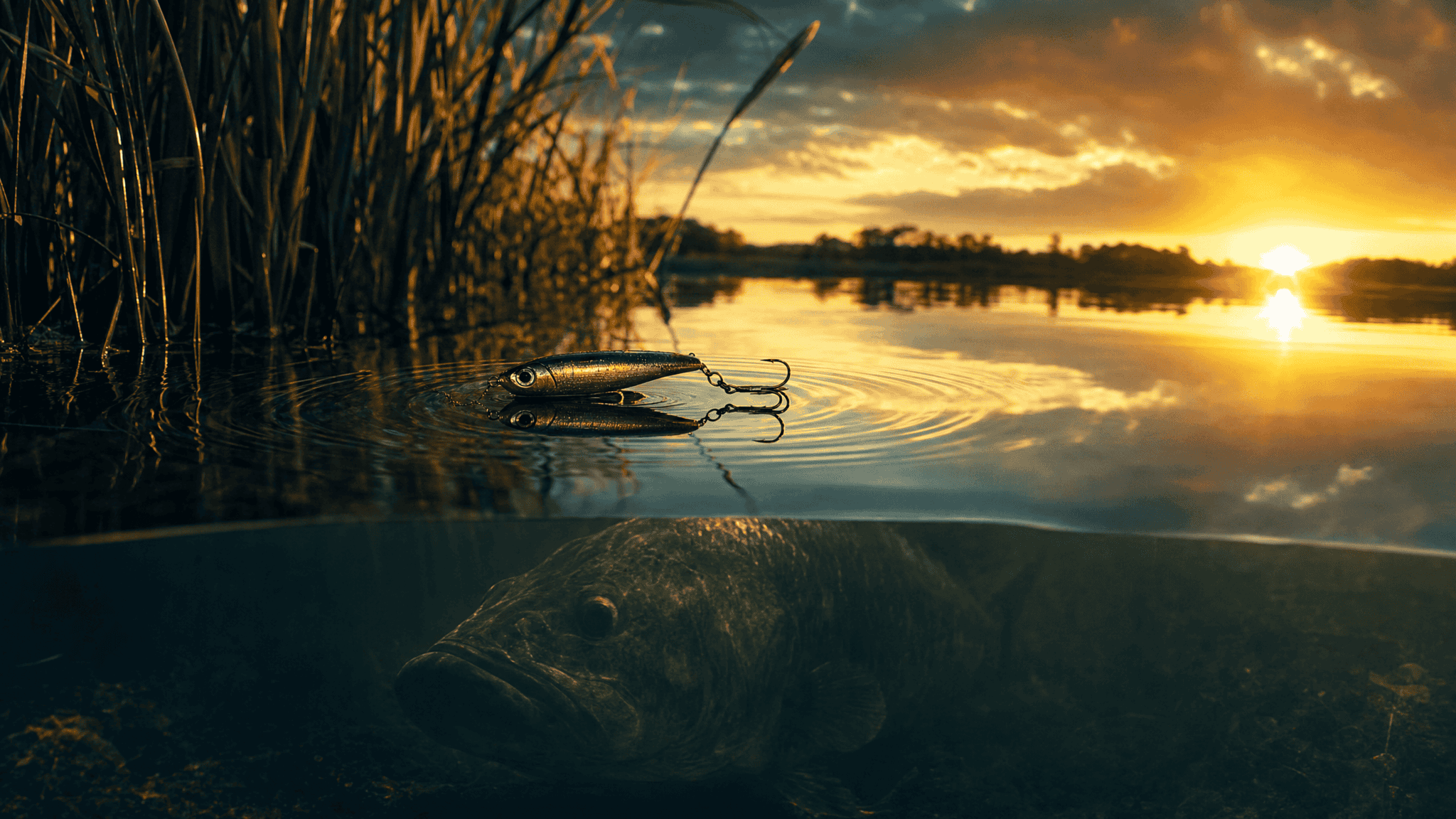
The clock is a lousy way to decide on a topwater. What matters is whether the surface is part of how the bass are feeding right now.
FIELD PLATE · FORAGE
Silhouette and movement beat a confident guess.
Bass can eat on top at dawn, under docks at noon, over grass in bright sun, and on windy afternoons. So start with the water actually in front of you: the light, the chop, the cover, what the bait’s doing, how deep it is, and whether a surface lure can stay under control out there.
Read the surface before you pick the lure
Bait flicking, bugs on the water, wakes, scattered swirls, shade lines, grass mats, shallow cover, the seam where calm water turns into wind-roughed water — any of those is a reason to test the surface. A random shallow bank by itself isn’t.
Low light can help, but it’s not a rule. Dawn, dusk, clouds and shade all make comfortable surface windows. So can wind, overhead cover, weeds, and bait getting pushed around in the middle of the day.
Pick the lure for the job
Walking baits cover open water and long edges efficiently. They earn their spot over points, flats, schooling fish, and outside grass lines, where that side-to-side path can stay in good water the whole way back.
Poppers let you sit on one target longer. Dock corners, laydowns, pockets, shade — small pieces of cover where the pause matters as much as the pop.
Buzzbaits and other moving surface baits cover shallow water fast. They need enough speed to run right, so the line, reel, lure weight and retrieve have to be working together instead of arguing.
Hollow-body frogs crawl across mats and cover that would eat exposed trebles alive. The price is trickier hookups and heavier tackle to drag a fish back out of the salad.
Wind helps right up until it doesn’t
A little chop breaks up the light and moves bait around, and that can work in your favor. Too much bows the line, hides a small lure, makes a walking bait hard to steer, or makes the spot unsafe to fish at all. “Windy” isn’t one condition, so match the lure to the surface you’ve actually got.
A subtle popper that vanishes in chop is close to impossible to fish well. A bigger or louder bait is easier to track, as long as you can still control where it’s going.
Wind Redraws the Fishing Map gets into the bigger wind picture: direction, fetch, exposure, and where to put yourself or the boat because of it.
Water clarity changes how far off you fish
In clear water, fish can spot a surface lure from farther away. They can also spot the boat, you, your line, and the same bad cast landing for the fourth time. Backing off helps, but only if the longer cast still leaves enough line control to work the lure and land the fish once it eats.
In stained water, getting close, silhouette, vibration and sound usually matter more. That doesn’t mean the loudest lure wins. Get the bait near real cover on a path a fish can actually intercept, instead of turning the tackle box into a noise contest.
Fish the edges
Topwaters are especially good at tracing boundaries: an outside grass edge, dock shade, the end of a laydown, a pocket in the reeds, the line where shallow water drops away.
A cast parallel to an edge keeps the bait beside it for most of the retrieve. A cast straight across the same edge might spend three feet in the useful zone and the rest of the trip nowhere. Try a different angle before you try a different lure.
Don’t set the hook at the splash
A topwater strike is pretty much designed to make you do something dumb and immediate. Fish miss, slap, and shove the lure around without ever actually taking it.
With treble-hook baits, wait until the line loads or you feel the fish before sweeping into it. With a hollow-body frog, make sure the fish has the bait and the line’s come tight before you drive the hooks with tackle built for that cover.
Exact timing shifts with distance, rod action, line stretch, lure design, and what that particular fish is doing. The cue worth trusting is weight on the line. The explosion is only the announcement.
Trebles and a thrashing fish
A topwater plug can put several bare hook points right next to a fish that’s still flopping. Keep pliers or forceps where you can reach them, use a proper landing tool, and don’t grab a shaking fish anywhere near loose trebles.
If getting the hook out starts turning unsafe for you or the fish, follow the local fish-care guidance and reach for the right tool, instead of turning the lure into a hand trap.
What the line does to the lure
Surface lures work best when the line isn’t fighting the way the lure is supposed to sit. Monofilament is common because it floats high and has some stretch. Braid floats too and gives you strong control around vegetation, but its low stretch changes how force gets to the hooks and the fish. Fluorocarbon generally sinks and can drag the nose of some surface lures down during a pause.
None of that crowns one line. Build the rod, reel, line and lure around the job — the Gear page goes further into how those pieces depend on each other.
Cadence is worth testing before anything else
If fish follow, swirl, or miss, change the pace before you rebuild the rig. Stretch or shorten the pause, tighten the walk, make each pop smaller, or speed up if they’re chasing.
Keep the spot and the angle about the same long enough to learn whether the cadence change mattered. One missed strike is a clue. It isn’t the whole instruction manual.
When to put it down
Put it away when clean presentations keep getting nothing and the evidence points somewhere else: bait staying under the surface, fish showing up deeper on sonar or where you can see them, wind making the lure uncontrollable, or the useful cover sitting below the top layer entirely.
A topwater is one test of whether fish will come up and eat that day. It’s not a promise to spend the whole morning making noise at nothing.
The first pass through a spot
Pick one edge or piece of shallow cover that gives a fish an actual reason to be there, and make several controlled casts with one surface lure. Repeat the angle that looks useful before you mess with cadence. Follows and misses mean adjusting pace or profile, not abandoning the lane. If the surface stays dead quiet, run something subsurface through the exact same water, since a quiet top doesn’t make it an empty spot.
The hard part is the half second after the blowup, when your whole arm wants to swing. Let the fish finish eating first.