White Marlin: The Rounded Fins Matter More Than the Color
White Marlin identification starts with rounded fins and a spotted dorsal, then shifts to teaser behavior, bait timing, current HMS rules, and a clean in-water release.
By HunterUpdated September 14, 2026Read 10 min
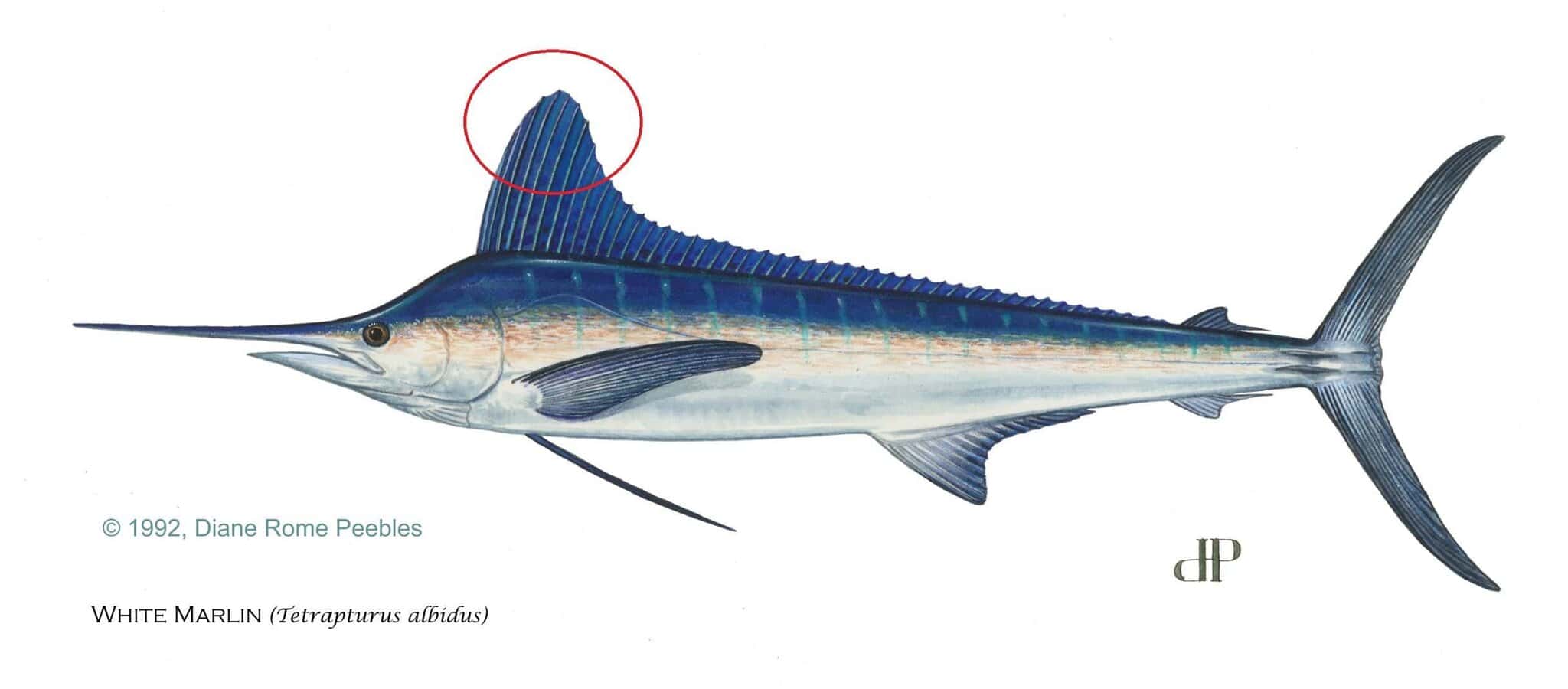
White Marlin identification illustration. Credit: Diane Rome Peebles / Florida Fish and Wildlife Conservation Commission.
White Marlin do not give a crew much time to settle an identification argument. A small billfish appears behind a teaser, its colors change, somebody calls a name, and the next decision is already due. The solution is to move the identification work earlier: know the rounded fins and spotted dorsal, then let the fish’s behavior control the bait.
At a glance · The useful version
I have not watched a White Marlin behind an Atlantic teaser. That distance matters most in the timing details, so this profile keeps the observed biology, legal rules and practical inferences separate instead of borrowing a captain’s memories.
Scientific name
Kajikia albida; older references and the FWC illustration may use Tetrapturus albicans.
Field marks
Rounded tips on the first dorsal, pectoral and first anal fins; a spotted dorsal; curved lateral line.
Main confusion
Juvenile Blue Marlin and Roundscale Spearfish.
Food
Pelagic fishes and squid.
First question
Is this fish tracking the teaser, swiping at it, or ready to eat the replacement?
Atlantic stock
The 2025 assessment classified the stock as overfished but not experiencing overfishing, with important uncertainty.
01 · Identification
Rounded fins beat a remembered weight
The fin pattern
FWC describes rounded tips on the first dorsal, pectoral and first anal fins, plus noticeable dark spots on the dorsal. Blue Marlin carry pointed tips and usually lack those dorsal spots.
White Marlin and Roundscale Spearfish are difficult enough to separate that the federal 250-fish landing cap groups them with Blue Marlin. NOAA’s identification sheet uses scale shape, branchiostegal distance and vent-to-anal-fin distance—details that require a deliberate look.
FWC lists White Marlin as much smaller than the largest Blue Marlin, but size ranges overlap. A small fish does not become White Marlin because the crew expected one.
Photograph useful anatomy
For a released fish, prioritize images of the dorsal, fin tips, flank and lower body while it remains in the water. A distant jump photograph can prove a billfish was present without settling the species.
02 · Life history
Small for a marlin does not mean low consequence
Range
White Marlin range through the Atlantic and Caribbean in offshore water. A regional season is the arrival of suitable water and prey, not a fixed date that repeats perfectly.
FWC documents squid and pelagic fishes and describes the bill being used to stun fast prey before the fish turns to eat. The behavior explains why a slash can happen without a hooked fish.
FWC notes that spawning procedures remain poorly known. A gap in basic life history belongs in the profile because it limits how confidently a fishing pattern can be turned into a biological rule.
Stock context
The latest ICCAT assessment found biomass below the level associated with maximum sustainable yield while fishing mortality was below its threshold. Less current fishing pressure has not yet rebuilt the stock.
Follow the water mass, then look for its busy corner
Warm offshore habitat
White Marlin occupy tropical and temperate Atlantic water. Temperature can define plausible habitat, but it cannot tell you where the prey compressed inside it.
Edges need agreement
A front deserves more attention when color, current, temperature and life line up. If only one instrument changes and the surface stays empty, make a test pass before committing the day.
Surface sign
Billfish, bait showers, low working birds, floating structure and scattered tuna can reveal activity in the upper layer. The absence of birds is not proof of absence if the bait is deeper.
A season moves
Yesterday’s waypoint is useful when it describes yesterday’s water. Carry the pattern forward—edge direction, temperature range, bait depth and current—then relocate it.
04 · Forage
The replacement bait has to make sense beside the teaser
Profile and size
Start with the forage the crew can actually see or mark. A pitch bait that looks unrelated to the available prey may still work, but it begins as the weaker test.
Health is presentation
A live bait that spins, tires or hides beside the boat is reporting its condition. Replace it before blaming the fish; a White Marlin cannot choose a bait it never sees cleanly.
Squid and small pelagics
Documented prey support ballyhoo, small tunas, mackerel-like baits and squid profiles as reasonable regional imitations. Local availability and rules decide what belongs in the well.
If a fish fades, change profile, speed or lane one step at a time. Replacing every bait and teaser together produces activity without an answer.
05 · Search pattern
A readable spread finds more than a crowded one
Field inference. The following is diagnostic fishing logic based on a mobile surface predator. It is not a claim that one spread fits every boat.
Clean water
Each lure or teaser should surface, dive and track consistently in the sea you have. Positions that tumble or cross are failed presentations, even if the color looks perfect.
Give positions jobs
Use close teasers where the crew can read a fish, longer offerings for coverage, and enough separation to clear a pitch path. The goal is to notice behavior, not display the whole lure bag.
Cross the feature
Approach a front or weed edge from more than one angle. The productive side may become obvious only when the boat crosses bait depth, current direction or the clean-water boundary.
Set a move condition
Decide what ends the test before boredom decides for you: no life after a timed pass, bait leaving the sounder, the edge dissolving, or stronger evidence elsewhere.
06 · Teaser handoff
Keep the fish looking at one problem
Call the fish
Name side, distance and behavior. A fish pacing behind the teaser offers time; one slashing across it may require the replacement to appear immediately in the same visual lane.
Withdraw cleanly
The teaser leaves as the bait arrives. If they overlap, the fish can stay with the wrong object or the crew can hook its own gear.
Do not outrun it
The replacement should look alive and vulnerable without sprinting away from the fish. Boat speed, bait condition and the fish’s approach angle decide the motion.
Second chance
After a refusal, keep one controlled bait available while the boat holds a predictable path. A fish may reappear; it is less likely to find the offering if the cockpit becomes a pile of loose line.
07 · Drop-back and circle hook
Line speed is a better clock than a chant
Watch, then feed
A bait that jumps, stalls or accelerates is reporting pressure. Feed line while staying connected to the fish’s direction instead of counting a memorized number.
Circle-hook motion
With a circle hook, let the fish move away and bring the line tight steadily so the hook can turn toward the jaw. A hard sweeping set works against that path.
Tournament requirement
In a registered Atlantic HMS tournament, natural bait or a natural/artificial bait combination requires a non-offset circle hook. Artificial-only presentations follow the hook options in the current federal guide.
If baits return crushed or scaled without line load, shorten the uncertainty: improve sightlines, adjust position or change the handoff timing before making a blind hook change.
08 · Fight
Keep the line angle boring
First run
Let the drag system work while the helm protects line angle. Sudden extra drag after a jump can punish a small hook hole and a leader already touched by the bill.
Use the boat
Shortening the distance with the boat can reduce fight time and keep the fish from settling far down-sea. The angler gains line under pressure instead of trying to lift with a high rod.
Near the leader
White Marlin can change direction quickly beside the hull. Clear feet, keep one leader person, and never wrap line around a hand.
What came loose
After a pulled fish, inspect the hook point, leader abrasion, bait placement and drag setting. ‘It just came off’ throws away the only physical evidence the fish returned.
09 · Release
The photograph stays secondary
In the water
Federal rules require an Atlantic HMS that is not retained to be released immediately without removing it from the water. Build the photo and tagging plan around that boundary.
Gloves, cutters and a dehooker should be placed before lines go out. A hook that cannot be removed safely and quickly can be cut close rather than turned into a long boatside fight.
Recovery evidence
Keep the fish upright with water moving past the gills. Regular ventilation, balance and a firm kick away are more useful release signs than the time someone wants the camera held.
Fight time matters
Use tackle that can apply controlled pressure. The point of lighter tackle is lost if it produces an exhausted fish and a dangerous leader job.
10 · The legal measurement
Sixty-six inches means lower-jaw fork length
LJFL
The federal minimum for White Marlin is 66 inches lower-jaw fork length, measured in a straight line from the tip of the lower jaw to the fork of the tail.
Roundscale Spearfish shares the same 66-inch minimum, but Longbill Spearfish is prohibited. Do not use the shared number as permission to stop identifying the fish.
A retained billfish may be gutted but must come ashore whole with head, fins and bill intact. It cannot be retained if a hammerhead is already aboard or has been offloaded from the vessel.
Blue Marlin, White Marlin and Roundscale Spearfish share an annual U.S. landings limit of 250 fish. Check the live NOAA landings update before a retention decision.
A private vessel fishing recreationally for Atlantic billfish in federal waters needs an HMS Angling permit; an HMS Charter/Headboat permit covers qualifying for-hire operations. Permits are issued to a vessel for the calendar year.
Federal HMS rules can apply to permitted vessels in state waters, while a state may impose more restrictive rules. Check the landing state as well as NOAA.
Report the landing
Every recreational billfish landing must be reported to NOAA within 24 hours through the HMS permit system or another accepted reporting platform. Tournament reporting follows the current guide.
These requirements were checked September 15, 2026. The guide itself warns that rules change frequently; the current permit portal and federal regulations outrank this summary.
12 · Stock truth
The rebuilding signal is real and incomplete
2025 result
ICCAT’s 2025 White Marlin assessment used data through 2023 and classified the stock as overfished but not experiencing overfishing. Its selected model estimated biomass at 0.80 of the benchmark and fishing mortality at 0.19 of the benchmark.
The assessment team found tension between reduced catches since 2012 and abundance indices that still showed declining biomass. It declined to run projections because recruitment and model behavior remained uncertain.
Plan for release, shorten the fight and preserve identification evidence without lifting the fish. Those choices remain useful even when the exact population estimate moves.
No victory language
‘Not experiencing overfishing’ describes the current rate relative to a threshold. It does not mean the population has rebuilt, and the 2025 assessment says it has not.
Keep moving · The family is close
Related profiles and practical handoffs
Blue Marlin — Compare pointed fins, heavier tackle and Atlantic stock status.
Sailfish — Read the sail, pelvic fins and surface behavior.
Striped Marlin — Compare a Pacific species with visible flank bars.
The weakest shortcut here is calling every small Atlantic marlin a White Marlin. I would rather leave one fish cautiously unidentified than teach a rule that collapses Blue Marlin, White Marlin and Roundscale Spearfish when the useful field marks are available.
Profile created 2026-09-15. Verify federal, state and tournament rules for the exact trip before fishing.
White Marlin make restraint useful twice. First, restraint keeps the crew from naming a blur by size. Then it keeps the handoff, fight and release from becoming more complicated than the fish required.
Saltwater & CoastalSurf, shoreline, nearshore, offshore, and deep-sea fishing — technique, gear, and safety content spanning the full range from the beach to blue water.103 articles
Species & BehaviorFish behavior, habitat, depth, forage relationships, and species-specific field decisions. Start with the Freshwater Fish Species field guide.159 articles
Cookie Consent
We use cookies to improve your experience on our site. By using our site, you consent to cookies.
Contains information related to marketing campaigns of the user. These are shared with Google AdWords / Google Ads when the Google Ads and Google Analytics accounts are linked together.
90 days
__utma
ID used to identify users and sessions
2 years after last activity
__utmt
Used to monitor number of Google Analytics server requests
10 minutes
__utmb
Used to distinguish new sessions and visits. This cookie is set when the GA.js javascript library is loaded and there is no existing __utmb cookie. The cookie is updated every time data is sent to the Google Analytics server.
30 minutes after last activity
__utmc
Used only with old Urchin versions of Google Analytics and not with GA.js. Was used to distinguish between new sessions and visits at the end of a session.
End of session (browser)
__utmz
Contains information about the traffic source or campaign that directed user to the website. The cookie is set when the GA.js javascript is loaded and updated when data is sent to the Google Anaytics server
6 months after last activity
__utmv
Contains custom information set by the web developer via the _setCustomVar method in Google Analytics. This cookie is updated every time new data is sent to the Google Analytics server.
2 years after last activity
__utmx
Used to determine whether a user is included in an A / B or Multivariate test.
18 months
_ga
ID used to identify users
2 years
_gali
Used by Google Analytics to determine which links on a page are being clicked
30 seconds
_ga_
ID used to identify users
2 years
_gid
ID used to identify users for 24 hours after last activity
24 hours
_gat
Used to monitor number of Google Analytics server requests when using Google Tag Manager
1 minute
Jetpack's built-in visitor analytics. It records page views, referring sites, search terms, and outbound link clicks, and also carries the shared visitor-tracking library used by Jetpack Instant Search and WooCommerce Analytics.