Western Atlantic ridge-bearing requiem shark dossier · Carcharhinus falciformis
Silky Shark’s useful clue is not the texture of its skin. Look for a small first dorsal set behind the pectoral free rear tip, then confirm the unusually long free rear tip on the second dorsal.
The name is not a field character
The skin can feel smoother than that of some sharks because of small dermal denticles, but touch is a poor and unnecessary identification method. It puts hands near a live prohibited shark and says little in a photograph.
The species is identified by proportions and fin placement. That evidence can be collected while the fish remains in the water.
Confirm the interdorsal ridge
Silky Shark has a low ridge between the dorsal fins. That moves the comparison away from Blacktip, Spinner, and Bull Sharks. Sandbar and Dusky Sharks also have the ridge, so the next landmarks sit at the pectoral and second dorsal.
A wet back can reflect a false line. Look for a continuous raised ridge rather than a color boundary or shadow.
The first dorsal sits conspicuously rearward
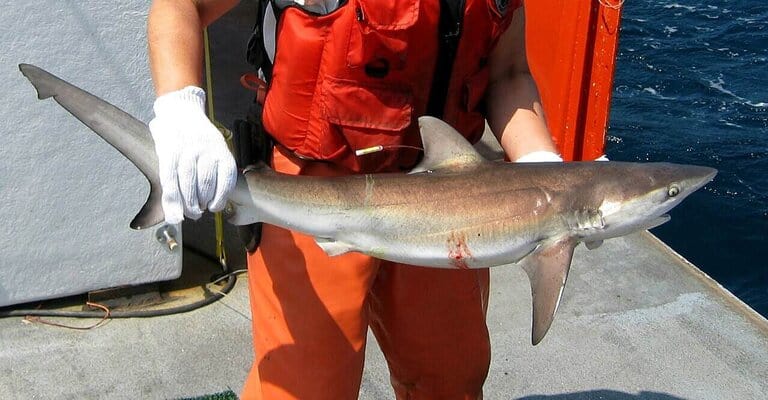
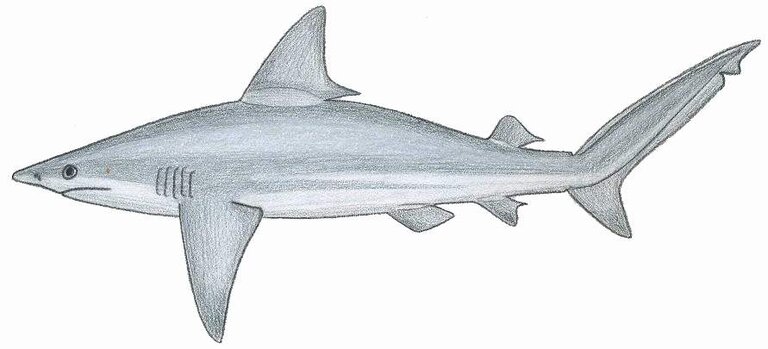
The first dorsal is relatively small and begins behind the pectoral fin’s free rear tip. Among this trio, that is the farthest-back origin. The body ahead of the dorsal can look long and clean.
“Behind” should be visible in the same side view. Comparing landmarks from two different tilted photos can manufacture a relationship that was not there.
The second dorsal carries the confirmation
A Silky Shark’s second dorsal is small but trails into an unusually long free rear tip, more than twice the fin’s height in the FWC comparison used for Dusky Shark. That narrow extension is easy to miss if the tail is cropped.
This clue matters because first-dorsal height alone is subjective. Rearward first dorsal plus long second-dorsal tip gives two separate checks.
The pectorals fit an open-ocean body
The pectoral fins are long and narrow, and the body is streamlined rather than deep through the shoulders. The snout is moderately long and rounded. Color ranges from bronze-gray to dark gray above with a pale underside.
None of those traits is exclusive. They support the dorsal geometry; they do not replace it.
Dusky stops at the pectoral tip
Dusky Shark places the first dorsal origin over the pectoral free rear tip, not behind it. Its second-dorsal free tip is shorter, and large fish often show broader, more falcate pectorals.
When the origin lands on the tip rather than behind it, work through the Dusky Shark profile. Both are prohibited, so a cautious release does not depend on winning a close debate.
Sandbar brings a tall fin forward
Sandbar Shark is the easiest member of the trio when its full side is visible: the first dorsal is much higher and starts over or ahead of the pectoral insertion. The heavier forward body also differs from the Silky’s slimmer outline.
Use the Sandbar Shark profile for the insertion-versus-free-tip distinction. A hidden pectoral base makes size and color poor substitutes.
Open water is part of the evidence
Silky Sharks occupy tropical and subtropical oceanic water, often along shelf edges and around seamounts or other structure that gathers prey. They are strongly associated with tuna schools and drifting objects in many pelagic systems.
Habitat changes probability, not anatomy. Dusky Sharks can range offshore, and a Silky can cross shelf water. The fin landmarks still decide the record.
Young sharks use different water
Juveniles may use more coastal shelf habitat than adults before expanding into oceanic water. That makes age part of the encounter context and helps explain smaller Silkies away from a classic blue-water scene.
It also means a juvenile can enter fisheries that were not directed at pelagic sharks. The response remains quick identification, minimum handling, and release.
Tuna schools create the bycatch problem
Silky Sharks feed on tuna, mackerels, squids, and other pelagic prey. Following the same forage brings them into purse-seine and longline fisheries and into recreational trolling spreads.
A shark behind a hooked tuna is not proof of Silky, but repeated ridge-bearing shark interactions around the same school should change the fishing decision. Move, alter depth, or stop the pattern that is producing prohibited bycatch.
Global movement complicates stock stories
Silky Sharks occur across warm oceans, but genetic and tagging work tests whether those movements connect populations enough to manage them as one. NOAA-hosted genomic research found that broad ocean-basin labels can hide finer population structure.
That is why a global conservation label and a local regulation should not be collapsed into one sentence. The legal answer for a western Atlantic recreational encounter comes from NOAA’s current Atlantic table.
The release plan belongs beside the trolling plan
Keep a dehooker, cutters, gloves, and a clear side ready before a shark reaches the boat. Use tackle capable of ending the fight promptly. Leave the fish in the water, keep the gills submerged, and cut close when safe hook removal would extend handling.
Do not bring the shark aboard to inspect its skin or photograph the second dorsal. Video during the controlled approach can preserve more identification evidence with less restraint.
Current rules remove the retention question
As checked in September 2026, NOAA lists Silky Shark among Atlantic species prohibited from recreational retention. Prohibited sharks must be released with minimal injury and without removal from the water. Florida also prohibits harvest and requires the gills to stay submerged while the fish is controlled.
| Landmark | Silky pattern | If it differs |
|---|---|---|
| Interdorsal ridge | Present | No ridge: leave this trio |
| First dorsal origin | Behind pectoral free rear tip | Over tip: compare Dusky |
| First dorsal height | Small to moderate | Very high and forward: compare Sandbar |
| Second dorsal free tip | Exceptionally long | Shorter: species unresolved or Dusky |
Primary references and nearby records
NOAA’s live Atlantic shark table supplies current federal status and release language. The 2026 HMS Recreational Compliance Guide covers permits, circle-hook rules, and handling. FWC’s prohibited-shark page supplies Florida’s list and in-water requirement. FWC’s Dusky Shark profile provides the explicit Dusky–Silky fin comparison. NOAA’s silky-shark genomics paper supports the population-structure caution.
Complete the ridge-bearing trio with Sandbar Shark and Dusky Shark. For pelagic context, compare Blackfin Tuna, Wahoo, and Blue Marlin.
My stopping rule is two-part: the first dorsal has to begin behind the pectoral free rear tip, and the second dorsal needs the long trailing extension. Without both, the shark stays unresolved and goes back immediately.