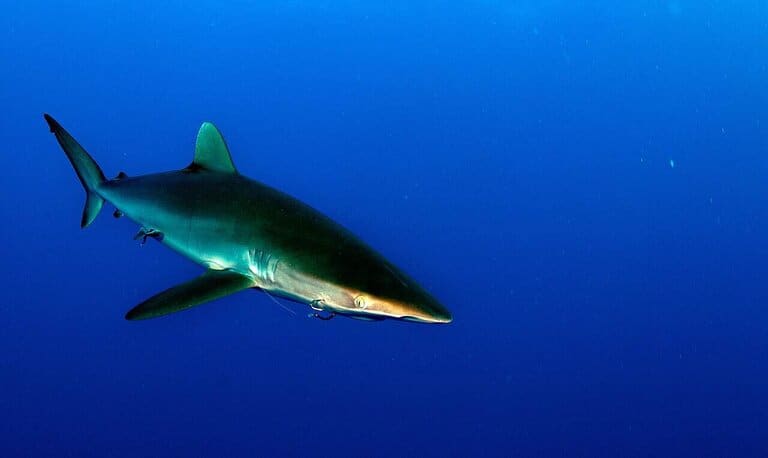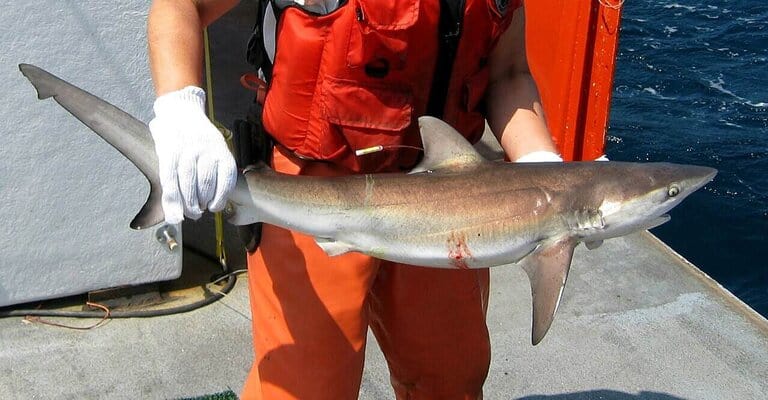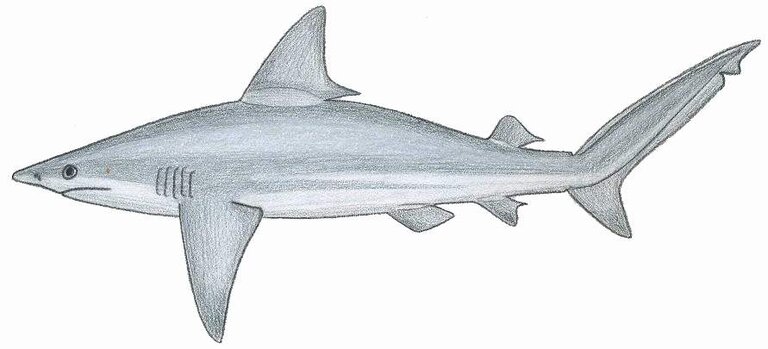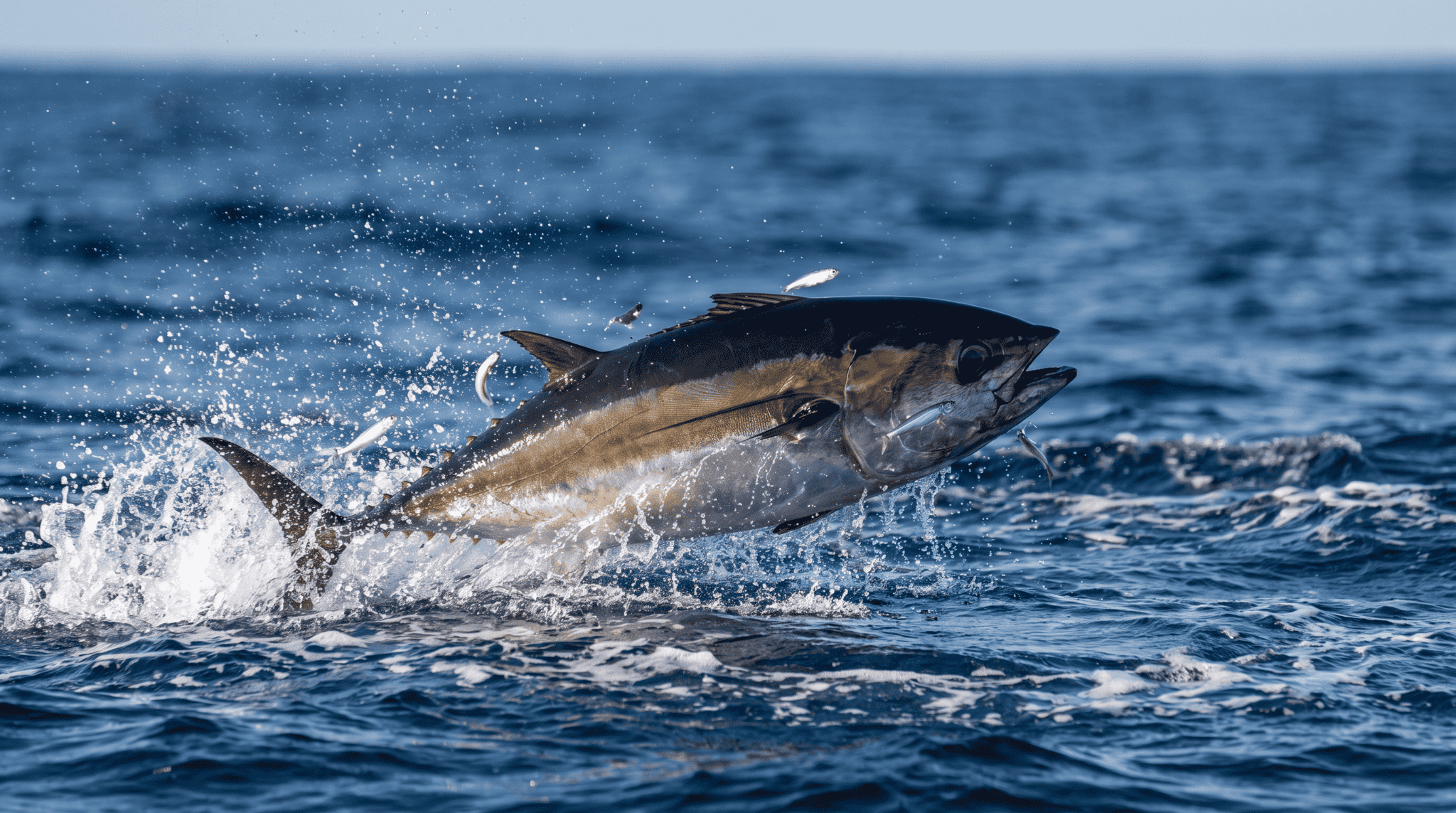
Range: Warm western Atlantic from Brazil to Cape Cod, including the Caribbean and Gulf
Best clues: Uniformly dusky finlets with pale edges, dusky second dorsal, bronze side band, and no greatly elongated dorsal or anal fin
Core water: Coastal-to-offshore warm water, reef and drop-off edges, current seams, bait schools, and near-surface feeding zones
Fishing problem: Identifying the tuna inside a mixed school, then matching a presentation to the prey size and depth
Management reality: Blackfin are not one of NOAA’s federally managed Atlantic HMS tunas, but Florida has a specific recreational limit
Blackfin Tuna are often introduced as “the smallest true tuna” and immediately buried under claims about how hard they fight. The useful question arrives sooner: which tuna just ate? Blackfin can feed with skipjack, and a small yellowfin can enter the same conversation. Until somebody checks the finlets, dorsal fins, pectorals, and body pattern, the school is only “tuna.” The identification controls both the rule and what the next presentation should imitate.
01. Start with the finlets, not the fish’s size
Blackfin Tuna have a dark blue-black back, silvery lower sides, a pale belly, and often a bronze band along the flank. The second dorsal and anal fins are not dramatically elongated. The finlets are uniformly dusky with pale or white margins, rather than the bright yellow finlets of Yellowfin Tuna. The second dorsal is also dusky.
FWC describes the pectoral fin as long enough to nearly reach below the beginning of the second dorsal. That clue requires the fin to lie naturally against the body. A folded or damaged pectoral creates a false comparison. Use several external traits before considering internal characters. Photograph the side, finlets, second dorsal, and pectoral position while the fish is controlled and still has color.
02. Mixed schools make look-alikes a practical problem
NOAA’s western Atlantic tuna guide notes that Blackfin can school with Skipjack Tuna. Skipjack show dark horizontal stripes low on the body; Blackfin do not. Yellowfin have much brighter yellow finlets and may develop long second dorsal and anal fins, although juveniles will not carry the exaggerated adult shape. Atlantic Bonito show angled dark stripes across the upper back and are not a Thunnus tuna.
Bluefin Tuna have much shorter pectorals relative to the second dorsal origin and grow vastly larger. Bigeye identification can require internal characters and careful proportions, but ordinary Blackfin size and dark finlets usually move the comparison elsewhere. Never identify a school solely from birds, surface splashes, or the captain’s expectation. Put the first fish on a wet measuring surface and finish the call before retention.
Keep a simple deck sequence: dark or yellow finlets, pectoral reach, dorsal and anal shape, then flank markings. Size comes last because juveniles overlap. If the external clues disagree, release the fish and photograph what made the identification uncertain. That record is more useful than forcing a confident name onto a moving target.
03. This tuna belongs to the western Atlantic
Thunnus atlanticus ranges from Brazil north to Cape Cod through the Caribbean and Gulf. It is a warm-water tuna rather than a global species with one identical seasonal pattern everywhere. FWC describes it from coastal to offshore water. That range lets anglers encounter Blackfin along reefs and drop-offs without making the very long canyon runs associated with some larger tunas.
Spawning timing varies regionally. NOAA’s identification synthesis describes a long Florida season from spring into fall with a May peak and a roughly June-through-September Gulf window. Those are broad biological summaries, not exact annual forecasts or fishing seasons. Offshore spawning and moving water make local presence dependent on more than the calendar.
04. Surface chaos has a structure
A tuna blitz looks random from a distance. Up close, bait is usually being compressed against something: the surface, a current seam, a depth change, a weed edge, another predator group, or a moving water boundary. Birds reveal different parts of the event. Tight diving birds may be reaching bait driven near the surface; high traveling birds may only be commuting. Scattered picking can mark tiny prey rather than a large bait ball.
Approach from outside and watch before charging through the center. Note the direction in which the school reforms after each burst. If the fish repeatedly surface ahead of the boat, intercept that line at idle or casting speed. If the school stays deep and only birds show, use the sounder to find the bait layer. The goal is to place a bait or lure at the front or edge of the feeding movement, not where the last splash disappeared.
05. Match the prey before changing every color
Blackfin eat small fishes, crustaceans, squid, and other pelagic prey. That breadth explains why one school may attack compact baitfish profiles while another ignores them for tiny jigs or flies. Look at what the birds carry, what bait spits from a hooked fish, and what appears under the boat. “Tuna lure” is not a forage size.
When tuna refuse a normal trolling feather or casting jig, reduce the silhouette before assuming they have stopped feeding. Shorten the lure, reduce hook bulk, or use a small bait behind a modest leader. When larger flying fish or robust bait dominates, a larger presentation may hold up better at speed. Keep the hook gap exposed. An exact color match wrapped around the hook point is still a bad rig.
06. Trolling should locate the school, then get out of its way
A small spread can search current edges, reef contours, color changes, weed lines, and open-water bird lanes. Give lines different jobs: a short active lure, a longer subtle presentation, and one deeper option when marks sit below the surface. Watch each lure beside the boat, then watch again in turns. The inside lure slows and sinks while the outside lure accelerates.
After a strike, mark the track and note direction, lure, setback, and water feature. If tuna begin surfacing, clearing the trolling spread and switching to casting may produce cleaner presentations and fewer crossed lines. Repeatedly driving over a compact school can put it down. Circle outside the action and re-enter along the fish’s movement rather than through its center.
07. Casting is an interception, not a distance contest
Long casts help only when they land where the tuna will be. Read the leading edge of the school and place the lure beyond or beside it, then retrieve through the feeding path. A lure dropped on top of the tightest splash may scatter bait and start behind the fish by the time it sinks.
Retrieve speed should keep the lure in the prey layer. A surface-feeding school may respond to a fast horizontal retrieve, while marks twenty feet down may require a counted sink before the first turn. If strikes occur after a pause, repeat the pause depth. If followers turn away beside the boat, change angle or size before assuming leader visibility is the entire problem.
08. Chum and live bait can hold fish without anchoring them
Chumming may pull Blackfin into a repeatable line, but it also attracts sharks and can turn the crew into a bait-delivery system with little control over species. Start with a measured stream. Watch how quickly pieces sink and whether tuna appear at the surface or only on the sounder. Feed enough to maintain interest without burying the hooked bait inside a cloud of free meals.
A live bait should move naturally in the same line. Hook placement must support breathing and the intended direction. If the bait races to the boat or spins, change placement or replace it. Free-line when the current carries the bait correctly; add only enough weight to reach fish holding deeper. Keep one outfit ready for a fish that rises while another works the marked layer.
09. Vertical jigs belong below the birds
When surface activity stops but bait and tuna marks remain, a compact jig can continue the search vertically. Drop to a measured depth rather than automatically to bottom. Count the descent or use color-marked line, then work through the upper edge of the marks. Blackfin may strike on the fall, during a short lift, or as the jig accelerates away.
A strike on descent should change the next drop. Engage slightly above that depth and keep the lure in the zone longer. If every hookup ends with a shark interception, moving is the responsible adjustment. Faster retrieval alone may not solve predators waiting under a repeatedly fed school.
10. The fight is a pressure-and-angle problem
Set drag before the first cast and confirm that it starts smoothly. Blackfin may be smaller than Yellowfin or Bluefin, but a compact tuna can sustain pressure and change direction quickly. Let the first run happen under controlled drag, then gain line with the rod at a working angle. High-sticking a circling fish beside the boat loads the weakest part of the rod.
Follow the circle and keep the fish away from running gear. When the tuna turns broadside, use steady lift rather than a sudden yank. Prepare the net or leader-handling plan before color. If releasing, avoid exhausting it simply to prove tackle is light. If retaining, the landing team should already know where the fish is going after it clears the rail.
11. Tuna quality is a clock
Tuna remain warm and metabolically active after a hard fight. For retention, dispatch the fish humanely, bleed it safely where lawful, and chill the body rapidly. An ice slurry cools more surface than a few cubes beneath the fish. Gutting rules and offshore cleaning restrictions vary, so verify what may be removed before landing.
Time-temperature abuse in tuna and other scombroids can allow histamine to form; cooking does not reliably remove that hazard. Keep the cold chain intact from deck to kitchen. For release, minimize air exposure, support the fish horizontally, and return it to moving water promptly. A fish too exhausted to hold orientation needs more careful recovery, not a longer photograph.
12. Blackfin are not a small Yellowfin for regulation purposes
Regulation snapshot checked September 15, 2026: Florida listed no minimum size, a recreational limit of two Blackfin Tuna per person or ten per vessel—whichever is greater—and an open year-round season. The same live page stated that a federal HMS Angling Permit was not required for Blackfin in state or federal water. Those are Florida landing rules, not a universal western Atlantic rule.
Use the current FWC billfish and tuna regulations page before fishing or landing in Florida. If a mixed school includes Yellowfin, Bigeye, Skipjack, Albacore, or Bluefin, federal HMS permit, size, reporting, and retention requirements may apply to those fish even though the Blackfin line is different. Verify the species first, then the water, vessel, landing state, and permit.
13. Let the miss narrow the problem
- Fish splash but ignore normal lures: inspect prey size and reduce profile before changing every color.
- Birds move but never dive: they may be traveling; find bait or repeated surface pressure before committing.
- One pass works in a turn: reproduce the inside-versus-outside speed and depth change.
- School disappears after the boat crosses it: widen the approach and intercept from outside.
- Marks remain after surface activity stops: count a jig or weighted bait to the marked depth.
- Fish breaks near the boat: inspect leader abrasion, rod angle, drag increase, and contact with the hull.
- Every hooked fish is taken by sharks: stop feeding the pattern and relocate.
- Identity is uncertain: keep the fish wet, photograph the finlets and fins, and do not guess the rule.
14. Family resemblance should lead to better questions
Wahoo share offshore edges but add cutting teeth, a long-barred silhouette, and a spread built around interception speed. King Mackerel move the tooth-and-leader tradeoff into coastal migration corridors. Mahi-Mahi can appear around the same floating structure, but the fish’s stronger relationship to debris changes how long an object remains worth working.
- NOAA Fisheries — Guide to Tunas of the Western Atlantic Ocean
- Florida FWC — Blackfin Tuna identification, habitat, and diet
- Florida FWC — live billfish and tuna regulations
- FDA — scombrotoxin and temperature-control guidance
Identification, biology, food-safety guidance, and regulation links were reviewed September 15, 2026. Live agency rules control.