Range: Western Atlantic from Massachusetts to Brazil, including the Caribbean and Gulf
Best clues: Sharply dipping lateral line below the second dorsal, gray front dorsal fin, and usually clean silver sides on adults
Core water: Warm coastal pelagic water, generally over the continental shelf and wherever bait collects
Fishing problem: Keeping a bait natural while building enough cut resistance for a fish with real teeth
Management reality: South Atlantic, Gulf, and Puerto Rico management units are not interchangeable
The first king-mackerel lesson is usually expensive and extremely short: the line goes tight, something accelerates, and the leader returns with no hook attached. That does not prove every bait needs a cable. It proves teeth touched the connection. King fishing is a series of controlled trades—visibility against cut resistance, speed against bait condition, early pressure against pulled hooks, and one remembered waypoint against the bait and water that exist today.
01. Read the lateral line before you read the spots
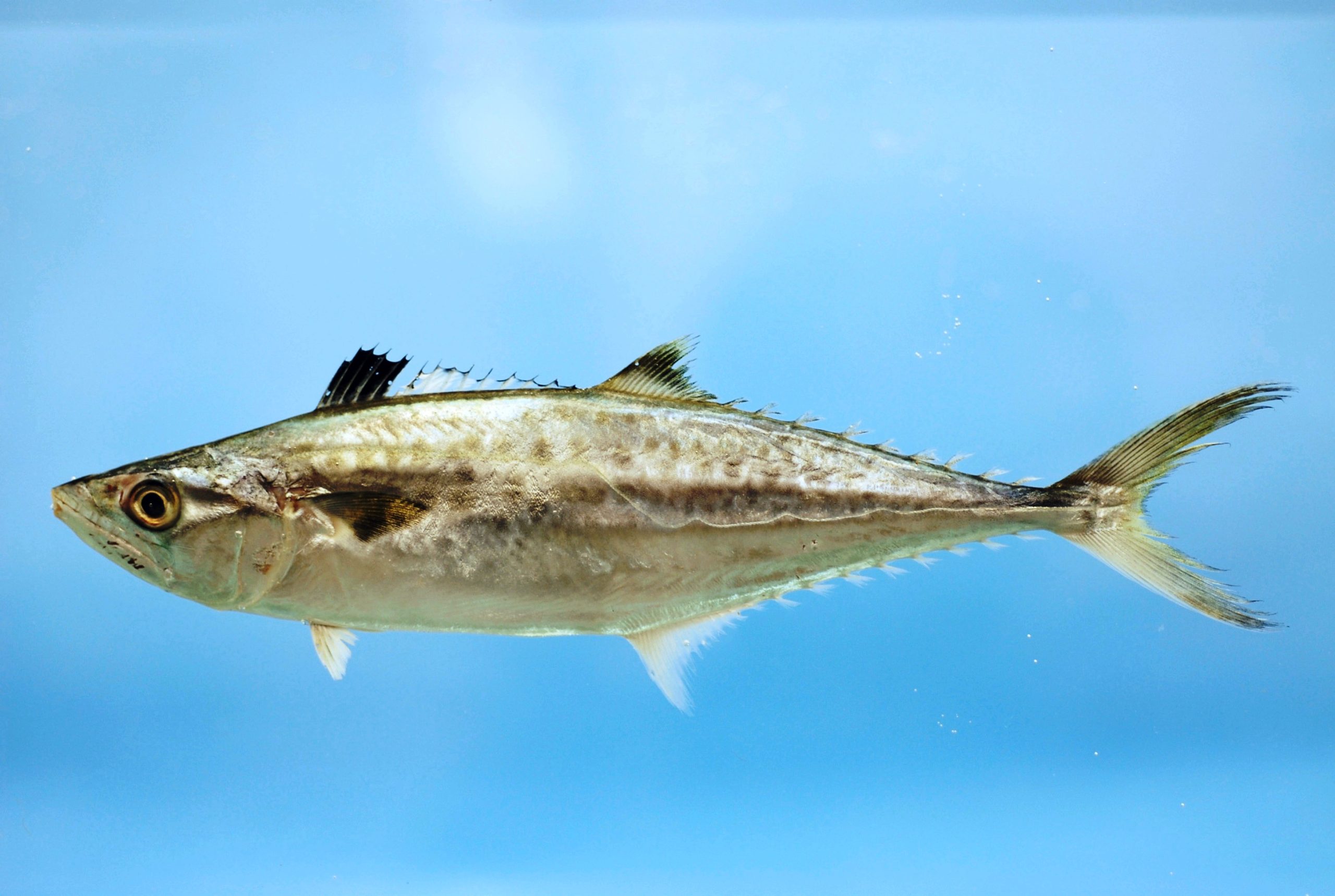
Adult King Mackerel are iron-gray or bluish-green above and silver along the sides and belly. The most dependable visible clue is the lateral line: it runs high along the front half, then drops sharply below the second dorsal fin. The front of the first dorsal is gray rather than carrying the dark blotch typical of Spanish Mackerel. The body is long and powerful, with a deeply forked tail, narrow caudal peduncle, finlets, and a mouth lined with cutting teeth.
Juvenile kings complicate the easy rule because they can carry yellowish spots. That is why “spots mean Spanish” fails. On a small fish, check the sharp lateral-line drop and the first dorsal together. Spanish Mackerel keep a gently sloping lateral line and a dark patch at the front of the first dorsal. Cero add a strong mid-side stripe. Wahoo are longer and more torpedo-shaped, with a much longer first dorsal and vertical bars. Make the call before applying a size or bag rule.
02. Migration follows warm water and food
NOAA describes King Mackerel as warm-water coastal pelagics that seldom enter water below about 68°F. They move north during warmer seasons and south during cooler ones, following temperature and forage. Reefs, piers, inlets, wrecks, and shelf edges matter because they interrupt current or hold prey; they are gathering places, not permanent addresses.
The South Atlantic and Gulf groups overlap in a winter mixing zone south of the Florida Keys between November and March. That biological overlap does not erase the management boundary. Log the date, location, water temperature, current, bait type, and strike depth. A waypoint alone records where the boat was. The other details record why a king was there.
03. Fast growth does not mean disposable fish
King Mackerel grow quickly, can exceed five feet, and may live more than twenty years. NOAA reports maturity around age two and spawning along the outer continental shelf from May through October. Females grow much larger than males and may release from tens of thousands to several million eggs. A very large king is therefore not simply an average fish that kept eating.
Spawning occurs in open water; there is no nest to find or defend. Regional timing and migration overlap, so a warm-season run may include fish at different reproductive stages. Avoid converting a broad May–October federal summary into one guaranteed local peak. Water, latitude, and forage move the useful window.
04. Find the meal before choosing the lure
King Mackerel eat fishes, squid, and shrimp. Menhaden, sardines, anchovies, cigar minnows, threadfin herring, blue runners, and smaller mackerels can all matter by region. The practical task is not memorizing a king’s menu. It is identifying what is abundant, what depth it holds, and whether predators are forcing it into a vulnerable shape.
Look for nervous surface bait, birds that repeatedly work the same line, bait stacked over relief, an inlet plume, a clean color edge, or a school stretched along a temperature boundary. Scattered bait with no pressure calls for a search presentation. Tight bait balls, showering fish, or clean predator marks call for a precise pass. If the bait vanishes, the reason for fishing the waypoint may have vanished with it.
Use two passes before declaring a zone empty. On the first, map the bait height and current direction. On the second, put one surface presentation, one mid-depth bait, and one deeper line through the same piece of water. If only the deep line is marked or struck, move the rest of the spread deliberately instead of calling the lure color magical. When bait is spread from top to bottom, hunt the compressed end of the school—the edge against current, temperature, or structure where a predator can attack efficiently.
05. A live bait has to survive the assignment
Slow-trolled live bait is useful because it can show its own distress and stay in a narrow depth band. Hook placement should let the bait breathe and swim without spinning. A nose or bridle presentation tracks differently from a back-hooked bait; neither is universally correct. Match it to speed, current, and whether the bait needs to stay near the surface or work lower.
Watch each bait before sending it out. A bait that rolls beside the boat will not improve fifty yards back. Separate lines by distance and depth, and keep one bait where the sounder says fish or forage are holding rather than putting the entire spread in the prop wash. Replace a tired bait before it becomes a beautifully rigged dead weight.
06. The leader question is a probability question
FWC fishing guidance allows for wire or monofilament leader, which is more honest than the dockside claim that one material always wins. Wire raises cut resistance but can change visibility and bait movement. Heavy mono or fluorocarbon is less conspicuous and easier to rig, but a tooth crossing it at the wrong angle can end the encounter instantly.
Start with the actual failure. Clean diagonal cuts justify more bite protection. Frayed leader points to abrasion or hardware. Open hooks, failed crimps, and knots broken away from the mouth are different problems. Keep the bite section short enough that it does not overpower a small bait, and inspect every connection after a strike. Use a stinger hook only when short strikes on the rear of a bait are recurring and when the rig is legal for the bait and jurisdiction.
07. Troll the water, not the speedometer
A productive trolling speed is the speed at which the chosen bait or lure works cleanly in the current and sea state. Natural baits usually demand more restraint than high-speed lures. Watch the presentation beside the boat, then check it again after a turn. The inside line slows and sinks; the outside line speeds up and rises. A spread that looked perfect in a straight line can collapse in a corner.
Build passes that answer questions. Cross the up-current face of a reef, then run the down-current bait line. Work the clean side of a color change, then the mixed edge. When a strike happens, note the lure, setback, direction, depth, and whether the boat was accelerating or turning. Circle wide enough to avoid driving through the school or tangling the remaining lines.
08. Casting and drifting belong in the system too
When kings show around a pier, inlet, reef, or concentrated bait school, casting a metal jig, spoon, plug, or live bait can cover the strike zone without dragging a full trolling spread through it. Cast beyond the activity and retrieve through the edge. A lure landing in the center of a tight bait ball can scatter the evidence you were trying to fish.
Drifting a bait can be quieter than trolling, especially in clear or pressured water. Control depth with bait placement, small weights, or line angle. If one bait is consistently cut while another is ignored, record the depth difference before changing every leader. The bite may be telling you where the fish are, not which brand of wire to buy.
09. Let the rig decide the hook-set
A king may slash, miss, return, or take a bait and accelerate without pausing. With a circle-hook live-bait rig, wind steadily into pressure instead of swinging immediately. With a lure and conventional J-hook, the moving boat and fish may already create all the load required. The universal command to “never set” or “always hit it” ignores the hook and presentation.
Set the drag before deploying. The first run is the wrong time to discover a sticky spool. Too much initial drag can straighten hardware or tear a hook free; too little can empty line and let a fish cross the spread. Clear threatened rods, keep the boat moving only as needed to maintain control, and communicate before anyone changes course.
10. The fish can still win beside the boat
King Mackerel often arrive at the rail with enough energy for another run. Leave the reel in a usable drag setting until the fish is controlled. Keep hands away from the mouth and use long pliers. If retaining the fish, decide who leads and who gaffs before it reaches color; a late conversation produces crossed hands, loose hooks, and a green fish on deck.
For release, keep the fish in the water when practical, remove or cut the hook quickly, and support it horizontally if lifting is unavoidable. Do not suspend a large king by the jaw. Point the head into clean moving water until the fish maintains balance and kicks away. If sharks are taking hooked or released kings, leaving the spot is a handling decision, not a failure of patience.
11. Fish care starts before the bite
King Mackerel flesh benefits from immediate chilling. If retaining one, dispatch it humanely, bleed it where lawful and safe, and get it into an ice slurry rather than leaving it warm on deck. Keep knives and the landing zone separate from loose wire and treble hooks. The same organized station that protects the fish protects the crew.
King Mackerel also carry an important consumption advisory. FDA and EPA place king mackerel in the “Choices to Avoid” category for people who are or might become pregnant, are breastfeeding, or are feeding young children because of mercury. Local advisories can be more specific. A legal fish is not automatically the right meal for every person.
12. Current management depends on which king you met
Regulation snapshot checked September 15, 2026: NOAA currently lists the South Atlantic and Gulf stocks as not overfished and not subject to overfishing under their latest assessments. The Puerto Rico mackerels complex has not been assessed, so its population level is unknown, though the complex was not subject to overfishing under the cited catch data. Do not compress those three statements into “king mackerel are fine everywhere.”
Check the NOAA King Mackerel hub, then the current council and landing-state rules. Size, bag, season, zone, vessel type, permit, possession, and whole-fish requirements can differ. Commercial quota status is not a recreational season notice. Closures may occur when a quota is reached, and the winter mixing zone makes guessing the management unit especially risky.
13. Use the failure to choose the next move
- Clean cut above the hook: increase or lengthen bite protection, then check whether the bait still swims correctly.
- Bait spins: correct hook placement, slow down, or trim the bait before changing the whole spread.
- Rear half missing: shorten the bait or test a legal stinger arrangement.
- Only one corner gets bit: note whether that line changed speed or crossed a depth seam during the turn.
- Small kings but no large marks: finding juveniles proves suitable water and forage, not that larger fish sit directly underneath.
- Repeated pulled hooks: inspect drag startup, rod angle, hook gap, and how quickly pressure is applied.
- Nothing after yesterday’s limit: rebuild the water-temperature-and-bait picture instead of defending the old coordinate.
14. Follow the family, then check the source
Compare juvenile kings with Spanish Mackerel before relying on spots. Wahoo move the tooth-and-leader problem farther offshore and add a very different silhouette. Blackfin Tuna remove the cutting teeth but make mixed-school identification and bait-size matching more important.
- NOAA Fisheries — King Mackerel biology, stocks, habitat, migration, and management
- Florida FWC — King Mackerel identification and regional biology
- NOAA Fisheries — Making Sense of Mackerel management boundaries
- FDA/EPA — current fish-consumption advice
Biology, stock language, safety guidance, and regulatory gateways were reviewed September 15, 2026. Live agency notices control.
FIELD OBJECT
This one should leave the page.
The article is the long version. These are the pieces worth carrying into the next trip.
The 30-second version
Wire or mono is the king mackerel argument that never ends, and the teeth behind it are real. The honest answer is a tradeoff between how the bait looks and how often you get cut off. Check the lateral line before you call a small one a Spanish.
What to watch
- 01. Read the lateral line before you read the spots
- 02. Migration follows warm water and food
- 03. Fast growth does not mean disposable fish
- 04. Find the meal before choosing the lure
Field card
- Clean cut above the hook: increase or lengthen bite protection, then check whether the bait still swims correctly.
- Bait spins: correct hook placement, slow down, or trim the bait before changing the whole spread.
- Rear half missing: shorten the bait or test a legal stinger arrangement.
- Only one corner gets bit: note whether that line changed speed or crossed a depth seam during the turn.
- Small kings but no large marks: finding juveniles proves suitable water and forage, not that larger fish sit directly underneath.
RIGHT TOOL, NEXT
Tackle Link Analyst
Follow the load path and find the part of the setup that actually limits the rest.