Spanish mackerel usually leave right about when you finish tying on. The lateral line separates them from a small king better than the spots do, and the teeth make leader material a real argument.
By HunterUpdated September 12, 2026Read 6 min
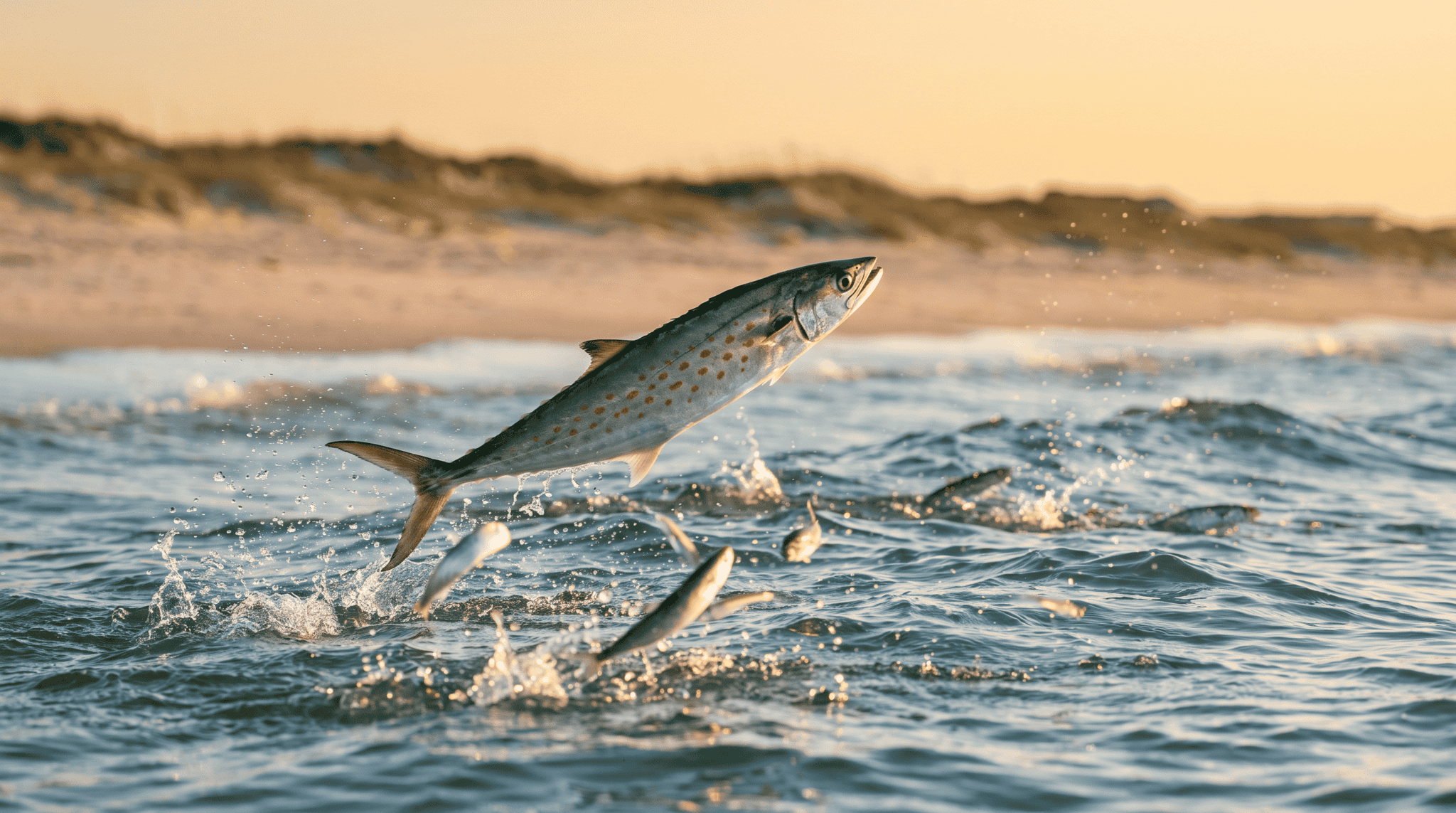
Image: leaping with the school
A school of Spanish mackerel can cross the water in front of you and be gone before you’ve decided which lure to tie on. Just about every account of this fish says some version of that. Scomberomorus maculatus grows fast, follows warm water and bait, and gives itself away with birds and spray. It also carries enough teeth that leader choice turns into a real tradeoff instead of a tackle-counter opinion.
At a glance · The short version
Scientific name
Scomberomorus maculatus
Spanish vs king
Spanish: golden spots, black blotch on front of first dorsal, gently sloping lateral line. King: sharply dropping lateral line; adult kings usually lose spots.
Temperature clue
FWC: northward migration in spring and retreat south as water drops below about 70°F.
Life history
Fast-growing; reproduce by about age 2; NOAA lists lifespan to about 12 years.
Small kings are the identification trap
Identification
Golden spots
Spanish mackerel carry irregular yellow-gold spots over silver sides. FWC and NOAA both use those spots as a primary field character, but juvenile king mackerel can also show spots. The spot pattern therefore starts the call rather than finishing it.
On Spanish mackerel the lateral line slopes gradually toward the tail. On king mackerel it takes a much sharper dive below the second dorsal. That line is one of the most useful separators when both fish are spotted and similar in size.
Cero mackerel can share the same Florida water. FWC separates cero by a yellow-gold stripe along the side rather than only isolated spots. Geography, stripe pattern and lateral line should all be checked before a small mackerel goes in the cooler.
Spanish mackerel use inshore, nearshore and offshore coastal water, frequently over reefs and grass beds in Florida. NOAA manages separate Atlantic and Gulf migratory groups because the fishery moves across broad coastal regions instead of living on one fixed reef.
FWC describes schools migrating north in spring and returning south when water temperature drops below about 70°F. That number is a useful Florida-oriented movement clue, not a coastwide magic bite temperature. Bait and local water masses still decide where the fish actually concentrate.
A productive point can go empty without anything being wrong with the structure. If the warm-water edge and the forage move, the school goes with them. A waypoint is a record of what the water was doing that day, not a permanent Spanish-mackerel address.
Fast growth and open-water spawning
Life History & Reproduction
Growth and lifespan
NOAA describes Spanish mackerel as fast-growing, reaching roughly 13 pounds and living up to about 12 years. They can reproduce by age two. That replacement schedule is much faster than the reef fish and sharks elsewhere in this guide, but it still depends on catch limits and successful year classes.
FWC describes offshore spawning from spring through summer. NOAA’s management material separates Gulf and Atlantic stocks and applies annual catch limits to both. Regional spawning schedules don’t collapse into one universal date.
FWC lists small fish and invertebrates. The diet explains why little spoons, jigs and baitfish-sized presentations belong in the conversation, but prey size should come from what is actually being chased rather than from a fixed lure chart.
FWC recommends watching for birds diving on bait that mackerel are driving to the surface. Terns dipping, bait showering, one rough patch in otherwise calm water: any of those says the feeding is happening up top, right now.
Evidence level. The moving-school and leader material below is reasoned from the biology above and from what other anglers report, not from time spent watching one break the surface myself. The life history above is agency-sourced, and the two evidence layers stay separate.
Cast ahead of the boilinference
A boil is where the school was, not where it is. If the bait is moving left, the smarter cast lands left of the last surface eruption, ahead of where the school is going. Chasing yesterday’s splash with every cast is how a fast school stays thirty yards ahead of the boat all morning.
Speed before colorinference
Small bright metal and slim jigs work because they can be moved fast and stay in the bait-size range. When a school follows but does not commit, retrieve speed is the first thing worth changing, before rebuilding the entire lure decision. “Slow always fails” is too absolute; the better rule is testing speed against the behavior actually visible on the surface.
Leader is a tradeoff, not a religioninference + sourced
FWC recommends heavy mono leader because of the teeth. Short light wire is the usual answer once bite-offs get expensive. Wire adds cut resistance and visibility/stiffness. Mono or fluorocarbon presents more naturally but is not tooth-proof. The call comes down to water clarity, lure value and the actual bite-off rate, not one material declared mandatory everywhere.
When a school disappears, the direction it was traveling and the tide stage are worth logging. If it reappears on the same edge during the same phase, that pattern is more useful than remembering only the lure.
Teeth change the release routine
Handling
Pliers before fingers
Spanish mackerel are smaller than kings but use the same basic cutting hardware. Control the fish and use pliers for hook removal. A lure with exposed trebles plus a toothy fish is a two-part handling hazard.
Fast fish need fast release
If the fish is not being retained, keep air exposure short and avoid turning a moving school into a long deck-photo session. The next fish will probably appear before the camera routine is finished anyway.
Not established here
What this profile will not claim
one universal leader material
that every slow retrieve fails
that 70°F is a coastwide bite switch rather than a Florida movement clue
that spots alone distinguish every juvenile Spanish from every juvenile king
that a school will return to the same point simply because it did once
The first time a school blows up and then vanishes the second your lure lands, it’s easy to decide you spooked it. Probably not. Those fish were leaving anyway, and the next cast just needs to land where they’re headed instead of where they were.
— · Sources
FEEDING ECOLOGY · STANDARDIZED
How this fish gets fed.
Primary prey
Anchovies, sardines, menhaden and other small schooling fishes dominate, with shrimp, squid and other small pelagic prey also taken.
Feeding mode / location
A fast schooling pursuit predator that hunts bait along beaches, inlets, channels, nearshore reefs and open-water current seams. Birds and surface spray can reveal feeding schools, but fish can also feed below the visible surface.
Diel / seasonal pattern
The profile does not establish one universal daily feeding window. Seasonal warm-water migration and bait movement determine availability more reliably than a fixed clock.
Ontogenetic diet shift
Young Spanish mackerel use smaller crustaceans and fishes; larger fish become increasingly oriented toward schooling fishes and squid.
A school’s speed does not mean every presentation should be retrieved at maximum speed; prey behavior still matters.
Compiled 2026-09-11. Limits and advisories are set per water and per state and change between seasons — the managing agency for wherever you are fishing has the current answer.
FWC leans toward heavy mono for good reason, since a leader-shy fish won’t care how cut-proof your wire is. Short wire still earns its spot the day bite-offs start eating your jigs faster than you can tie them. Let the bite-off count settle it, not whichever material somebody at the counter swears by.
Saltwater & CoastalSurf, shoreline, nearshore, offshore, and deep-sea fishing — technique, gear, and safety content spanning the full range from the beach to blue water.103 articles
Species & BehaviorFish behavior, habitat, depth, forage relationships, and species-specific field decisions. Start with the Freshwater Fish Species field guide.159 articles
Cookie Consent
We use cookies to improve your experience on our site. By using our site, you consent to cookies.
Contains information related to marketing campaigns of the user. These are shared with Google AdWords / Google Ads when the Google Ads and Google Analytics accounts are linked together.
90 days
__utma
ID used to identify users and sessions
2 years after last activity
__utmt
Used to monitor number of Google Analytics server requests
10 minutes
__utmb
Used to distinguish new sessions and visits. This cookie is set when the GA.js javascript library is loaded and there is no existing __utmb cookie. The cookie is updated every time data is sent to the Google Analytics server.
30 minutes after last activity
__utmc
Used only with old Urchin versions of Google Analytics and not with GA.js. Was used to distinguish between new sessions and visits at the end of a session.
End of session (browser)
__utmz
Contains information about the traffic source or campaign that directed user to the website. The cookie is set when the GA.js javascript is loaded and updated when data is sent to the Google Anaytics server
6 months after last activity
__utmv
Contains custom information set by the web developer via the _setCustomVar method in Google Analytics. This cookie is updated every time new data is sent to the Google Analytics server.
2 years after last activity
__utmx
Used to determine whether a user is included in an A / B or Multivariate test.
18 months
_ga
ID used to identify users
2 years
_gali
Used by Google Analytics to determine which links on a page are being clicked
30 seconds
_ga_
ID used to identify users
2 years
_gid
ID used to identify users for 24 hours after last activity
24 hours
_gat
Used to monitor number of Google Analytics server requests when using Google Tag Manager
1 minute
Jetpack's built-in visitor analytics. It records page views, referring sites, search terms, and outbound link clicks, and also carries the shared visitor-tracking library used by Jetpack Instant Search and WooCommerce Analytics.