
Description
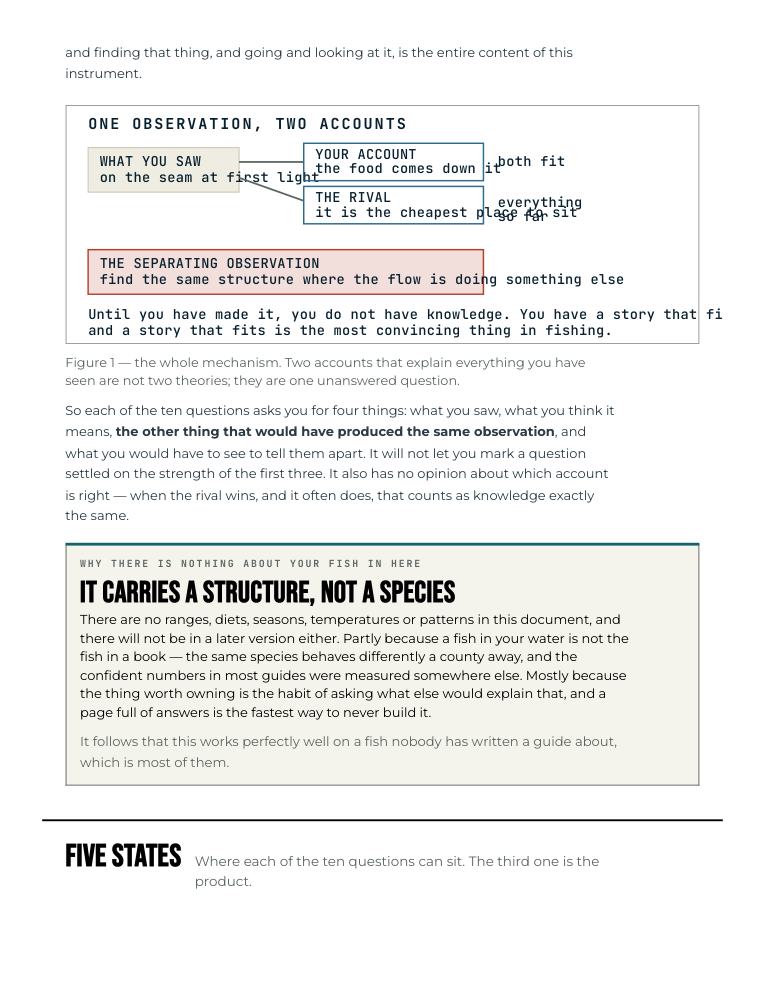
Here is the ordinary way a season goes. You notice something — the fish were on the seam at first light. You reach for an account of it: they are there because the food comes down the seam. The account fits everything you saw, so it stops feeling like an account and starts feeling like a fact. Next season you fish the seam at first light, catch some, and file it as confirmation. You now believe something quite strongly on the basis of no test whatsoever.
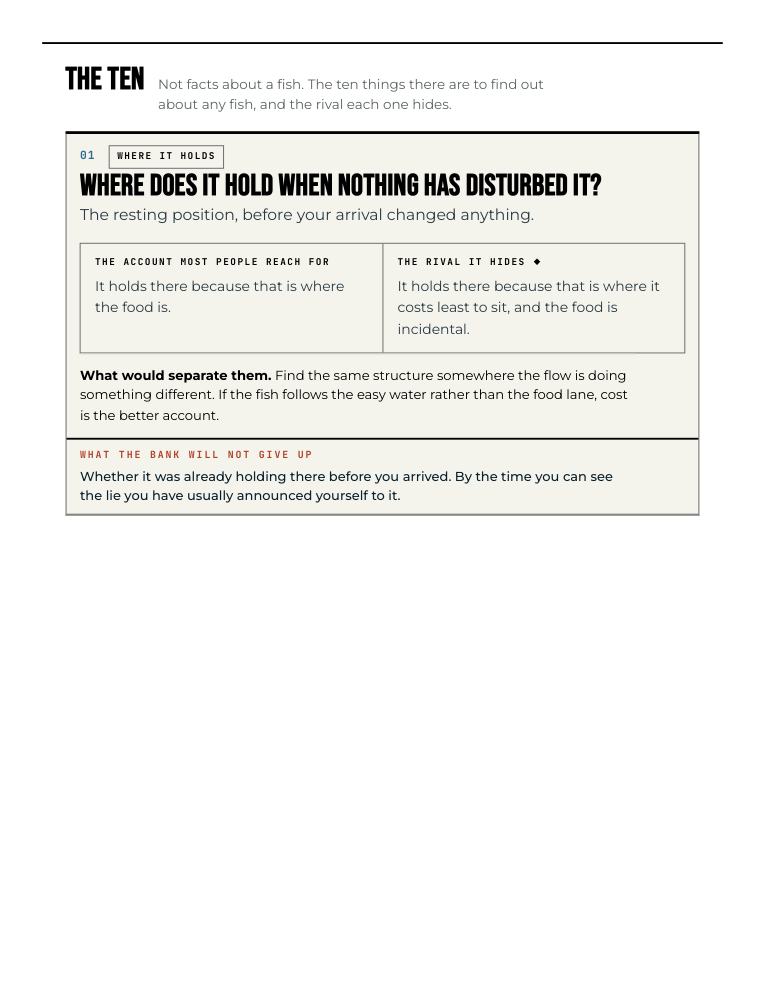
The trouble is that at least one other explanation fits the same observation just as well. They may be on the seam because it is the cheapest place in the river to sit, and the food is incidental. Both accounts predict everything you have seen. They differ only in what they predict about something you have not looked at yet — and finding that thing, and going and looking at it, is the entire content of this instrument.
One rule, applied ten times
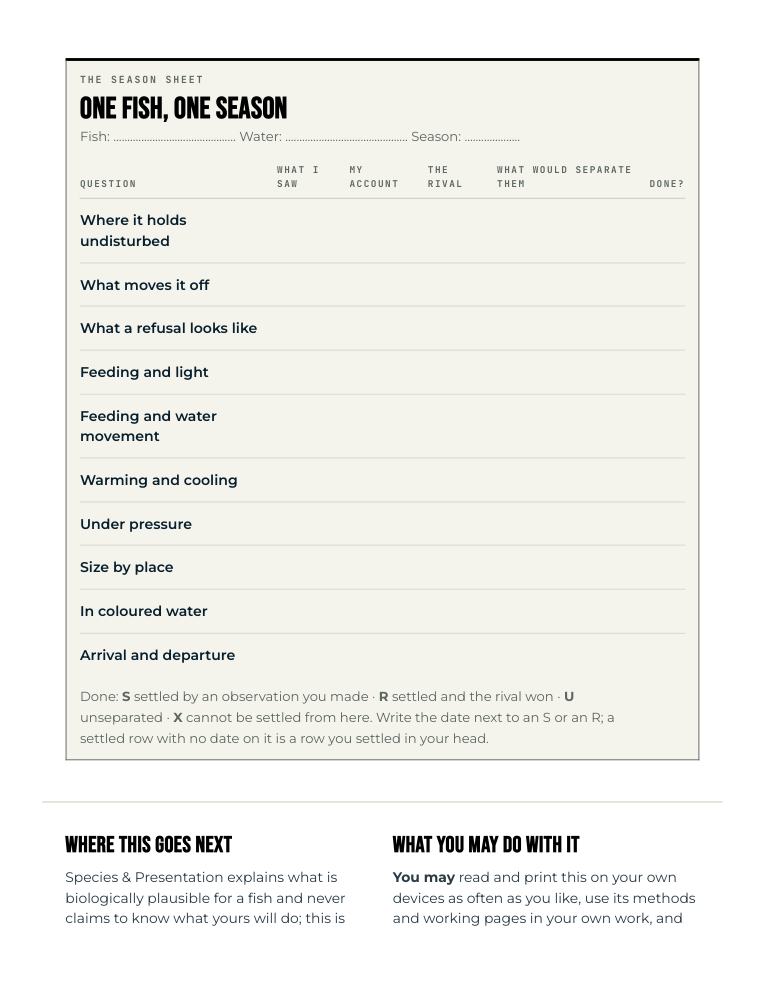
Each of the ten questions asks for four things: what you saw, what you think it means, the other thing that would have produced the same observation, and what you would have to see to tell them apart. It will not let you mark a question settled on the strength of the first three. It has no opinion about which account is right — when the rival wins, and it often does, that counts as knowledge exactly the same.
Five states, and the middle one is the product
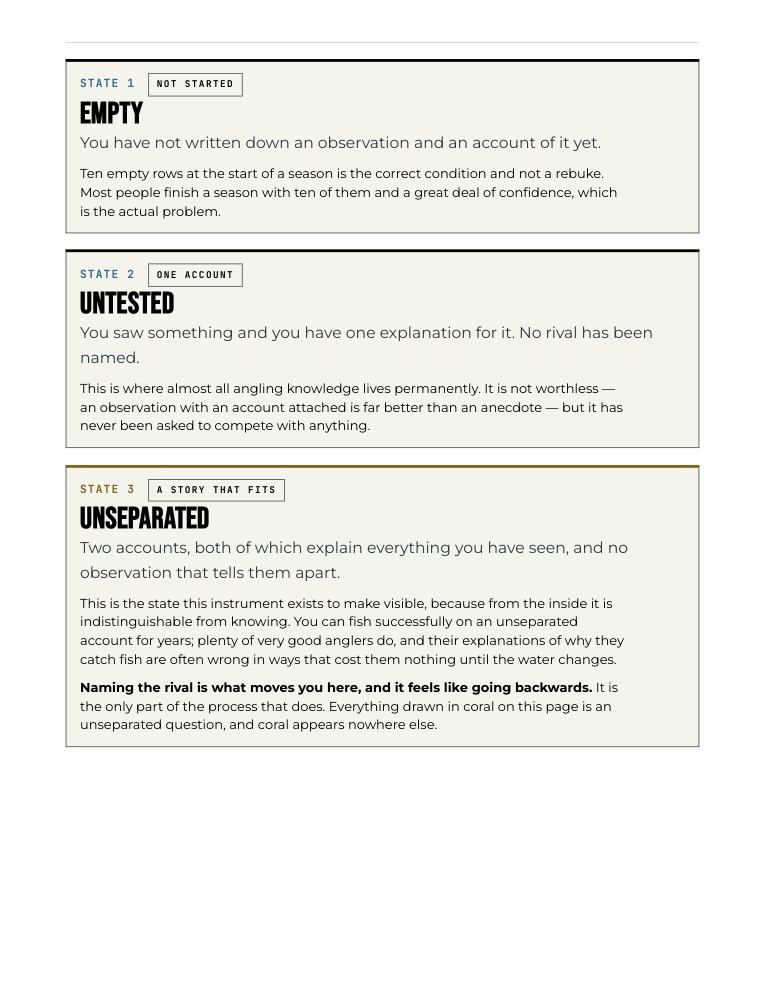
- Empty — nothing recorded.
- Untested — an observation with one account. This is where almost all angling knowledge lives permanently.
- Unseparated — two accounts that both fit, and nothing that tells them apart. From the inside this is indistinguishable from knowing, which is why it needs naming.
- Separated — you named what would tell them apart, went and looked, and one account survived.
- Unsettleable — the separating observation is not one the bank will give up. Marking a question closed is worth more than a confident answer to it.
Why there is nothing about your fish in here
Partly because a fish in your water is not the fish in a book: the same species behaves differently a county away, and the confident numbers in most guides were measured somewhere else. Mostly because the thing worth owning is the habit of asking what else would explain that, and a page full of answers is the fastest way to never build it. It follows that this works perfectly well on a fish nobody has written a guide about, which is most of them.
What you get
- A self-contained offline browser edition — no account, no server, nothing uploaded, and the water you name is never sent anywhere.
- A 19-page Letter print edition, legible in grayscale, with a season sheet for the ten questions.
- A local working record on your own device, with JSON export and import so a season’s work is yours to keep.
Poor fit
If you want to be told what your fish does, this will frustrate you from the first page. It is a structure, not a guide, and it is deliberately empty of answers.
Your purchase includes the browser edition and the print edition, and any corrected release of this edition at no further cost.
You may read and print this on your own devices as often as you like, use its methods and working pages in your own work, and — if you work with clients — use it while serving them and hand a client a completed output you produced with it.
You may not redistribute the publication itself, the blank working masters or the print file; resell or republish it; put the complete work in a shared library or community drive; or share your purchase credential in place of a purchase. It may not be used for model-training ingestion.
Refunds: fourteen days, no reason required. A broken, missing or materially misdescribed file is corrected or refunded without relying on that cutoff.
Nothing in this document is a claim about any fish. Every account on a finished sheet is yours, tested or untested, and the instrument’s only opinion is about whether it has been tested.