Description
A brief written a fortnight ago still looks confident. Four of its six dimensions stopped being evidence days ago.
Most trip briefs get written once and trusted until the tab closes. That would be fine if everything in one decayed at the same speed — but whether a boat ramp exists and what the flow did on Tuesday are not the same kind of claim, and treating them alike is how people drive two hours to a river that came up eight feet on Wednesday.
What dynamic means here
Every fact you enter carries an as-of date and a decay class. Standing facts — public access, a road, a launch — are good for a year. Seasonal facts — regulations, closures, limits — for weeks, and never across a season boundary whatever the age says. Weekly facts — level, clarity, vegetation, pressure — for about three days, and after rain for hours. Same-day facts — wind, tide, the weather actually happening — are already the weakest thing in the brief by morning.
Open the file tomorrow and it says the same thing. Open it in three weeks and it will have demoted four dimensions to unknown and told you which ones and why. It gets less confident on its own, which is the behaviour you want from a brief and almost never get.
How it decides
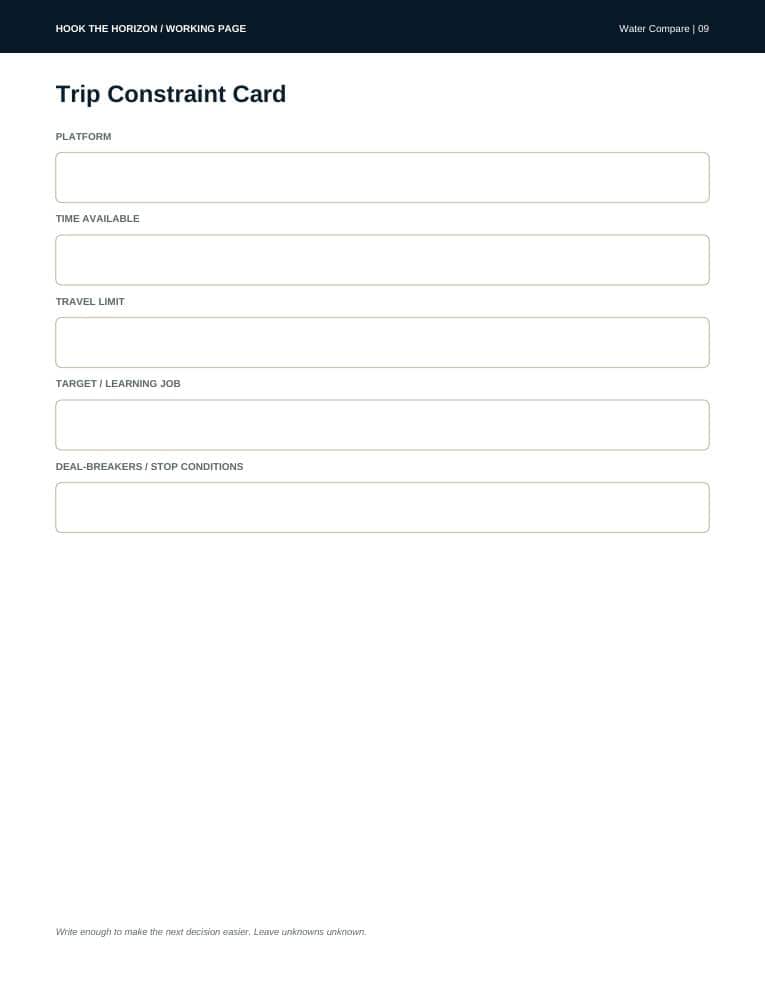
The trip comes first — your window, your travel limit, your platform, the job — because the trip is the thing that is fixed and it decides which waters are even candidates. Then a gate: a blocker removes a water from the comparison entirely rather than scoring it low, because unverified access is not a thing a pretty stretch of river can outweigh. What survives is compared on six dimensions that stay separate. There is no composite score anywhere in it.
The result is one of several shapes, and NO CLEAN WINNER is one of them — a first-class answer with its own reasoning, not a failure message. A brief that always produces a winner is not deciding anything; it is agreeing with whoever filled it in.
It carries the fleet’s own packet
Reads and writes HTH-1.0 under the HTH-FLEET-1.0 contract, so a water you looked at in Waterways or Field Ops arrives here with its evidence class and reviewed-at date attached, and leaves with this instrument appended to the trail. Coordinates are stripped in both directions, at any depth, by key name — the same rule the applications apply to each other.
Who it is for
Anyone choosing between a few public waters for one real outing, especially with a drive involved or other people in the car.
Who should not buy it
If you want a bite forecast, a ranking of which water is the better fishery, or one number that decides, it refuses all three. It is also overkill for a water you already know.
What is in it
- A live brief for up to three waters across six dimensions, with a staleness report naming every fact that has aged out since you wrote it.
- The blocker gate, the arrival verification list, and abandon-or-switch conditions written at a table rather than at the water.
- HTH-1.0 packet import and export, with coordinate stripping, and a named door to the free application that resolves each unresolved dimension.
- Three diagrams: four speeds of decay on a log scale, the gate before the ranking, and the handoff map.
- A blank three-water comparison sheet for the ones you work out before you leave.
Format, offline and printing
Two files. The brief itself is a single self-contained web page — it opens in any browser on any device, the brand faces are embedded in the file, and once it is on your phone it works with no signal at all. There is no app, no account and no server: everything you type stays in that browser, on that device, and you can export a JSON copy or an HTH-1.0 packet whenever you want one.
The print edition is 14 pages at US Letter, laid out for a cheap printer. The as-at date prints deliberately: a printed brief cannot re-read itself, so the date is the only honest thing on the page. It is readable in grayscale and the type is set at field sizes rather than desk sizes.
Where it sits beside the free work
Waterways holds the public record for 1,159 named waters and its compare route is free — use it to source the facts this then dates, ages and carries across trips. Field Ops Desk takes the chosen water into the trip itself.
What it will not do
It never predicts fish, never ranks fisheries by quality, and is not a substitute for checking access, regulations and safety with the agency that governs the water on the day you go.
Version 1.0 · September 2026 · Edition hth.field.water-compare
Your purchase includes
- Water Compare — the Dynamic Brief, a self-contained web page that works offline.
- The Letter print edition, 14 pages, including the blank comparison sheet.
- Eligible corrections and updates to the same Edition, at no further cost.
You may
- Read and print it on your own devices, as often as you like.
- Use its methods and working pages in your own work.
- If you guide, teach or work with clients: use it while serving them, and hand a client a completed output you produced with it.
You may not
- Redistribute the publication, the blank working masters or the print file.
- Resell or republish it, or put the complete work in a shared library or community drive.
- Share your purchase credential in place of a purchase, or use the work for model-training ingestion.
Refunds
Fourteen days, no reason required. A broken, missing or materially misdescribed file is corrected or refunded without relying on that cutoff. Terms of Sale


