Western Atlantic ridge-bearing requiem shark dossier · Carcharhinus obscurus
Dusky is not a color call. I want the interdorsal ridge, a moderate sloping first dorsal whose origin sits over the pectoral free rear tip, and a second dorsal without Silky Shark’s exaggerated trailing tip.
Compare three ridge-bearing sharks
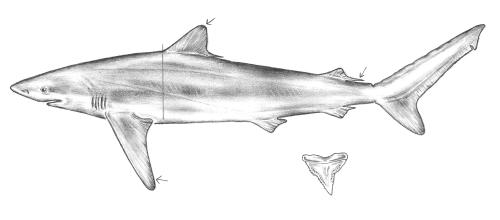
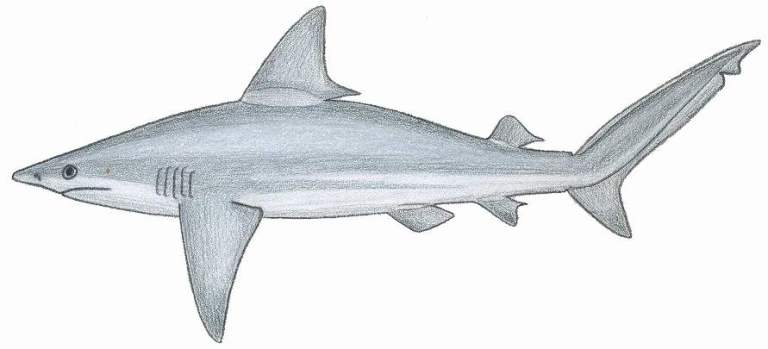
Silky Shark
Ridge: present. First dorsal: begins behind the pectoral free rear tip. Second dorsal: unusually long free rear tip.
Mark Grace / NOAA Technical Report NMFS 153 (2001), public domain.
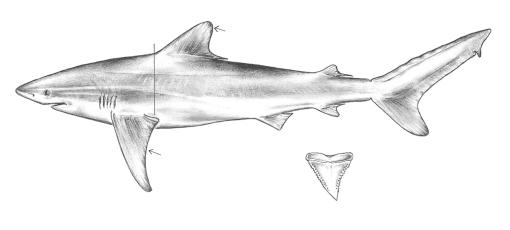
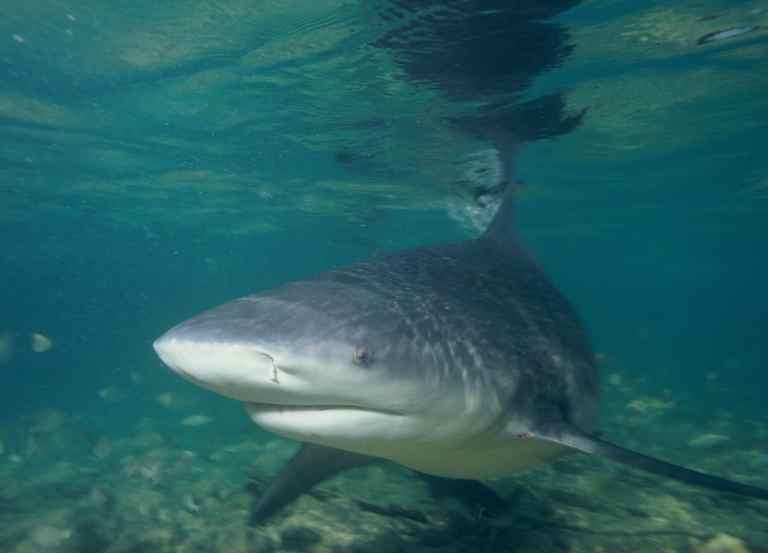
Dusky Shark
Ridge: present. First dorsal: origin over the pectoral free rear tip. Second dorsal: free rear tip shorter than Silky.
Mark Grace / NOAA Technical Report NMFS 153 (2001), public domain.

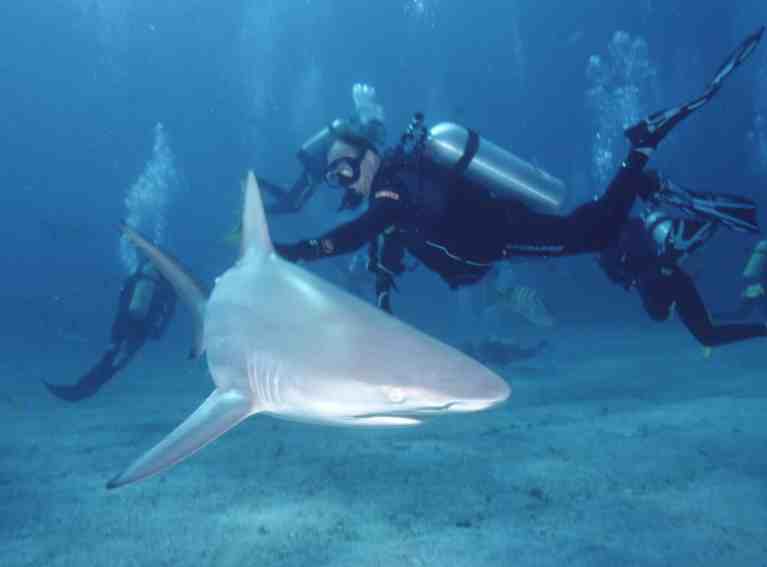
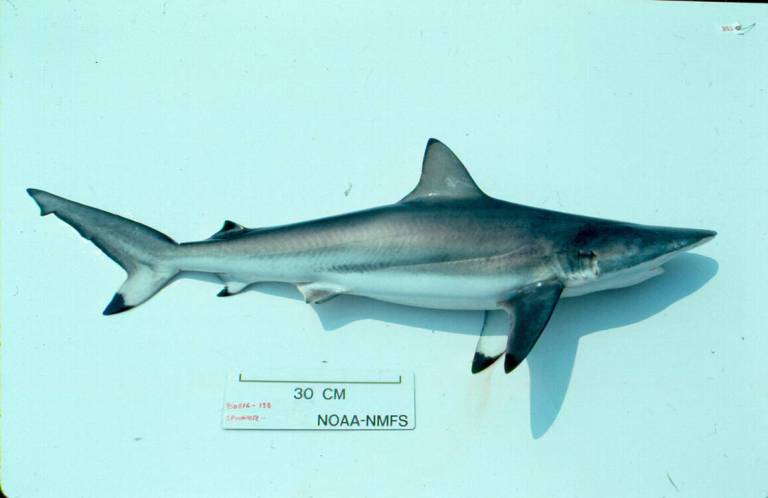
Sandbar Shark
Ridge: present. First dorsal: very tall and triangular, originating over or ahead of the pectoral insertion. Second dorsal: not the Silky pattern.
Photo: Josh Hallett, CC BY 2.0.
Field identification: the pectoral landmark leads
Dusky Sharks may look bronze-gray, blue-gray, or plain brown depending on depth and light. Other requiem sharks do the same. “Dark shark” is not an identification, and darkened fin margins are too variable to carry the call.
The useful evidence is geometry: ridge, pectoral fin, first dorsal, and the free rear tip of the second dorsal.
The ridge opens the right comparison
An interdorsal ridge links the first and second dorsal areas. It separates Dusky from Bull, Blacktip, and Spinner Sharks, which lack that ridge. Sandbar and Silky Sharks remain in the comparison.
On a flexed fish the ridge may disappear into shadow. I would confirm it from more than one view if the identification matters to a record.
Anchor the first dorsal to the pectoral tip
FWC’s strongest field landmark is the first dorsal origin over the pectoral fin’s free rear tip. That puts the fin behind Sandbar’s origin over or ahead of the pectoral insertion, but ahead of Silky’s origin behind the free tip.
The wording matters. Insertion means the front attachment; free rear tip means the back point. Mixing those two landmarks can turn the entire key backward.
The first dorsal stays moderate and sloping
The first dorsal is not the high triangle of a Sandbar Shark. Its leading edge slopes and the apex sits lower over a long body. Large Dusky Sharks also carry long, curved pectorals that add a more ocean-going outline.
A camera tilted above the fish can distort fin height. Placement is usually sturdier evidence than an impression of “tall” or “low.”
The second dorsal checks the Silky comparison
Dusky Shark has a small second dorsal whose free rear tip is less than twice the fin’s height. Silky Shark stretches that rear tip much farther, creating one of the clearest confirmations when the back half of the fish is visible.
Do not prolong restraint to measure it. A clean approach photo or video frame can preserve the relationship without adding handling time.
Look-alikes: Sandbar and Silky
A Sandbar Shark pairs the ridge with a much higher first dorsal beginning over or in front of the pectoral insertion. It also tends to look heavier through the forward body. See the Sandbar Shark profile for that forward-origin test.
If the pectoral base is hidden behind a hand, gunwale, or foam, the closer pair may stay unresolved. The legal response does not change.
Silky moves the dorsal behind the pectoral
Silky Shark usually looks slimmer, with a smaller first dorsal beginning behind the pectoral free rear tip. The long free rear tip on the second dorsal then confirms the rearward geometry.
Open blue water and tuna activity support Silky, while continental shelf and coastal water support Dusky, but neither setting overrules the fin landmarks. Use the Silky Shark profile when the dorsal sits far back.
Habitat and life history
Adults use continental shelves and offshore water and can migrate long distances. Juveniles spend more time in coastal areas, including shallow bays and estuaries, though adults tend to avoid low salinity.
That range makes “inshore” versus “offshore” too simple. A Dusky Shark can meet surf, nearshore, reef, and pelagic fisheries during different life stages and seasons.
Nursery water holds the smaller fish
Shallow bays and coastal lagoons give young sharks feeding habitat and some refuge from larger predators. These areas also overlap boating, shore fishing, gill nets, and bottom gear.
A juvenile may lack the dramatic proportions people expect from a large Dusky. The fin-origin key still applies, and the release should stay quick.
A broad diet follows a broad range
Dusky Sharks eat bony fishes, smaller sharks, skates, rays, squid, and other invertebrates. The prey field changes from nursery bays to shelf edges, so there is no single surface sign that defines the species.
Repeated shark bycatch around a bait school or bottom edge is a signal to change the fishing plan. It is not evidence that every shark there is Dusky.
This is an unusually slow life history
FWC describes maturity near 20 years and longevity beyond 45 years, with gestation around 16 months. Those numbers make adult survival carry unusual weight. A population cannot quickly replace mature fish lost to capture mortality.
The federal prohibition has been in place for decades because recovery is measured on a long clock. The older SEDAR 21 assessment record remains useful background, while current legal status belongs to the live NOAA table.
Release planning and current rules
Before fishing overlapping habitat, set out cutters, a dehooker, gloves, and enough tackle to regain control without a drawn-out fight. Keep the shark alongside and the gills submerged. If hook removal will take too long, cut the leader close.
Do not lift a prohibited shark for a species check. Collect the dorsal-placement evidence while it swims beside the boat, then release. From shore, keep it supported in water rather than dragging it onto sand.
The law and the field table point the same way
Verified October 12, 2026: NOAA’s current Atlantic recreational shark table lists Dusky Shark as prohibited from retention and requires release with minimal injury without removing the shark from the water. Florida also prohibits harvest and requires gills to remain submerged. Federal shark fishing on a covered vessel requires the applicable HMS permit and shark endorsement. Regulations can change; check NOAA’s live Atlantic shark table before fishing.
| First dorsal origin | Supporting feature | Working call |
|---|---|---|
| Over/ahead of pectoral insertion | Very high triangular dorsal | Sandbar |
| Over pectoral free rear tip | Moderate dorsal; shorter second-dorsal tip | Dusky |
| Behind pectoral free rear tip | Long second-dorsal free rear tip | Silky |
| Origin hidden | Ridge only | Species unresolved |
Primary references and nearby records
FWC’s Dusky Shark profile supplies the identification and life-history baseline. NOAA’s live Atlantic shark table supplies current federal status and release language. NOAA’s HMS Recreational Compliance Guide — landing page updated October 2, 2026 covers permits and gear. FWC’s prohibited-shark page supplies Florida’s current handling rule. NOAA’s SEDAR 21 catalog record links the federal stock assessment.
Keep the ridge-bearing trio together with Sandbar Shark and Silky Shark. For the no-ridge branch, compare Bull Shark, Blacktip Shark, and Spinner Shark.
Field decision sequence: start with the pectoral landmark. If I cannot place the first dorsal over the free rear tip—and cannot rule out Sandbar or Silky—I record a ridge-bearing requiem shark and release it under the stricter assumption.
FIELD OBJECT
This one should leave the page.
The article is the long version. These are the pieces worth carrying into the next trip.
The 30-second version
Dusky Shark identification rests on the first dorsal origin over the pectoral free rear tip, backed by a moderate dorsal and shorter second-dorsal tip. Retention is prohibited.
What to watch
- Compare three ridge-bearing sharks
- Silky Shark
- Dusky Shark
- Sandbar Shark
Field card
- Compare three ridge-bearing sharks
- Silky Shark
- Dusky Shark
- Sandbar Shark
- Field identification: the pectoral landmark leads
RIGHT TOOL, NEXT
Species & Presentation
Carry the species behavior and presentation question into a narrower water-to-fish-to-presentation handoff.