Western Atlantic ridge-bearing requiem shark dossier · Carcharhinus plumbeus
The ridge between the dorsal fins starts the comparison. The high first dorsal and where it begins are what make Sandbar Shark the defensible call. If those landmarks stay hidden, release first and keep the identification broad.
The ridge narrows the list, not the species
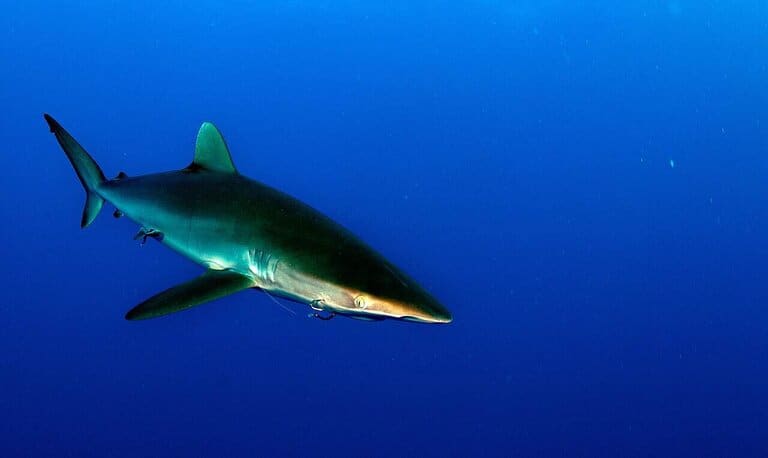
A raised interdorsal ridge runs along the back between the two dorsal fins. That removes familiar lookalikes such as Bull and Blacktip Sharks, which lack the ridge, but it leaves several gray Carcharhinus sharks in play. Dusky and Silky Sharks carry one too.
I treat the ridge as a sorting clue. It tells me which comparison to open. It does not earn a species name by itself, especially when glare or a curved body can fake a low line along the back.
The first dorsal is built tall
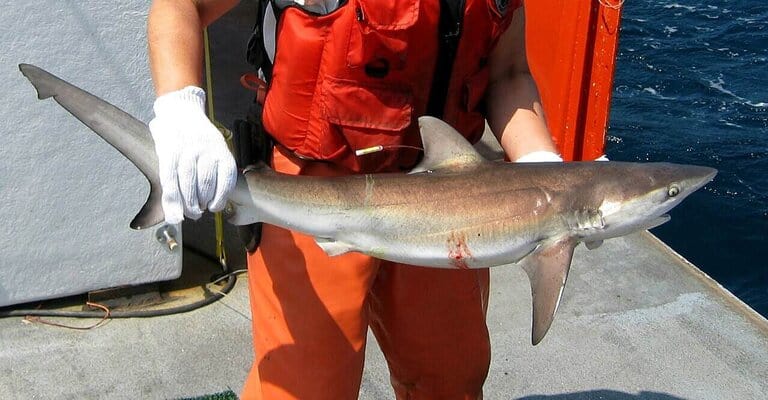
Sandbar Shark has a high, strongly triangular first dorsal that looks oversized beside the second dorsal. On a clean side view, this is the loudest clue. The leading edge rises steeply and the apex sits high above a fairly heavy body.
Fin height changes with camera angle, so I still need the fin’s origin. A foreshortened Dusky Shark can look taller than it is. Shape and placement should agree.
Place the dorsal against the pectoral base
The Sandbar’s first dorsal begins over or slightly ahead of the pectoral-fin insertion—the point where the leading edge joins the body. That is farther forward than the Dusky’s origin over the pectoral free rear tip and clearly farther forward than the Silky’s origin behind that tip.
This distinction depends on seeing the entire pectoral base. A fish rolled toward the camera can hide the insertion. When the landmark is missing, “ridge-bearing requiem shark” is a stronger record than a guessed Sandbar.
The head supports the fin evidence
The snout is short and broadly rounded, and the body is substantial without the blunt, thick-headed look of a Bull Shark. Color usually runs gray to brown above and pale below. There is no dependable black fin-tip pattern.
Color is weak evidence in green bay water or a phone photograph. Head shape, ridge, dorsal height, and dorsal origin survive changes in light better.
Bull Shark is the useful negative check
Bull Sharks share the broad snout and inshore setting. The decisive separation is structural: Bull Sharks have no interdorsal ridge, and their first dorsal is not the same towering triangle. A photograph that shows a smooth back between dorsals pushes the call away from Sandbar.
The habitat can overlap near bay mouths. Fresh or very low-salinity water favors Bull Shark, but location cannot replace anatomy.
Dusky Shark moves the dorsal rearward
Dusky Shark carries the ridge, a rounded snout, and a gray-brown body, which is why the pair causes trouble. The Dusky first dorsal is lower and more swept, with its origin near the pectoral free rear tip rather than above the pectoral insertion.
Long, falcate pectorals also fit Dusky. If the first dorsal looks moderate and the pectoral landmarks point rearward, compare the Dusky Shark profile instead of stretching the Sandbar diagnosis.
Sandy shelf water explains the name
Sandbars, shoals, bay mouths, and continental-shelf bottoms are core habitat. The species often works near the bottom over sand or mud and can move seasonally between coastal and deeper shelf water as temperature changes.
“Sandbar” is habitat information, not a promise that every gray shark over sand is this species. Blacktip, Bull, Lemon, and juvenile Dusky Sharks can use the same general water.
Nursery bays change the stakes
Shallow coastal bays and estuaries serve as nursery habitat in parts of the western Atlantic. Young Sandbar Sharks may be common where adults are less obvious. That concentrates a slow-growing species in predictable water and exposes juveniles to recreational and commercial gear.
A small ridge-bearing shark in a bay deserves the same quick release planning as a large one. Small size does not make identification easier or handling less important.
Bottom prey shapes the route
Small fishes, eels, skates, rays, cephalopods, and crustaceans make up much of the diet. The shark’s coastal tracks often follow productive bottom edges rather than a single bait school at the surface.
That helps explain incidental encounters around channels, shoals, and bottom-oriented rigs. It is not a reason to direct effort at a prohibited species.
Slow growth makes each adult expensive
FWC describes maturity around 12 to 13 years and a lifespan beyond two decades. Females produce live young after a long gestation, with modest litters compared with fast-replacing bony fishes.
This life history is the reason a short encounter matters. Mortality removed from a slow population takes years to replace, even where juveniles look locally abundant.
Plan for bycatch before the line goes out
When fishing overlaps ridge-bearing sharks, use tackle strong enough to shorten the fight and have a long-handled dehooker, cutters, gloves, and a clear release side ready. Natural bait from a federally permitted HMS vessel brings NOAA’s non-offset, non-stainless circle-hook requirement into the plan.
Changing location, depth, bait presentation, or timing after repeated shark interactions can prevent another prohibited capture. The decision is avoidance, not how to make the next shark easier to land.
Release is a waterline operation
NOAA’s federal rule is direct: prohibited sharks are released with minimal injury and without being removed from the water. Keep the gills submerged, control the leader from a safe position, remove the hook only when it can be done promptly, and otherwise cut close.
A photograph should not extend restraint or move the shark onto a deck or dry beach. Record the visible landmarks during the approach and let uncertainty remain in the notes.
The current legal answer is no retention
As checked in September 2026, NOAA lists Sandbar Shark among Atlantic species prohibited from recreational retention. Covered vessels fishing for Atlantic sharks also need the appropriate HMS permit and shark endorsement. Florida prohibits Sandbar harvest in state waters and requires prohibited sharks to remain in the water with gills submerged.
| Visible evidence | Working call | Decision |
|---|---|---|
| Ridge, very high dorsal, origin over pectoral insertion | Sandbar Shark | Release in water |
| Ridge, lower dorsal, origin over pectoral free tip | Compare Dusky | Release in water |
| Ridge, dorsal begins behind pectoral free tip | Compare Silky | Release in water |
| Landmarks hidden | Species unresolved | Release in water |
Primary references and nearby records
FWC’s Sandbar Shark profile supplies the identification, habitat, age, and reproduction baseline. NOAA’s live Atlantic shark table supplies the current federal prohibition and release language. The 2026 HMS Recreational Compliance Guide covers permits, gear, and handling requirements. FWC’s prohibited-shark page supplies Florida’s current list and in-water rule.
Continue the ridge comparison with Dusky Shark and Silky Shark. For the no-ridge branch, compare Bull Shark, Blacktip Shark, and Lemon Shark.
My stopping rule: if the ridge, tall dorsal, and forward origin do not agree, I do not promote the fish to Sandbar. The release decision is already settled, so uncertainty costs nothing.