Species Intelligence · Western Atlantic large coastal sharks
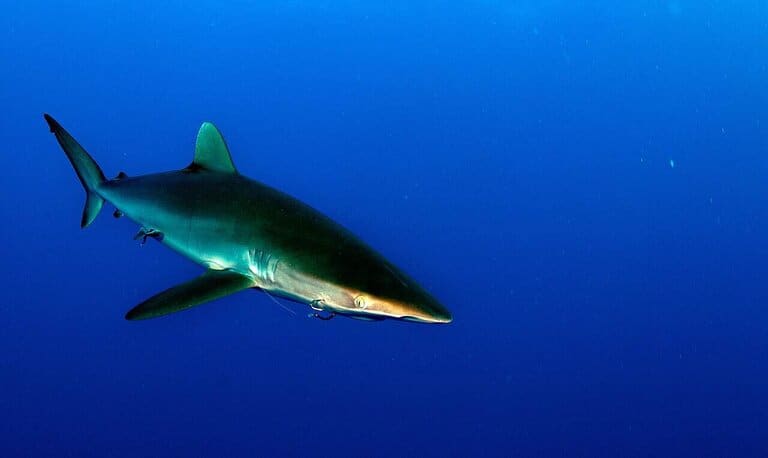
Lemon sharks disappear against the sand by looking almost exactly like the water above it: yellow-brown, broad-headed, and quiet until they move. Their two nearly equal dorsal fins are the identification shortcut worth keeping.
Jurisdiction matters immediately: NOAA currently lists lemon shark in the federal 54-inch large-coastal aggregate, but Florida prohibits harvest in state waters. The state line can change the legal answer without changing the fish.
1. The fast read
Negaprion brevirostris is a large coastal requiem shark of warm Atlantic reefs, flats, bays, mangroves, and estuaries. The back ranges from yellow-green to olive-gray over a pale belly.
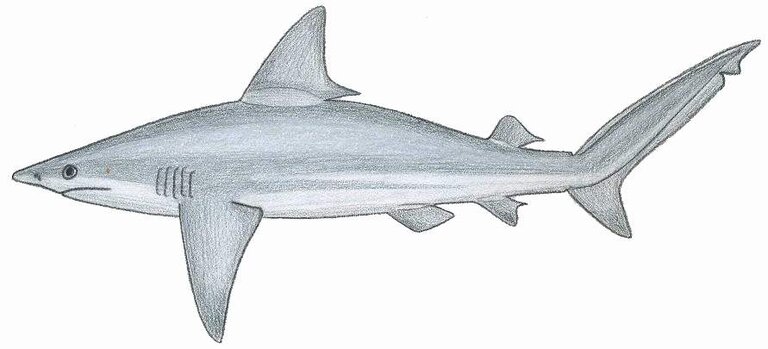
- Best mark: first and second dorsal fins nearly equal in size.
- Head: short and blunt, but the body is less deep and blocky than a bull shark.
- Nursery habitat: seagrass flats, mangrove shorelines, and tidal creeks.
- Rule split: federal retention may be open under the large-coastal aggregate while Florida state waters prohibit harvest.
2. Equal dorsals separate Lemon from Bull
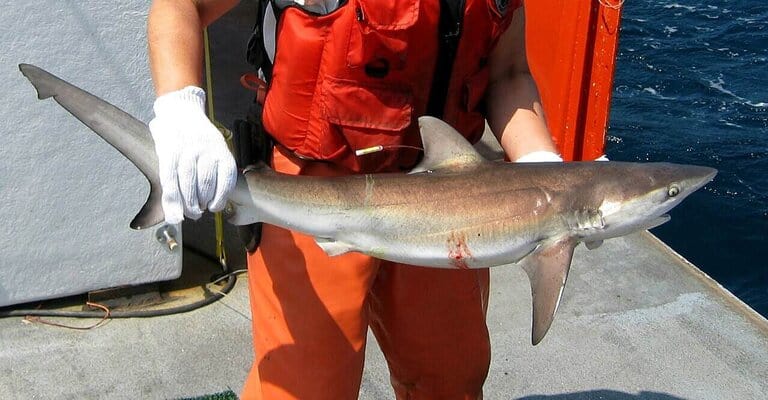
Color is helpful only after structure. Sand, depth, and camera balance can make a lemon shark look gray. The durable clue is the second dorsal: it approaches the first dorsal in size. On a bull shark, the second dorsal is much smaller.
The first dorsal of a lemon shark also begins farther back, and the body lacks the bull’s extreme depth. A nurse shark can carry two similar dorsals too, but it has nasal barbels, rounded fins, a bottom-built mouth, and a tail without a distinct lower lobe.
Photograph the whole side. A dorsal cropped out of frame can erase the one mark that settles the argument.
3. Yellow-brown is camouflage, not a promise
The name comes from the yellowish cast that blends with sand and shallow green water. That color can be obvious in clear Bahamian water and nearly absent in dark estuarine water.
Do not demand a lemon-yellow shark. Use body color as supporting evidence after fin proportion, snout, and overall form. Juveniles and adults can also look different under changing light.
Countershading still applies: darker above, lighter below. From above, the shark vanishes into bottom tone; from below, the pale belly reduces contrast with surface light.
4. Mangroves are working nursery structure
Females give birth to live young in shallow flats after about twelve months of gestation. FWC reports four to eighteen pups, about two feet at birth. Juveniles use mangrove forests, grass flats, and tidal creeks as nursery habitat.
Mangrove roots break current, shelter prey, and create edge. Tidal creeks exchange food and water with the flat. A nursery is therefore a network, not a single scenic shoreline.
Removing mangroves, degrading seagrass, or cutting off tidal flow reduces more than cover. It changes the prey production and movement routes young sharks use for years.
5. Site fidelity makes local damage matter
Lemon sharks are famous research subjects partly because juveniles return to and remain within defined nursery systems. Tagging and long-term study can follow individuals through a landscape that looks small on a map.
That fidelity means a healthy creek can support repeated years of use. It also means chronic disturbance, habitat loss, or concentrated fishing can revisit the same animals.
A school beside a dock is not an endlessly replaced population. Treat repeated encounters as contact with a finite neighborhood.
6. Growth is slow enough to shape every decision
Lemon sharks may reach nine or ten feet, mature around eleven to twelve years, and live at least into their late twenties. Reproduction arrives after a long juvenile period.
That timing matters when judging a legal fish. Large body size does not equal fast replacement, and a mature female carries more future reproductive value than a simple weight suggests.
Rules set a boundary. Biology explains why careful release remains worthwhile inside it.
7. The menu follows the flat and reef
Lemon sharks eat bony fishes, crustaceans, mollusks, rays, and smaller sharks. Juveniles working mangrove edges encounter grunts, mojarras, mullet, crabs, and shrimp; adults range more broadly across reef and shelf habitat.
Current and cover determine which prey is exposed. An ebb pulls small animals from a creek. A reef point compresses fish on its current face. A sandy lane through grass creates a travel corridor.
Match bait scale to the fish expected and the forage present. Oversized bait adds drag, complicates hook exposure, and does not repair a poor location.
8. Read shallow water without crowding the shark
In clear water, look for a broad back, steady tail, and pale shape crossing sand. Give the animal room. A boat repeatedly cutting its path or swimmers closing for a photograph can turn observation into disturbance.
For fishing, identify a route that also offers a safe release: open sand beside a channel is better than roots, pilings, coral, or a packed beach. In dirty water, use tide, bait, and bottom transitions to infer that route.
If sharks are gathered around fish cleaning or feeding activity, do not add people to the same water.
9. Tackle should shorten the argument
A lemon shark is heavy, strong, and capable of long runs. Choose drag and line capacity for control, then choose a rod the angler can load without high-sticking.
Build abrasion resistance for rough skin, coral, shell, and tail contact. Use a bite leader appropriate to teeth and expected size. Rig the sinker so a break does not leave a fish towing a heavy anchor.
Long dehookers, leader cutters, hook-capable bolt cutters, gloves, and a measuring device should already be out.
10. Circle-hook mechanics are simple on purpose
Federal Atlantic HMS rules require a non-offset, non-stainless-steel circle hook when targeting sharks with natural bait. Keep the gap clear. Let the shark move, engage smoothly, and wind into the load.
A violent hook-set can pull the bait away or force the hook where it was not designed to lodge. Steady tension lets the hook travel toward the jaw corner.
Use fresh bait and secure it without wrapping the hook into a closed package.
11. The release should stay horizontal and wet
Work from the side. Do not straddle the shark, sit on it, pull it by the tail alone, or hold it vertically. Keep hands away from the mouth and gill openings.
Use a long tool when the jaw hook is accessible. Cut close if removal is slow or destructive. Support the shark into clean forward flow and release when it holds itself level.
A photograph is optional. Ventilation is not.
12. Federal permission does not override Florida prohibition
NOAA’s live table currently lists lemon shark as open federally with a 54-inch minimum fork length and within the one-shark-total-per-vessel-per-trip aggregate. Covered vessels also need the relevant HMS permit and shark endorsement.
Florida prohibits lemon shark harvest in state waters. Prohibited sharks must be released without delay; current FWC handling guidance keeps gills submerged. Other states can create different limits or prohibitions.
Verify both NOAA’s live federal status and the local state rule before fishing.
13. A field board for shallow-water Lemon Sharks
| Evidence | Interpretation | Response |
|---|---|---|
| Two dorsals look almost equal | Strong lemon-shark mark | Confirm blunt snout, lack of barbels, and no interdorsal ridge. |
| Second dorsal is plainly small | Bull shark becomes more likely | Recheck body depth and dorsal origin. |
| Barbels hang beside the nostrils | Nurse shark | Expect a bottom-built mouth and rounded fins. |
| Fish is inside Florida state waters | Harvest is prohibited | Keep it submerged and release promptly. |
| Juveniles repeat on one creek edge | Possible nursery concentration | Move rather than stacking handling events. |
Log tide, depth, temperature, bottom, mangrove or grass proximity, fork length, hook location, fight time, and release condition. A record of habitat use is more valuable than a close-up of teeth.
14. Sources and related profiles
Compare the unequal dorsal fins in the Bull Shark profile and the barbels in the Nurse Shark profile. For faster nearshore requiem sharks, continue to Blacktip and Spinner.
- FWC: Lemon Shark — identification, habitat, reproduction, and Florida prohibition.
- NOAA Fisheries: Lemon Shark research bibliography.
- NOAA Fisheries: current Atlantic recreational shark status.
- NOAA Fisheries: 2026 HMS Recreational Compliance Guide.
- FWC: current shark regulations.
Biology and rules were checked September 15, 2026.
Bottom line: count the dorsals before counting the shark. Equal-looking fins point toward lemon; jurisdiction decides what happens next.