Blue Marlin Make the Tackle Decision Before the Bite
Blue Marlin reward crews that solve productive water, spread clarity, heavy-tackle geometry, identification, and release before the first run.
By HunterUpdated September 14, 2026Read 11 min
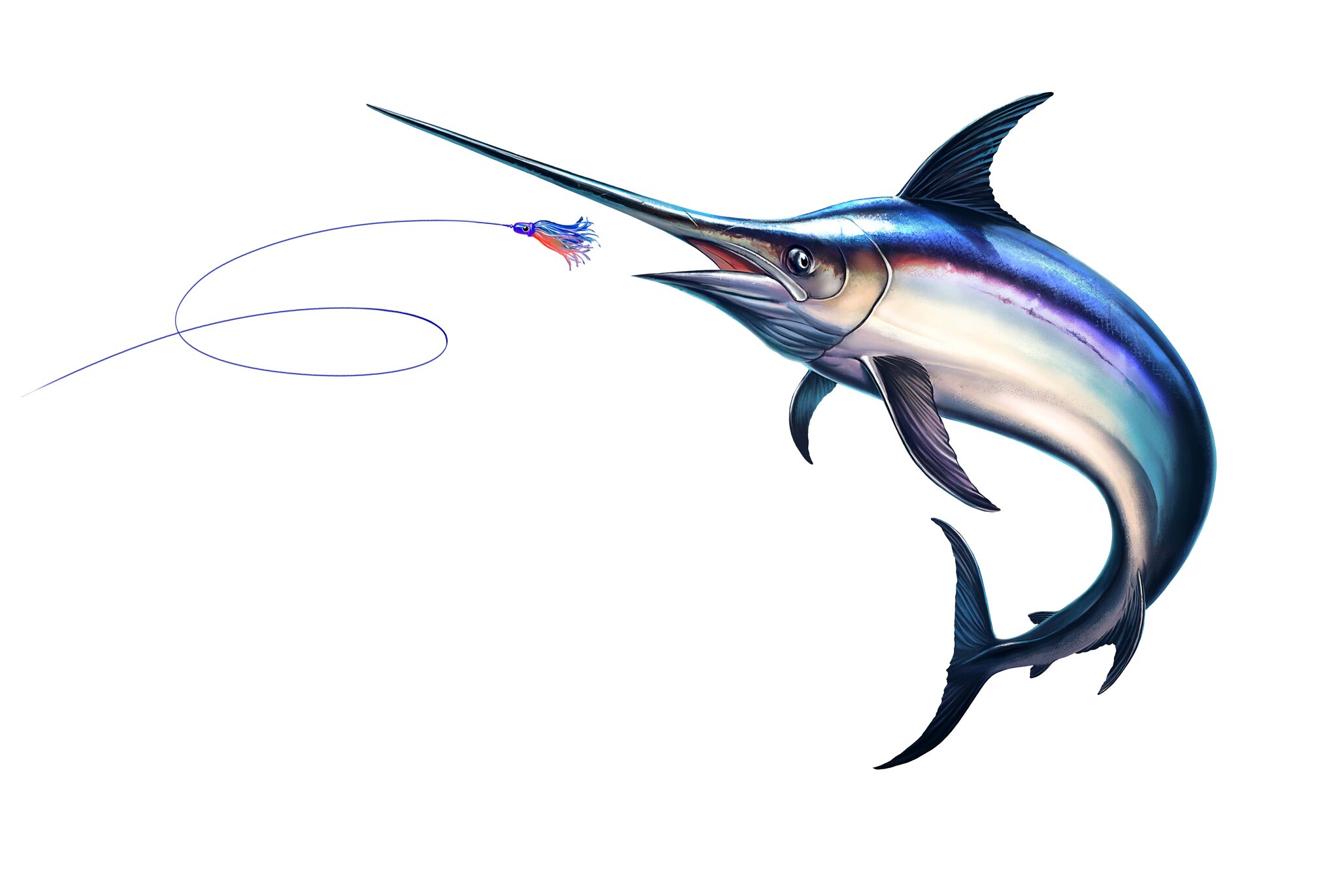
Editorial illustration. Adobe Stock / Konstantin Gerasimov.
A Blue Marlin can make the first thirty seconds feel like the whole story. It is not. The useful work happened before the bite: choosing water worth crossing, building a spread the crew can read, and using tackle that can apply pressure without turning the fight into an endurance contest.
At a glance · The useful version
I have no Atlantic marlin memory to lean on here. That costs this profile the little details a practiced billfish crew would know by feel, so the fishing sequences below are labeled as field reasoning and tied back to agency biology, identification and release rules.
Scientific name
Makaira nigricans
Field marks
Very large billfish; pointed first dorsal, pectoral and anal fins; blue-black back; pale belly; no black dorsal spots.
Water
Warm offshore water in the Atlantic, usually read through current, temperature, color and forage rather than bottom contour alone.
Food
Pelagic fishes and squid, including tuna-sized prey.
First question
Does this water contain enough life to justify keeping a heavy spread in it?
Atlantic stock
The 2024 assessment classified the stock as overfished but not subject to overfishing, with wide uncertainty.
01 · Identification
Start with the fin tips, not the color
Blue is unreliable
Excited marlin can show vivid bars and a dark fish can look washed out beside the boat. Color changes with light, angle and behavior, so it should support an identification instead of carrying it.
Florida FWC separates Blue Marlin from White Marlin with pointed tips on the dorsal, pectoral and anal fins and an unspotted dorsal. A Blue Marlin also develops the mass and depth through the shoulder that make a large fish look built around its engine.
A smaller Blue Marlin can enter the same conversation as White Marlin and Roundscale Spearfish. If the fin shape, dorsal spotting and scale pattern are not clear, record what is visible and leave the name open rather than forcing it from size.
Swordfish are different
Swordfish have a broad, flat bill and lack the long pelvic fins carried by marlins. The one-page NOAA key is worth keeping aboard because a loud cockpit is a poor place to reconstruct anatomy from memory.
The largest fish are female, and that changes the stakes
Sex and size
Blue Marlin show strong sexual size differences. Females grow much larger than males, so an enormous fish is not merely an older version of the average catch; it is also likely part of the female side of the population.
Fast growth, limited certainty
Billfish grow quickly, but age estimates and growth curves still carry real disagreement. ICCAT’s 2024 assessment describes incompatible age information from fin spines and otoliths and keeps that uncertainty inside the stock model instead of pretending it disappeared.
FWC describes daytime feeding on fishes and squid and notes use of the bill to slash or stun prey. That does not mean every strike is a bill swipe. The line, lure and fish still have to show whether the offering was eaten.
The combination of female size, stock condition and difficult aging argues for restraint. A live fish beside the boat is more valuable as a clean release than as proof that the crew won an argument.
03 · Habitat
A temperature edge needs a food reason
Offshore does not mean featureless
Blue Marlin live in the water column, but the useful habitat is structured by moving water: fronts, current boundaries, upwellings, eddies, color changes and the prey those features gather.
Temperature sets the neighborhood
This is a tropical and subtropical billfish. Warm water can narrow the search, but a temperature number without bait, birds, marks or current structure is still empty water.
Depth is movable
A surface lure spread samples only the upper slice. If bait and predators mark deeper during bright hours or stable conditions, the absence of surface action does not prove the area is vacant; it means the presentation may be above the work.
My stopping rule
I would spend time where two independent signs agree—perhaps a current edge plus bait, or birds plus repeated marks. One pretty color break earns a pass. It does not earn the whole afternoon.
04 · Forage
Find the meal before choosing its costume
Prey scale
Blue Marlin eat pelagic fish and squid and can handle prey larger than the bait used for smaller billfish. Lure size should still follow the forage and sea state, not the reputation of the predator.
High traveling birds say little. Birds that wheel, dip repeatedly or reset over one line of water are describing prey near the surface. They identify activity, not the predator responsible for it.
Tuna can be a clue
Tuna marks, flying fish, scattered mahi and cut bait in the water can all reveal a functioning offshore food chain. None guarantees a marlin. Together they can justify another controlled pass.
Do not match only color
Profile, splash, cadence and running depth change how an offering reads. When forage is small, a huge lure in the right color is still the wrong experiment.
05 · Search plan
Make the route test the water
Field inference. This is a search method built from open-water predator ecology, not an agency recipe.
Connect evidence
Build the first route through the strongest intersections: a temperature boundary crossing a current line, a weed edge meeting clean water, or a contour where bait and birds keep reappearing.
Cross, do not trace forever
One pass along an edge shows only one angle. Crossing it can reveal which side holds forage, how sharply conditions change and whether the bite sits on the boundary or in one water mass.
Give silence a limit
Before setting lines, decide what would make you move: a fixed time without life, the end of the edge, bait disappearing from the sounder, or cleaner water showing ahead. Otherwise hope quietly becomes the navigation plan.
Record the whole contact
Log position, direction, sea, water color, temperature, lure position, bait sign and fish behavior. A waypoint without those details preserves where the ocean used to be.
06 · Heavy-tackle spread
Every lure needs clean water and a reason
Separation first
A lure that tumbles, crosses another line or spends half its time hidden in prop wash is not fishing correctly. Reduce the spread before adding another object to manage.
Different jobs
Closer lures can be watched and changed quickly; longer lures reach fish that avoid the boat; a shotgun position samples a different piece of wake. Size and action should vary enough to test the fish without turning the pattern into random inventory.
Speed is conditional
The right speed is the one that lets every lure breathe and track in the existing sea. Head sea, following sea and quartering turns change lure behavior, so a number on the throttle is only a starting point.
Hook system
Match hook, leader, drag and line as one system. A giant hook that ruins lure action or a leader too heavy for the presentation can reduce the chance of a clean bite before strength becomes relevant.
07 · Teaser and pitch
A raised Blue Marlin is a communication problem
Call direction and distance
The most helpful cockpit call is specific: which teaser, which side, how far back, and whether the fish is pacing, slashing or fading. Volume does not replace information.
Keep the lane
The replacement bait or lure should appear where the fish is already looking while the teaser leaves cleanly. If both remain in the same lane, the crew has built a tangle instead of a handoff.
Feed the behavior
A fish that has clearly taken a natural bait and is moving away gives different evidence from a fish batting at it. With a circle hook, steady pressure after the fish turns is more useful than a reflexive sweeping strike.
Reset without theater
After a miss, restore one readable offering and keep the helm predictable. A Blue Marlin may return, but the second chance shrinks when every line and person moves at once.
08 · Strike response
The first run is not permission to stop thinking
Confirm load
A violent surface crash can happen without a secure hookup. Keep the rod pointed into the working angle, let the system come tight as intended, and avoid a drag jump made from surprise.
Clear what threatens the line
Remove lines that cross the fish’s path while leaving the helm room to maneuver. Clearing everything automatically can waste time when the fish is still close and the boat needs a quick angle change.
Mark the bite
Save the position and the direction of travel immediately. Even if the fish comes off, that contact may identify a productive water line worth approaching again from a different angle.
Name the miss
A bill slash, a lure knockdown, a brief load and a pulled hook are different failures. If the crew calls every one a short strike, the next change is guesswork.
09 · Fight geometry
Pressure is useful only when the angle supports it
Use the boat
The helm can shorten line, keep it clear of the hull and reduce a long sideways pull. The angler gains line when the fish and boat geometry allow it instead of trying to lift with a high rod.
Drag was decided earlier
Set the working drag against the actual line, knots, leader and hook before fishing. Heat, abrasion and changing line angle make a large late increase a much riskier move than the lever position suggests.
Large circles
A fish that settles into a deep circle is giving a directional pattern. The helm can work above it while the angler gains on the upward half. Pulling against the downward half spends effort for very little line.
Leader safety
One trained person handles the leader, gloves stay on, and no wrap goes around a hand. A short leader beside a large marlin can change direction faster than the crew can step away.
10 · Release
The release is part of the rigging
Federal baseline
An Atlantic HMS that is not kept must be released immediately without removal from the water. NOAA recommends heavier tackle to reduce fight time plus circle hooks and dehooking tools where appropriate.
Cutters, gloves, dehooker, tagging equipment and the camera decision belong in place before the spread goes out. Searching for tools beside an exhausted fish spends the recovery window.
Keep water moving
Control the fish alongside without lifting by the bill or dragging it backward. Use slow forward motion when needed to move water across the gills, watch posture and ventilation, and release when the fish holds itself and kicks away.
Hook removal is conditional
If removing the hook requires dangerous leverage or a long struggle, cutting the leader close can be the lower-cost choice. A perfect-looking hook recovery is not worth extra injury to fish or crew.
11 · U.S. Atlantic rules
Measure and report before the dock story starts
Permit
A private vessel fishing recreationally for Atlantic billfish in federal waters needs an HMS Angling permit; for-hire vessels use the HMS Charter/Headboat permit. Federal requirements can also follow an HMS-permitted vessel into state water.
The federal minimum for Blue Marlin is 99 inches lower-jaw fork length. LJFL is a straight-line measurement from the front tip of the lower jaw to the fork of the tail.
A retained billfish may be gutted at sea but must land whole with head, fins and bill intact. Blue Marlin, White Marlin and Roundscale Spearfish also share a 250-fish annual U.S. landing limit, so an in-season closure can override an older summary.
Recreational billfish landings must be reported to NOAA within 24 hours through the HMS permit system or approved reporting route. Released fish still have to be handled under the immediate in-water release rule.
In a registered HMS tournament, natural bait or a natural/artificial combination requires a non-offset circle hook. Artificial bait allows the hook types listed in the current guide.
ICCAT’s 2024 assessment, using data through 2022, classified Atlantic Blue Marlin as overfished but not subject to overfishing. The median biomass estimate remained below the level associated with maximum sustainable yield.
The combined assessment gave wide confidence bounds and the two main modeling approaches did not tell identical stories. That is a reason to state the result carefully, not a reason to choose the most comfortable model.
Most U.S. anglers can make the cleanest contribution by planning to release. The legal ability to retain a qualifying fish does not turn retention into the default decision.
Freshness check
This snapshot was checked September 15, 2026. Before fishing, confirm the HMS permit, current landings update, tournament status and state rules for the water where the trip begins and ends.
Wahoo — Separate high-speed searching from billfish presentation.
Evidence · Follow the source
Primary sources and current checks
The part I would argue hardest for is identification before celebration. A billfish at the rail is already a safety and handling problem; guessing the species from excitement makes every later decision worse.
Profile created 2026-09-15. Regulations, permit terms, tournament rules and in-season closures can change. Check NOAA and the landing state before fishing.
The size of a Blue Marlin makes tackle important. The moving water still decides whether that tackle ever gets used. Find the food chain, keep the spread readable, and have the release work arranged before the ocean gets loud.
Saltwater & CoastalSurf, shoreline, nearshore, offshore, and deep-sea fishing — technique, gear, and safety content spanning the full range from the beach to blue water.103 articles
Species & BehaviorFish behavior, habitat, depth, forage relationships, and species-specific field decisions. Start with the Freshwater Fish Species field guide.159 articles
Cookie Consent
We use cookies to improve your experience on our site. By using our site, you consent to cookies.
Contains information related to marketing campaigns of the user. These are shared with Google AdWords / Google Ads when the Google Ads and Google Analytics accounts are linked together.
90 days
__utma
ID used to identify users and sessions
2 years after last activity
__utmt
Used to monitor number of Google Analytics server requests
10 minutes
__utmb
Used to distinguish new sessions and visits. This cookie is set when the GA.js javascript library is loaded and there is no existing __utmb cookie. The cookie is updated every time data is sent to the Google Analytics server.
30 minutes after last activity
__utmc
Used only with old Urchin versions of Google Analytics and not with GA.js. Was used to distinguish between new sessions and visits at the end of a session.
End of session (browser)
__utmz
Contains information about the traffic source or campaign that directed user to the website. The cookie is set when the GA.js javascript is loaded and updated when data is sent to the Google Anaytics server
6 months after last activity
__utmv
Contains custom information set by the web developer via the _setCustomVar method in Google Analytics. This cookie is updated every time new data is sent to the Google Analytics server.
2 years after last activity
__utmx
Used to determine whether a user is included in an A / B or Multivariate test.
18 months
_ga
ID used to identify users
2 years
_gali
Used by Google Analytics to determine which links on a page are being clicked
30 seconds
_ga_
ID used to identify users
2 years
_gid
ID used to identify users for 24 hours after last activity
24 hours
_gat
Used to monitor number of Google Analytics server requests when using Google Tag Manager
1 minute
Jetpack's built-in visitor analytics. It records page views, referring sites, search terms, and outbound link clicks, and also carries the shared visitor-tracking library used by Jetpack Instant Search and WooCommerce Analytics.