Fish can work the same lane for twenty minutes, eating something steady, while the fly on your tippet looks like it wandered in from a different meeting. That’s the actual problem. It isn’t a naming problem.
FIELD PLATE · SIZE
Size and outline get you further than the correct Latin name.
You can know every insect name in the book and still fish the wrong depth. You can also have no idea whether the bug in your hand is one very specific mayfly or a slightly different very specific mayfly, and still make a good call, because you noticed how big it is, what shape it is, and where it sits in the water.
That’s the practical version of matching the hatch. Identification is useful, but observation comes first, and when you can’t put a name on what you saw, Hatch Match can at least shorten the list.
The bug-name side of fly fishing can feel like walking into a test nobody told you about. You didn’t miss anything. Names are a shortcut for people who’ve been at it a while, and looking gets you to the same answer the long way, with the bonus that it keeps working on the day the insect in front of you isn’t in anybody’s chart.
Start with what a fish can reach
An insect on my sleeve doesn’t count. Bugs flying around at head height mostly don’t either, unless they’re coming down to lay eggs or getting blown onto the water. The food that matters is the food the fish can get to, right there.
So I look at the water first. Is something drifting just under the surface, stuck in the film, or riding on top? Are terrestrials dropping out of the bankside grass? Availability beats abundance somewhere else — if the obvious bugs are six feet over your head while the fish keep feeding subsurface, the fish have already voted on which part of the event matters.
The impressive specimen is a trap too. Something big lands nearby and becomes the prime suspect, while the fish are eating something smaller, lower, or earlier in the sequence. I look for repetition where fish are actually feeding: foam lines, eddies, whatever’s drifting past my knees. One bug is an observation. Food showing up over and over where fish can meet it is a clue.
Which floor
A beautiful dry fly isn’t a match if the food is two inches under the surface. A perfect nymph isn’t a match if fish are taking spent insects lying flat on top. Before I pick a pattern, I decide whether the feeding is near the bottom, up in the water column, just under the film, in it, or on top.
That one filter throws out more wrong answers at once than anything else, and it keeps me from answering every refusal with another fly change when the real problem is that the fly lives on the wrong floor.
If I honestly can’t tell, I cover the neighboring layers instead of pretending. One shallow subsurface fly, one in the film and one on top will teach you more than a box of tiny color variations.
Size, then bulk
You almost never need a measurement. You need to know whether the natural is much smaller, a little smaller, about the same, or bigger than what you’re throwing, and that means comparing length and bulk both, not just hook size.
Two insects can be the same length and look nothing alike from below. One’s thin and spare, the other thick and winged and wide, and a pattern that nails the length while doubling the body mass still reads wrong.
So the size steps in the box should mean something. If every fly differs from the next by the width of a nervous pencil line, that’s a collection, not a set of answers.
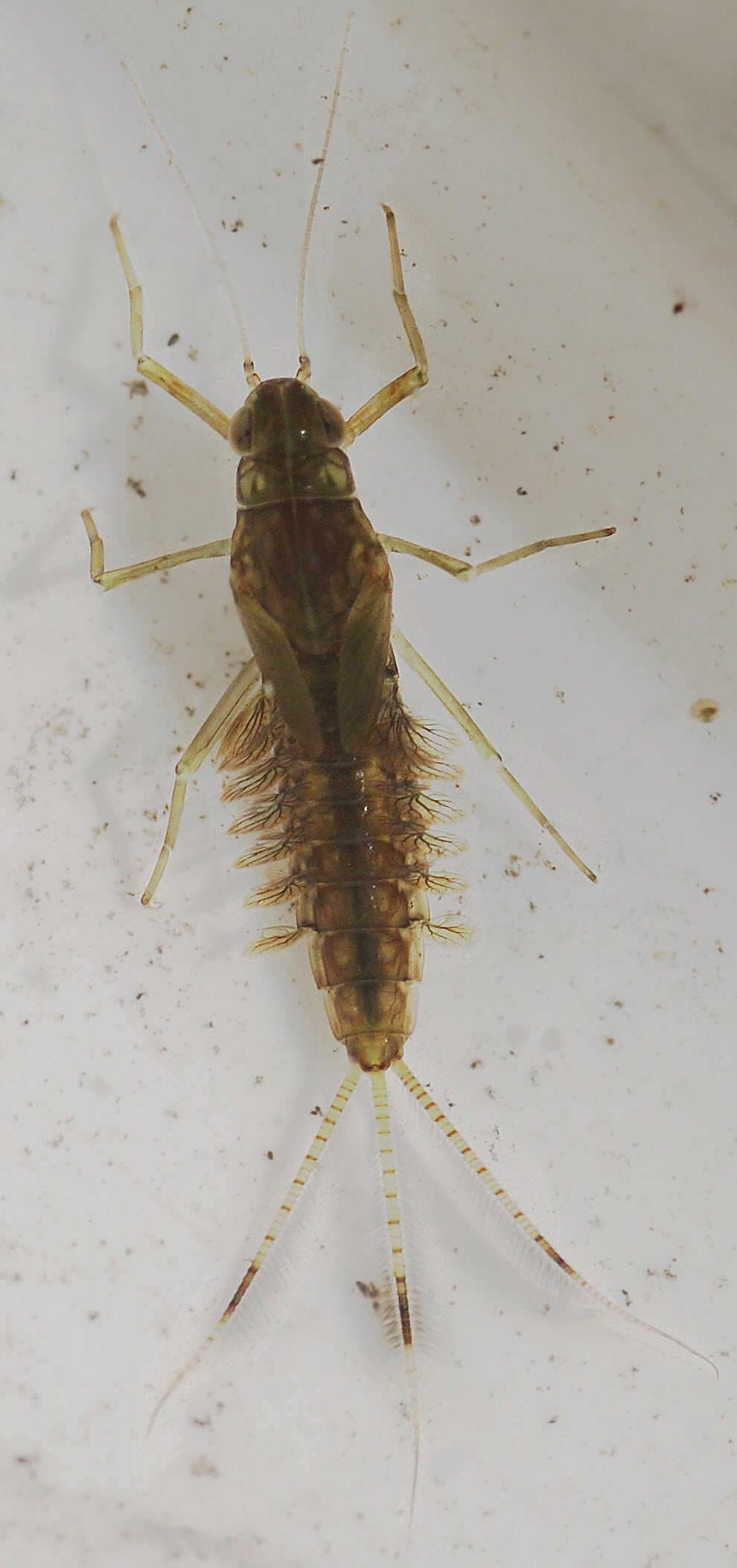
Then think about the outline from underneath. Slim or broad? Riding upright, or flat and low? Does it print a dark shape against the sky or nearly vanish? Details matter once the big shape is in the same neighborhood — a fish isn’t going to admire tail fibers on a fly twice as bulky as the naturals. “Small and slim, riding low” will get you further than a species name guessed off a blurry photo and then trusted for the rest of the afternoon.
What the natural is doing
I watch the real ones long enough to see whether they drift dead, twitch and swim, skitter across the top, or barely move at all. Then I look at what my fly is doing.
A fly can be visually close and behaviorally ridiculous. A natural dead-drifting past a fish, next to an imitation skating sideways under line tension, isn’t a subtle mismatch. Those are two different activities sharing a zip code.
Before adding action because nothing’s happening, check whether the naturals show that action. If they do, copy it on purpose. If they don’t, the extra movement mostly makes the fly easier to turn down.
Color is the last dial, and the fly isn’t the color you think it is
I work in ranges instead of paint samples: light or dark, translucent or muted, plain or strongly marked. Clarity, glare, depth and light angle all change how a color reads underwater anyway. If the size is wrong, the layer is wrong and the thing is dragging, going from olive-brown to brown-olive isn’t a rescue operation. Once the big traits are close, color becomes a real refinement. Until then it’s just the easiest variable to change, which is exactly why it gets blamed.
There’s a second problem hiding inside that one. Dry material in your fingers looks bigger, brighter, stiffer and fuzzier than the same material a few casts later. Fibers collapse and bodies darken, and once the floatant wears off the soft stuff starts moving differently. Check the fishing version of the pattern, not the version that looked perfect at the vise. A fly can wander out of the category you chose it for without ever changing its name, which is worth remembering when a pattern worked for a while and then quietly stopped.
The line is usually the one arguing
In moving water, the line and leader lie across currents running at different speeds, and that makes the fly speed up, skate, stall or pull out of the lane. On still water, wind bellies the line and drags a small fly faster than everything around it.
Shorten the cast, change the angle, mend, reposition, or adjust leader length and weight as the technique needs. If the presentation is obviously wrong, a new pattern just hands you a fresh fly to drag badly. The fly gets all the attention because it’s easy to change. The line may be the part causing the argument.
Water speed also sets how precise the match has to be. Fast broken water gives a fish very little time to inspect anything. Slow glassy water makes drag, posture and leader placement obvious to everybody, fish included. That isn’t a rule that fast water is easy and slow water is hopeless — it changes how much inspection to expect. In quick water, the right layer and a size in the right range can be enough to start. In slow clear water, small differences in posture and drift start deciding things.
Build a box that disagrees with itself
Forty nearly identical flies don’t run a comparison. For one food event, a few meaningfully different options teach more: smaller against larger, slim against bulky, quiet against mobile. If the layer’s still a mystery, spread them across floors before anything else. They don’t need to be copies of each other. They need to be plausible ways the same general food could be showing up.
Then change one major trait at a time so a better response actually tells you something. Change size, color, depth and leader all at once and you might still catch a fish, but you won’t know which correction did it.
Fish response narrows the next move without settling it. Steady sips, subsurface flashes and visible refusals are all useful, and none of them is a translation of fish thoughts. A refusal could be drag, size, posture, leader, or the fish sliding over a foot. If the fly keeps reaching the right lane and gets inspected but not eaten, size and posture get interesting. If it never drifts like the naturals, that comes first. Start with the biggest visible mismatch and give each change enough good drifts to mean something. One bad cast followed by another fly change isn’t matching the hatch.
When the hatch isn’t the problem
Sometimes bugs are everywhere and the fish plainly don’t care. The water can be full of one food while the fish chase another, or the fish can be scattered and sitting where you can’t reach them well. I try not to force a hatch story onto the water just because bugs are present. If clean drifts through the apparent feeding zone keep getting nothing, the question gets wider: other food, other layers, and where the fish are actually holding.
Learning insect groups and life cycles still pays, because it helps predict where food will show up, how it moves and which stages are likely available. Local hatch charts and people who know the water add real precision. Let that sharpen what you see instead of replacing it, since the exact biology varies by group, region, season and water. When I don’t know the bug, the note just says what I could see — “small dark insects emerging through the film” — and that note holds up. A confident species name off one blurry wing is mostly confidence wearing a tiny lab coat.
FIELD OBJECT
This one should leave the page.
The article is the long version. These are the pieces worth carrying into the next trip.
The 30-second version
How to match the hatch without the Latin: get the fly to the right depth and close in size and shape first. Leave color for last, since it’s the easiest thing to blame.
What to watch
- Start with what a fish can reach
- Which floor
- Size, then bulk
- What the natural is doing
Field card
- Start with what a fish can reach
- Which floor
- Size, then bulk
- What the natural is doing
- Color is the last dial, and the fly isn't the color you think it is
RIGHT TOOL, NEXT
Hatch Match
Turn the observed food, stage, size, silhouette, and behavior into the next presentation decision.