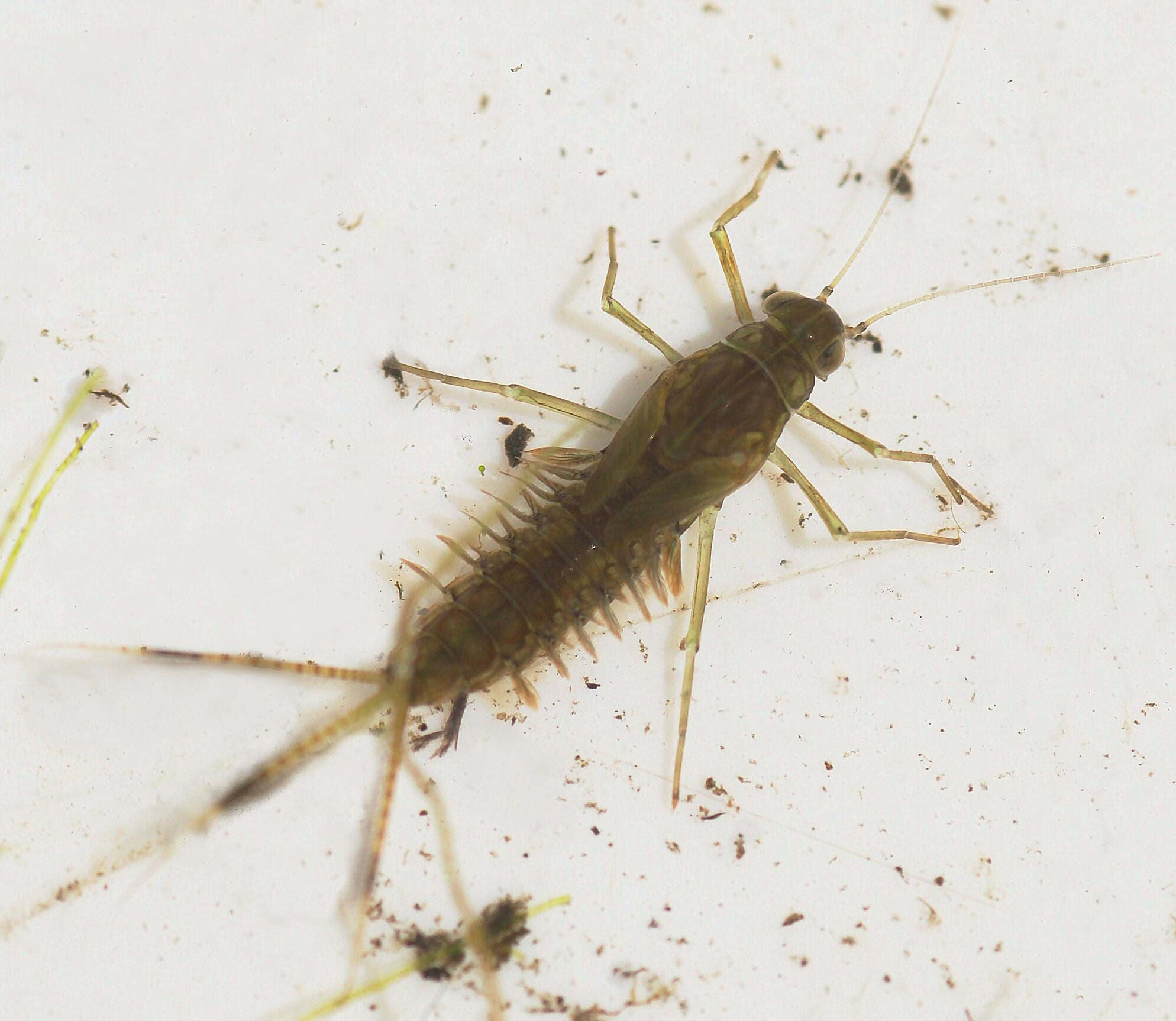
You can have bugs coming off everywhere and fish obviously working and still be fishing the wrong thing. That’s the annoying part. The bug floating past your face is the easiest one out there to notice, and it might be the least important one to the fish.
FIELD PLATE · FORAGE
Silhouette and movement beat a confident guess.
The question isn’t what is the exact Latin name of this insect? It’s much smaller than that: which stage can the fish actually get at right now? Down near the bottom, on the way up, stuck in the film, riding on top, or lying spent — that answer changes my presentation before an insect name changes anything.
Entomology goes very deep. Fishing mostly needs the part that tells me where the food is and how it moves.
Down where I can’t see it
Flying adults are hard to ignore. They land on my sleeve and bounce around like they’re the main event. Meanwhile the fish might be eating an earlier stage below the surface, where I can’t see much of anything. That’s how a visible hatch can mislead me — start with the air instead of the water and I’ve already picked a side. Adults tell me something is happening. They don’t tell me what’s getting eaten. I watch the feeding level first, and if nothing is actually breaking the surface, all that traffic overhead is mostly scenery.
Aquatic insects spend important parts of their lives underwater. Depending on the group, the immature forms cling, crawl, burrow, swim, or drift, and fish can be feeding on them long before anything dramatic shows up on top. That food behaves nothing like a floating adult, either — it’s a narrower shape moving along a path well below the surface. A fly matching the insect I can see may be nowhere near the layer where the eating is happening.
So when the water looks quiet, I don’t assume nothing’s available. Quiet water can be hiding a lot of groceries.
Coming up
At some point many aquatic insects leave the position they’ve been holding and get exposed. Some swim or float up through the water column, some crawl toward shore or onto structure, and others change right at the surface. The route depends on the group, which is why I don’t trust every hatch to run off one tidy diagram.
What matters to me is the vulnerability. An insect that leaves cover or crosses open water becomes easier to intercept, and that can produce feeding that looks almost like surface activity without ever quite being surface activity.
Bulges and flashes that stop just short of a clean rise fit that situation. They’re clues, not proof. The point is noticing the food may be climbing before it turns into anything with wings.
The film
If the surface film sounds like a technicality invented by people who wanted a harder version of dry-fly fishing, that’s a fair suspicion, and it’s wrong. Surface tension makes the very top of the water act like a thin skin. You’d never notice it, but a small insect trying to push through it can get stuck there, and a stuck insect is an easy meal. Learning to see what’s going on in that layer takes patience more than talent.
An insect partly trapped in that film, or hanging just under it, sits completely differently from one riding clean on top. Wings may be half out. A body may hang below. The movement can look awkward and stuck. Fish working there might show me a nose, a dorsal disturbance, a bulge, or a sip so quiet I’d miss it looking somewhere else.
When the eating keeps going and my high-floating imitation gets ignored, putting the presentation into the same layer usually does more than any pattern swap.
The adult shows up twice
Some newly emerged adults sit on the water a while before they go anywhere, and current or wind will gather them into lanes or push them into one part of a lake. When fish are taking those, size and how the insect sits on the water matter most.
The operative word is taking. Seeing adults doesn’t prove fish are eating adults. I watch for repeated surface feeding that lines up with the naturals in front of me, and until then I let the obvious insect be obvious while the fish do whatever they’re doing.
The cycle doesn’t end when the insect flies off, either. Depending on the group, adults come back to the water to lay eggs — a mayfly molts into a spinner first, while a caddis comes back as the same adult — and that opens another window. I look for adults dipping and skittering on the surface or hanging low over it, then compare that against what the fish are doing. An egg-laying adult may move nothing like a fresh one drifting along. If the naturals are working the surface, a completely dead presentation misses the point. If they’re barely moving, adding action because it feels productive misses it from the other direction.
Spent
After all that, some adults end up lying flat and nearly motionless on the water, wings out and body low, nothing like the upright look they had fresh.
That’s how a fly can be the right insect and still look wrong. The label on the compartment matches. The posture in the water doesn’t. If fish are calmly feeding on top and ignoring my upright imitations, I go look at how the naturals are actually sitting — a low flat profile reads very differently from a set of wings standing up like tiny sails.
Size and movement change with the stage
It’s tempting to judge everything off the adult, because that’s the stage I can see. But underwater bodies, emerging insects dragging their shucks, and spent wings all change the profile. I don’t need fake precision. I need to know whether my imitation is clearly too big, too bulky, or standing up when the naturals are lying down. Match the stage the fish can reach first, then the size and shape of that stage.
Movement sorts out flies that look identical in my hand. An emerger struggles; a spent spinner barely twitches. Two patterns that look like twins in the box fish completely differently once current, line tension, and my retrieve get a say. I watch the naturals when I can and copy the kind of movement I see rather than inventing some. When they’re drifting helplessly, I let helpless be helpless.
Nobody follows the same script
Mayflies, caddisflies, stoneflies and midges don’t develop or emerge the same way. Some groups have a pupal stage. Others don’t. Some transform at or near the surface. Others crawl out onto rocks, shore, vegetation or whatever structure is handy before they turn into adults.
So I use life stages as an observation tool, not a universal script. The actual biology still depends on the group, the region, the season and the water. When exact identification matters, I go to a reliable local or entomological reference and let it do the naming.
I don’t have to turn the bank into a lab
I can learn plenty from what’s on the water, on the rocks and brush where access is legal, and on my own sleeve. A photo holds enough detail for later without the session turning into specimen collection.
If collecting is legal and appropriate where I am, a small viewing container works, and live insects go back when that’s practical. Rules vary from place to place, so I check before collecting anything, and go easy on the habitat while I’m looking.
Where it all piles up
Life stage tells me what kind of food is out there. Water movement tells me where it collects. In rivers and streams, drifting insects and shucks concentrate along seams, foam lines, eddies, slower edges and other delivery lanes, so a fish will often hold where the food keeps arriving instead of rising at random across a pool. On lakes and ponds, wind does the same job, pushing insects toward a shoreline or bunching them into surface bands.
Which means two fish in the same piece of water may not be eating the same thing at all. One intercepts something subsurface along a current lane while the other takes adults off the top a little further along the bank. The hatch is shared. The feeding opportunity isn’t, and the one I’m standing in front of is the only one I have to solve.