MUSKELLUNGE · SPECIES PROFILE
A follow is not a failed cast. It is the fish finally telling you where it was.
Most of a muskie day is casting at water that doesn’t answer. They’re low-density ambush predators, so you can go hours without seeing one, and then a fish shows up behind the lure right at the boat and the last five feet of the retrieve suddenly matter more than the first fifty.
Profile basis: Wisconsin DNR · Minnesota DNR · Missouri Department of Conservation
MUSKIE OR PIKE?
The color pattern helps. The cheek scaling is cleaner.
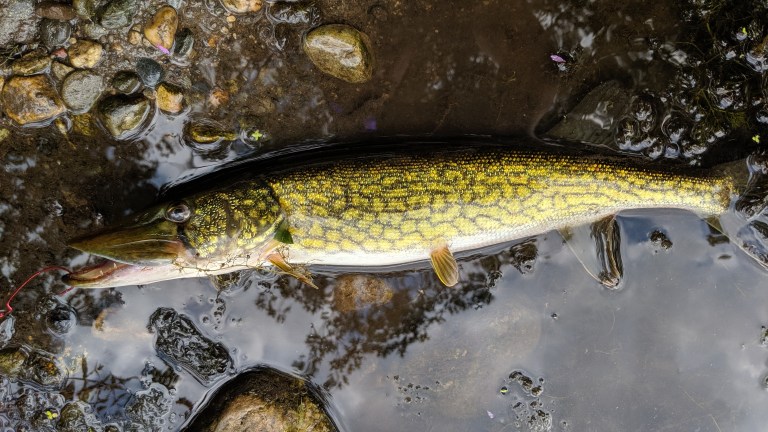
Muskellunge and northern pike share the same long Esox body plan, rear-set fins and broad snout. The pattern usually points in opposite directions: muskies generally carry dark bars or spots on a lighter background, while northern pike usually show light bean-shaped spots on a darker body.
Pattern can fade, especially in clear-water fish, so the cheek and gill cover are better structural checks. Northern pike have a fully scaled cheek and scaling over much of the upper operculum. Muskellunge leave the lower portions much less scaled or bare.
Jaw-pore counts are often taught as absolute and are not. Agency ranges overlap. If a six-pore fish has muskie cheek scaling, do not make the pore count win the argument just because the number felt objective.
Tiger muskellunge are pike × muskie hybrids. They usually carry a denser barred pattern and are stocked as sterile fish — the males are, though USGS notes the females are often fertile. A tiger muskie can look like both parents because that is exactly what it is.
LOW DENSITY CHANGES THE GAME
You are often searching for one fish, not finding the active school.
Muskellunge naturally occur at much lower densities than bass, perch or many other popular sport fish. They are large predators with big home ranges and high energy demands. That means a blank hour does not tell you the same thing it would in a bluegill pond.
The response you are looking for may be a single follow, one boil beside a weed edge, one fish spotted on electronics or one strike from a long piece of structure. That low encounter rate is why water coverage matters—but random speed does not.
Pick a high-percentage route: outside weed line into point, point into drop, rock/weed transition into deep water, channel edge past wood. Repeat enough casts that the lure actually samples the route rather than simply visiting every direction.
A fish seen once can be more useful than ten new lure changes. You now know an individual muskie used that habitat at that depth and time. The next test gets smaller.
AMBUSH ROUTES
The edge matters because it gives the fish cover, prey and a short acceleration path.
Muskies use vegetation, rock, timber, points, bars, reefs, shoals and drop-offs. Those nouns become useful only when they create a relationship.
A long weed edge beside open water gives a fish a place to hide and a lane to accelerate into. A rocky point near a basin can connect shallow feeding water to deep refuge. A channel edge can move prey past submerged timber. An offshore shoal can concentrate ciscoes or perch over water deep enough for a large fish to drop away quickly.
Large muskies also use open water more than the shoreline stereotype suggests, especially in lakes with pelagic forage such as ciscoes. The prey school itself can become the structure.
So “fish weeds” and “fish open water” are not competing schools of thought. Ask where large prey can be intercepted with cover or vertical refuge close enough to make the burst worth it.
THE FOLLOW
Write down where the fish appeared, not just that it refused.
A muskie follow is position evidence. Note the depth of the lure, where the fish first became visible, how far behind it tracked, whether it accelerated on a turn or speed change and where the fish finally broke off.
Those details separate several possible problems. A fish that follows from the weed edge all the way to the boat may like the habitat and depth but need a change in speed or direction. A fish that appears only when the lure rises at boatside may have been tracking deeper than you thought. A fish that bolts away when the boat shadow crosses it may have answered the approach question.
Snapping on a different color the second the fish leaves throws away most of that information.
Muskies can also revisit the same structural relationship later. That doesn’t mean the exact fish will be waiting on one waypoint. It means the reason it used that edge may still be worth testing under similar conditions.
THE FIGURE EIGHT
The retrieve isn’t finished when the lure reaches the rod tip.
The boatside figure-eight is one of the few muskie conventions that exists because of a very specific fish behavior: large predators often follow right to the boat and may react to a sudden change of direction, speed or depth.
Make the turn wide enough that a large fish can follow without folding itself in half. Keep the lure moving rather than stopping it at the boat. If the fish is deep, the first turn may need to drop; if it is high, keep the path where the fish can see it.
The point is not ritual. It is refusing to end the presentation precisely where the following fish finally became visible.
If no fish is there, a clean turn costs seconds. If a fish is there, those seconds can be the entire opportunity.
FOOD & LURE SIZE
Large prey matters. Bigger is not automatically more muskie.
Adult muskellunge eat fish heavily, including suckers, ciscoes, yellow perch, shad and other locally abundant prey. They can take very large meals relative to body size, and cannibalism occurs as well.
That supports large-profile lures without creating a universal “throw the biggest bait possible” rule. Prey size, visibility, water temperature and fish activity all affect what profile and speed a muskie can detect and intercept efficiently.
A large bucktail, jerkbait, crankbait, rubber bait, glide bait, topwater or fly can all solve different presentation jobs. The useful comparison is the path: depth, speed, vibration, direction change and how the lure moves beside cover.
If the fish is following a ten-inch bait but refusing at the boat, going to twelve inches is one hypothesis. Changing speed or angle is another. Keep both alive long enough to test.
SEASON
Spring, summer and fall can move the fish from shallow cover to pelagic water and back again.
Post-spawn muskies often use warming shallow water and developing vegetation. As summer progresses, some fish remain vegetation-oriented while others shift toward deeper edges, reefs or open-water forage.
Fall cooling can concentrate large forage and make deeper edges, cisco or sucker movement and basin-adjacent structure increasingly important. The famous “fall big bait” culture has a physical basis when prey size and energy payoff increase, but it still depends on the water.
Temperature also changes retrieve speed and release risk. Cold water slows metabolism; warm water raises handling stress. A muskie in July does not need to be fought until it is exhausted just because the lure was retrieved fast.
Season is useful when it explains vegetation, prey and temperature—not when it becomes a fixed calendar lure chart.
HANDLING
The release starts before the fish eats.
Muskellunge are large, toothy fish that are often targeted specifically for catch-and-release. That means handling equipment is part of the presentation system.
Use a large knotless or fish-friendly net that can keep the fish in the water while hooks are controlled. Long pliers keep hands away from teeth and trebles. Heavy cutters let you cut hooks instead of twisting them through a fish because the hook cost feels annoying.
Keep the fish horizontal when it leaves the water, supporting both head/shoulder area and belly/tail rather than hanging the entire body from the jaw. Keep air time short. If the fish does not recover strongly, the photo is over.
Warm-water fishing deserves extra restraint. Some muskie organizations and fisheries managers use voluntary high-temperature cutoffs because release mortality can rise when large fish are fought in very warm water. Use the current local guidance for the fishery rather than one internet temperature copied across the continent.
A muskie taking a long time to regain balance is already giving you the next decision.
NATIVE, STOCKED & HYBRID
Muskie management is often about creating a low-density trophy predator on purpose.
Muskellunge are native to parts of the Great Lakes, upper Mississippi, Ohio and St. Lawrence drainages and have been stocked into additional waters to create sport fisheries. Managers commonly use high minimum lengths, low possession limits or catch-and-release regulations because large fish are scarce and slow to replace.
Tiger muskies are stocked for a different reason. The pike × muskie hybrid grows quickly and is treated as sterile (the males are; USGS says the females often aren’t), giving managers a predator that can create a fishery or control prey without establishing the same self-sustaining population.
Stocked muskies can also create conflicts where they overlap sensitive native fish or where anglers assume every large esocid should be released.
Large predators attract strong opinions. The useful management question is not whether muskies are “good” or “bad.” It is why that particular water has them and what the managing agency is trying to accomplish.
DEEP REFERENCE · THE LOW-ODDS FISH
Great trivia. Not much help at the weed point.
How large and old can muskies get?
Exceptional fish can exceed fifty pounds and live for decades, with maximum size varying strongly by forage, latitude, sex and water. Those extremes help explain slow replacement of trophy fish. They don’t help decide which side of a weed point to cast first.
Do muskies have a home range?
Telemetry studies show both site fidelity and substantial movement. Individual fish can repeatedly use particular structural relationships while also traveling kilometers seasonally. “Same spot fish” and “moving fish” are therefore not mutually exclusive.
Moon phase and muskie activity
Moon-phase claims are common in muskie culture. The sources here don’t support treating moon phase as a standalone universal bite switch. Light, forage, weather and angler effort can all shift along with lunar timing, which makes the moon easy to credit for things it didn’t do. Until a local study earns it, moon phase stays down here.
Pike-muskie pore counts
Published pore-count ranges overlap at the edges. Cheek and opercle scaling plus body pattern are more reliable in the field than using one pore number as a verdict.
Wind, pressure and the magic color
No universal muskie response to barometric pressure, one wind direction, one lure color or one “major feeding window” is established strongly enough to replace direct habitat and fish-response evidence.
SOURCES
FEEDING · NOT ALWAYS IN THE WEEDS
Weed edges get all the credit, but it will follow suckers and ciscoes out over open water and feed at whatever hour it wants.
A follow or boatside turn is feeding-behavior evidence, not proof of a universal strike window.
The source shelf.
- Wisconsin DNR — Muskellunge
- Minnesota DNR — Muskellunge
- Missouri Department of Conservation — Muskellunge
- Michigan DNR — Muskellunge
Profile reviewed 2026-09-02.
FIELD OBJECT
This one should leave the page.
The article is the long version. These are the pieces worth carrying into the next trip.
The 30-second version
With a fish this scarce, a follow isn’t a failed cast. It’s the first real information you’ve had all day. Where muskies ambush, what to write down when one turns away, and the tools to have out before you ever hook one.
What to watch
- A follow is not a failed cast. It is the fish finally telling you where it was.
- The color pattern helps. The cheek scaling is cleaner.
- You are often searching for one fish, not finding the active school.
- The edge matters because it gives the fish cover, prey and a short acceleration path.
Field card
- Wisconsin DNR — Muskellunge
- Minnesota DNR — Muskellunge
- Missouri Department of Conservation — Muskellunge
- Michigan DNR — Muskellunge
RIGHT TOOL, NEXT
Species & Presentation
Carry the species behavior and presentation question into a narrower water-to-fish-to-presentation handoff.