Tiger muskies are stocked thin on purpose, so a blank day says less than you’d think and one follow says more. Also: how to tell one from a pike, and why “sterile” is solid for the males and shakier for the females.
By HunterUpdated September 13, 2026Read 7 min
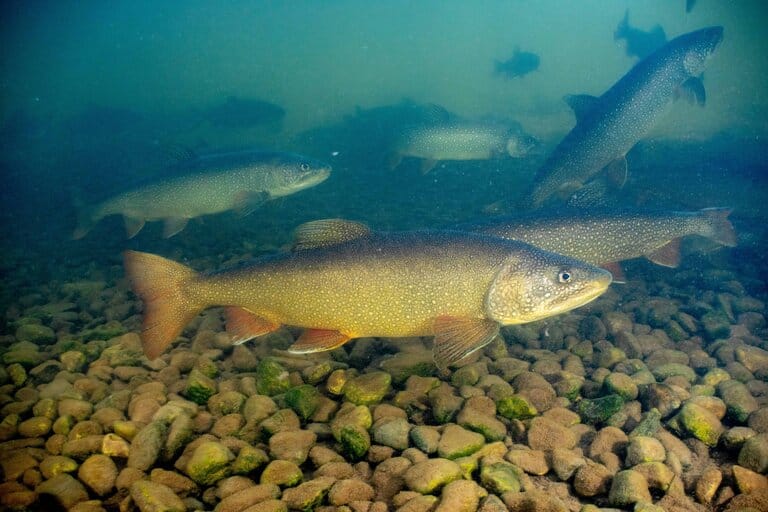
A school of tiger muskellunge fish swimming in their natural habitat, showcasing their striped patterns.
Most tiger muskies are in a lake because somebody put them there. They’re a northern pike × muskellunge hybrid, raised in hatcheries and stocked in modest numbers on purpose, so long stretches without a fish are built into the design. I haven’t caught one. Before the bucktail comes out, look up that lake’s rules for this fish, because where the limits differ from pure muskie you’ll want to know which one is in the net.
At a glance · A pike × muskellunge hybrid whose sterility is less simple than most agency summaries make it sound
Hybrid
Esox lucius × Esox masquinongy — northern pike × muskellunge.
Field marks
Bold dark vertical or slanting bars on a lighter body and rounded tail lobes; pattern and tail differ from most pure muskellunge.
Management
Most fisheries are intentionally stocked and maintained as low-density trophy-predator populations.
Sterility
Many state agencies describe stocked tiger muskies as sterile. USGS literature synthesis qualifies this: males are sterile, while females may be fertile and capable of backcrossing.
Habitat
Vegetation edges, points, weed canopies, wood, breaks, and nearby open-water forage; seasonal depth follows temperature and prey.
Handling
Heavy tackle, large net, long pliers, hook cutters, jaw-spreader only when appropriate, and release tools ready before the first cast.
The rounded tail matters more than the nickname
Identification
Tiger muskellunge
Minnesota DNR identifies tiger muskellunge by their rounded tail fins and hybrid pattern. Dark vertical or slanting bars commonly cross a lighter green-gray background, producing the tiger-like appearance that gives the fish its name.
Northern pike normally show light spots on a darker background rather than dark bars on light. Pike also have five or fewer sensory pores per side under the jaw in Minnesota’s key, while pure muskellunge have six or more. Hybrids can show intermediate meristics, so pore count alone should not be forced into a pure-species rule.
Pure muskellunge usually have more sharply pointed tail lobes and can be barred, spotted, or lightly marked depending on strain. A tiger’s rounded tail plus bold hybrid pattern is more useful than “it has stripes.” Where legal limits differ, photograph and identify carefully before harvest.
The population usually begins in a hatchery
Stocking & Reproduction
Intentional introductions
USGS reports tiger muskellunge intentionally stocked for sport fishing in most documented locations. Minnesota still maintains specific metropolitan tiger-muskie lakes through scheduled fingerling stockings, confirming that stocking is an active recruitment mechanism rather than an old historical event.
Minnesota describes the tiger muskie as a sterile hybrid, which accurately reflects the management expectation for stocked fisheries. USGS, however, summarizes older literature stating male tiger muskellunge are sterile while females are often fertile and can backcross. Both statements belong in the profile because “sterile” is operationally useful in hatchery management but biologically more qualified than a universal sex-independent rule.
USGS notes that tiger muskellunge can also arise naturally where northern pike and muskellunge overlap, particularly after pike have been introduced into native muskie waters. A tiger muskie is therefore not proof that the fish was individually stocked, even though most managed populations are hatchery-supported.
Minnesota stocking plans place relatively modest numbers of fingerlings into individual metro lakes on annual or alternating-year schedules. That creates a predator fishery where low encounter rates are expected. A five-hour fishless session can occur on a properly managed lake with healthy fish simply because there are not many adults per acre.
Minnesota describes tiger muskies as growing rapidly but generally not reaching the maximum size of pure muskellunge. That tradeoff is part of their management value: quicker development of a large predator in a fishery that can be adjusted through stocking.
Before writing off a lake, find out whether it’s stocked every year or every other year — but don’t read the off year as an empty lake. The adults from earlier stockings are still swimming around in there. What the schedule really tells you is how few of them you’re working with.
Where does the fish sit?
Habitat & Seasonal Position
Cover
New Jersey’s tiger-muskie guidance emphasizes weed edges and weed canopies. In stocked reservoirs and natural lakes, points, submerged vegetation, wood, drop-offs, and the first deep edge next to forage all create ambush positions. The species is not permanently buried in weeds; open-water prey can pull large fish away from visible cover.
Cool water expands shallow habitat and can bring prey onto flats, points, and weed growth. These seasons are often easier for covering water because temperature does not force predator and prey into narrow deep layers.
Summer
As water warms, fish may use deeper weed edges, breaks, shade, or suspended forage. A hot surface is not a command to fish the deepest basin; find where usable temperature, oxygen, and prey overlap.
Ambush predator, long search
Presentation
Large moving baits
Muskie-style bucktails, jerkbaits, crankbaits, swimbaits, and large topwaters are conventional tools where legal. The lure’s job is to cover high-value water at a controllable depth and trigger a predator that may see many casts before one fish commits.
Figure-eight
Minnesota’s muskie guidance emphasizes finishing casts at boatside because follows can continue all the way to the angler. A figure-eight or wide finishing turn changes direction and speed without ending the presentation. It is not superstition; it keeps a visible follower in a moving strike opportunity.
A follow without a strike is still location data. Mark the exact weed point, depth, light, wind, and retrieve angle. On a low-density fishery, returning to one known adult’s route later can be more rational than abandoning the lake for new water.
Handling is part of the tackle system
Release
Heavy gear shortens the fight
Muskie tackle is heavy partly because the fish is large and toothy, but also because long exhausted fights make release harder. Use a rod, line, leader, and drag capable of controlling the expected fish and lure.
Tools before fish
Have a large coated or knotless net, long-nose pliers, hook cutters, and release tools immediately available. Keep the fish supported in the net while hooks are controlled rather than laying it in the boat while equipment is found.
Air exposure
Keep measurement and photography brief, support the body horizontally, and revive the fish in the water until it can hold itself. Warm water warrants extra restraint because oxygen demand and fight stress are higher.
— · Where the sources disagree
Is a Tiger Muskie Sterile?
Here’s where I’d stop nodding along: Minnesota and other agencies call the stocked tiger muskie sterile, full stop. USGS’s synthesis says something narrower — males are sterile, females may not be, and backcrossing is on the table. For a hatchery program that gap is a rounding error, because stocking is doing the recruitment work either way. For anyone about to repeat “tiger muskies can’t reproduce” as settled biology, it isn’t.
Low density cuts both ways. A blank day proves almost nothing about the lake. A single follow, on the other hand, proves a lot: that fish has a spot and a route, and there aren’t many others out there to muddy the picture. Swapping lures after a quiet morning is mostly nerves. Going back to the weed point where a fish followed is a plan.
FEEDING ECOLOGY · STANDARDIZED
How this fish gets fed.
Primary prey
Fish are the central prey class for this large esocid hybrid; the profile’s management and angling sources support a fish-eating ambush predator rather than one narrow forage species.
Feeding mode / location
An ambush predator using weed edges and canopies, points, wood, breaks, and nearby open-water forage. Fish can leave visible cover when prey schools move offshore or suspend.
Diel / seasonal pattern
The profile supports seasonal movement more strongly than a fixed daily feeding clock: cool spring and fall conditions expand shallow habitat, while summer can push fish toward deeper weed edges, breaks, shade, or suspended forage. No universal diel feeding window is established here.
Ontogenetic diet shift
The sources behind this page don’t cover it.
The summary does not borrow an age-specific diet sequence from northern pike or pure muskellunge.
Lake FishPredominantly lake- and reservoir-centered U.S. fish profiles covering habitat, behavior, seasonal movement, fishing approaches, regional variation, and memorable biology without duplicating the River Fish cluster unless the lake fish is a distinct species, hybrid, or landlocked form. Start with Lake Fish of the United States: Species Profiles.27 articles
Species & BehaviorFish behavior, habitat, depth, forage relationships, and species-specific field decisions. Start with the Freshwater Fish Species field guide.159 articles
Cookie Consent
We use cookies to improve your experience on our site. By using our site, you consent to cookies.
Contains information related to marketing campaigns of the user. These are shared with Google AdWords / Google Ads when the Google Ads and Google Analytics accounts are linked together.
90 days
__utma
ID used to identify users and sessions
2 years after last activity
__utmt
Used to monitor number of Google Analytics server requests
10 minutes
__utmb
Used to distinguish new sessions and visits. This cookie is set when the GA.js javascript library is loaded and there is no existing __utmb cookie. The cookie is updated every time data is sent to the Google Analytics server.
30 minutes after last activity
__utmc
Used only with old Urchin versions of Google Analytics and not with GA.js. Was used to distinguish between new sessions and visits at the end of a session.
End of session (browser)
__utmz
Contains information about the traffic source or campaign that directed user to the website. The cookie is set when the GA.js javascript is loaded and updated when data is sent to the Google Anaytics server
6 months after last activity
__utmv
Contains custom information set by the web developer via the _setCustomVar method in Google Analytics. This cookie is updated every time new data is sent to the Google Analytics server.
2 years after last activity
__utmx
Used to determine whether a user is included in an A / B or Multivariate test.
18 months
_ga
ID used to identify users
2 years
_gali
Used by Google Analytics to determine which links on a page are being clicked
30 seconds
_ga_
ID used to identify users
2 years
_gid
ID used to identify users for 24 hours after last activity
24 hours
_gat
Used to monitor number of Google Analytics server requests when using Google Tag Manager
1 minute
Jetpack's built-in visitor analytics. It records page views, referring sites, search terms, and outbound link clicks, and also carries the shared visitor-tracking library used by Jetpack Instant Search and WooCommerce Analytics.