Dusky Rockfish school over offshore banks and gullies, often well above the bottom. Until 2004 the name also covered the shallow fish now called Dark Rockfish, so color alone won’t tell you which one is in your hands.
By HunterUpdated September 19, 2026Read 8 min
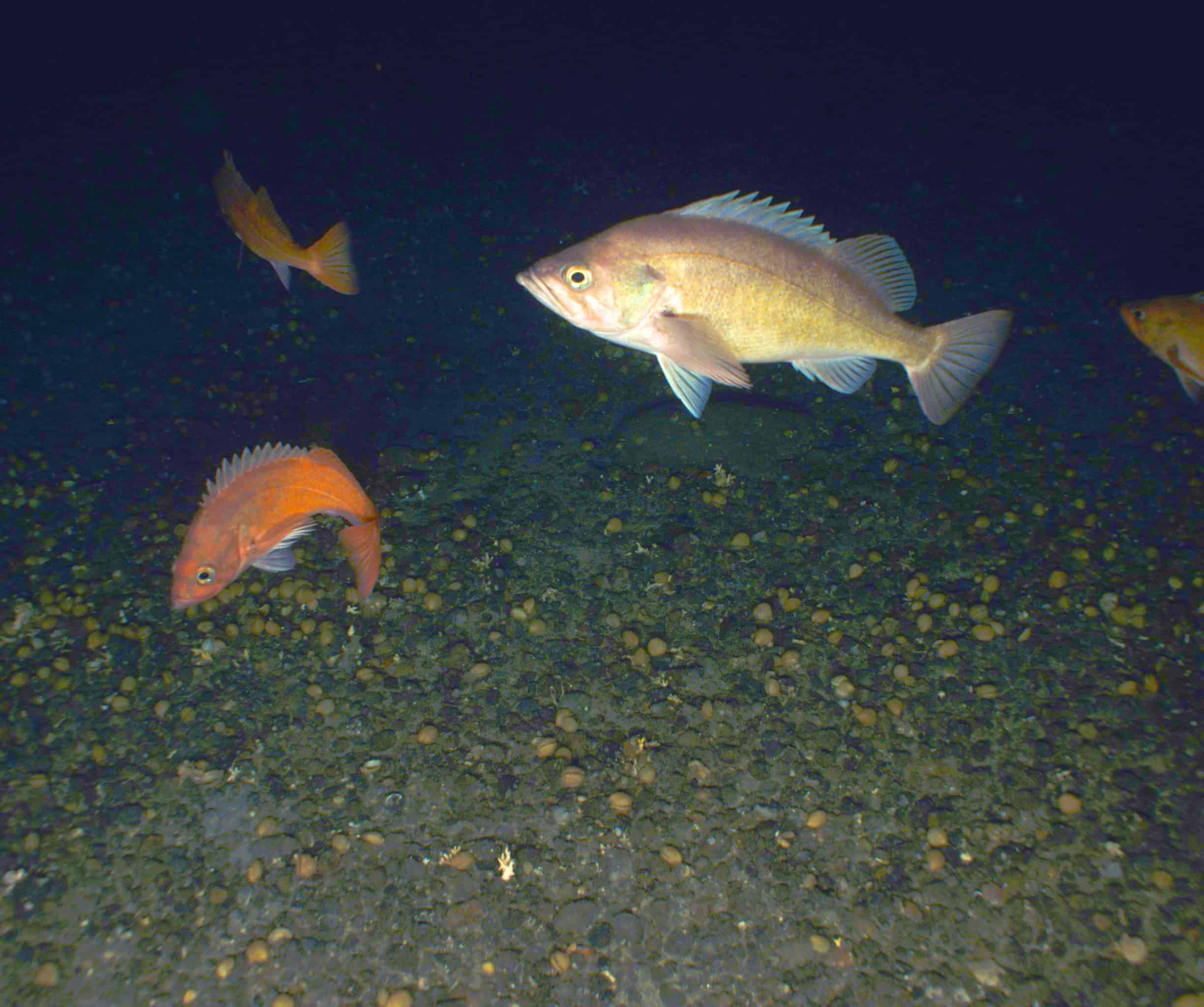
Dusky Rockfish (Sebastes variabilis) over rocky and coral habitat in the Gulf of Alaska. NOAA/NMFS; color correction by NOAA Fisheries.
Before 2004, “dusky rockfish” covered two different fish. Sebastes variabilis is the deeper, variably colored one that kept the Dusky name. The shallow dark one is now Sebastes ciliatus, Dark Rockfish. The NOAA/ADF&G revision that split them changes how you tell one from the other and where you should expect to find it, and it matters for management too.
At a glance · The short version
Scientific name
Sebastes variabilis
Do not confuse with
Dark Rockfish, Sebastes ciliatus, the shallower dark member of the former dusky-rockfish complex.
Management type
Alaska classifies Dusky Rockfish as pelagic / pelagic-shelf rockfish.
Adult habitat
Offshore banks, gullies, rocky shelf habitat and midwater above hard bottom, commonly around 100–200 m in Gulf of Alaska work.
Life history
ADF&G lists maximum age about 76 years and maturity around age 9.
Field rule
Identify before retaining. Dusky, Dark, Black and Silvergray Rockfish can overlap visually but do not belong to one management bucket.
Which rockfish is this?
Identification
Color is variable
The common name is more honest than it sounds: ADF&G describes Dusky Rockfish as golden yellow, greenish brown, or dark gray, often with a pink belly. That range is wide enough that color cannot be the only character. A dark fish is not automatically Dark Rockfish, and a gray fish is not automatically Black Rockfish.
ADF&G points anglers to pores on the lower jaw when separating dark-colored rockfish. Black Rockfish lack the mandibular pores used in the Dark/Dusky comparison. Those pores are a better field character than simply deciding one fish looks blacker than another under deck lights.
The 2004 taxonomic revision separated the deeper, more variably colored S. variabilis from the shallow-water Dark Rockfish S. ciliatus. Depth is supporting evidence, not proof, but a fish from offshore shelf water around 100–200 m fits Dusky far better than a dark fish taken on shallow nearshore reef.
ADF&G lists a maximum size of about 59 cm / 23.2 in, maximum age near 76 years, and maturity around age 9. That is not an invitation to age a fish from its length; it is the reminder that even a pelagic-shelf rockfish is still a slow life-history animal compared with most coastal game fish.
NOAA describes Dusky Rockfish from southern British Columbia north through the Gulf of Alaska and Bering Sea and west toward Japan, with the strongest abundance in the Gulf of Alaska. The 2026 Pacific Coast stock-definition analysis notes the light/dusky form extends south into central Oregon, but the species has not been assessed in the California Current the way it has in Alaska.
Calling them bottom fish skips the most useful part. Adult Dusky Rockfish are associated with offshore banks, gullies and hard rocky shelf habitat, but Alaska sources also describe midwater schooling. The structure sets the neighborhood; the fish can suspend above it. Treat every dusky mark like a bottom ambush fish and you can spend the day putting a jig underneath the school.
The current Pacific Coast stock-definition analysis describes juvenile Dusky Rockfish as pelagic and shallower, with fish moving deeper as they age. One habitat doesn’t describe this fish’s whole life. Surface and nearshore juvenile records don’t mean adults should be searched for in the same depth band.
NOAA’s Gulf of Alaska assessment describes adults concentrated on offshore banks and near gullies on the outer shelf, often around 100–200 m. Aleutian survey catches have also centered roughly around 125–200 m. Those are regional observations, not a universal depth prescription.
Like other Sebastes, Dusky Rockfish are livebearers rather than nest-building egg layers. NOAA’s Alaska research emphasizes that rockfish reproductive schedules differ by species and location and that older females can contribute disproportionately to production. Borrowing a spawning month or fecundity number from some other rockfish just to fill a card would be guessing, so neither one shows up here.
ADF&G lists age at maturity around nine years. That is the useful management fact: a population can lose years of future reproduction when adult removals outpace the slow replacement schedule.
Alaska food-web datasets include Dusky Rockfish among species with diet records, but diet composition shifts with size, location and available prey. The durable field inference is that a pelagic-shelf school can use small fish and zooplanktonic prey above structure; this page deliberately does not invent a coastwide percentage for herring, krill or sand lance.
Evidence level. Depth, pelagic-shelf behavior, adult bank/gully habitat and identification are sourced. The presentation decisions below translate that ecology into an angling plan and remain field inference rather than claimed personal experience.
Read the sonar verticallyinference
If fish are marking 10 or 20 m above the shelf, stop the jig in that band. Do not automatically pound bottom because the chart says rockfish. The habitat can be bottom-oriented while the feeding fish are suspended.
Search edges, not featureless depthinference
Banks, gullies, rocky breaks and outer-shelf relief create the physical reference. A school hanging off the face or over the lip is still using that structure even when the marks are off bottom.
Do not chase an uncertain ID deeper
If the first fish reveals that the school contains a species you cannot retain or cannot identify confidently, change depth, location or target rather than continuing to generate release mortality from the same aggregation.
Release is part of targeting
Barotrauma & Handling
Deepwater release
Rockfish brought rapidly from depth can suffer barotrauma. Alaska’s 2026 Southeast rules require a functional deepwater release device aboard and require unretained rockfish to be released at capture depth or 100 ft, whichever is shallower. Other Alaska regions have their own rules, but the preparation principle travels: the descender belongs rigged before the first drop.
Use the release method required or recommended for the jurisdiction. A descending device returns the fish toward the pressure where the gas expanded, without asking an angler to guess at internal anatomy.
Where the record can mislead
Source Disagreements & Open Questions
Older “dusky” records
Before the 2004 revision, records under S. ciliatus can mix today’s Dark and Dusky Rockfish. Geography, depth and specimen identity matter before reusing an old measurement.
Maximum age
ADF&G’s current identification program lists 76 years, while individual aging datasets and older regional work may report lower observed maxima. A maximum observed in one sample is not the species ceiling.
Not established here
What this profile will not pretend to know
a coastwide spawning month
a single depth that applies from Oregon to the Aleutians
a universal prey percentage
a color-only field identification rule
that every old “dusky rockfish” paper studied S. variabilis
Identification under pressure · Do not count by color alone
Three Jaw Pores Beat “Sort of Brown”
Dusky check
Look for three pores on each side of the lower jaw and two dark cheek bars, with pink or orange tinting on the fins. Water color and deck light can erase the subtler hues.
It takes krill and small fish somewhere between the rock and the open water above it, and which one depends on where the krill went that day.
What it eats
Euphausiids and other pelagic crustaceans, small fishes, and squid are important prey.
How and where it hunts
A schooling midwater-to-demersal rockfish associated with rocky shelf and slope habitat, feeding in the water above structure as well as near bottom depending on prey depth.
When it feeds
The profile does not establish one universal daily feeding window. Depth, prey layer, current and season are stronger context than a fixed clock.
What changes as it grows
Not established with enough post-split Dusky Rockfish detail in this profile’s cited source set to state a fixed juvenile-to-adult sequence.
Because the species was only recently separated taxonomically, older rockfish feeding literature is not automatically assigned to it.
Taxonomy, Identification, and Current Alaska Rules
Reviewed 2026-09-14. Dusky rockfish belong to Alaska’s pelagic management group, but group limits and emergency restrictions vary by area. Use cheek bars, lower-jaw pores, fin color, and the current identification key before counting a fish toward a limit.
The maximum age is where the sources split: ADF&G’s current identification program prints 76 years, while older regional aging work and individual datasets report lower ceilings. The oldest fish in one sample isn’t the ceiling for the species, so the lower numbers don’t cancel the 76. The question I’d want answered is how much of the older aging data comes from before the 2004 split, back when a “dusky rockfish” on paper could have been either species. I haven’t fished for duskies, so that one belongs to whoever holds the otoliths, not to a guess from me.
FIELD OBJECT
This one should leave the page.
The article is the long version. These are the pieces worth carrying into the next trip.
The 30-second version
Dusky Rockfish school over offshore banks and gullies, often well above the bottom. Until 2004 the name also covered the shallow fish now called Dark Rockfish, so color alone won’t tell you which one is in your hands.
What to watch
Identification
Range & Habitat
Life History & Feeding
Field Decisions
Field card
a coastwide spawning month
a single depth that applies from Oregon to the Aleutians
a universal prey percentage
a color-only field identification rule
that every old “dusky rockfish” paper studied S. variabilis
RIGHT TOOL, NEXT
Species & Presentation
Carry the species behavior and presentation question into a narrower water-to-fish-to-presentation handoff.
We use necessary cookies to operate the site. With your choice, we may also use analytics and advertising cookies. Choose Accept All, Reject, or Preferences.
Contains information related to marketing campaigns of the user. These are shared with Google AdWords / Google Ads when the Google Ads and Google Analytics accounts are linked together.
90 days
__utma
ID used to identify users and sessions
2 years after last activity
__utmt
Used to monitor number of Google Analytics server requests
10 minutes
__utmb
Used to distinguish new sessions and visits. This cookie is set when the GA.js javascript library is loaded and there is no existing __utmb cookie. The cookie is updated every time data is sent to the Google Analytics server.
30 minutes after last activity
__utmc
Used only with old Urchin versions of Google Analytics and not with GA.js. Was used to distinguish between new sessions and visits at the end of a session.
End of session (browser)
__utmz
Contains information about the traffic source or campaign that directed user to the website. The cookie is set when the GA.js javascript is loaded and updated when data is sent to the Google Anaytics server
6 months after last activity
__utmv
Contains custom information set by the web developer via the _setCustomVar method in Google Analytics. This cookie is updated every time new data is sent to the Google Analytics server.
2 years after last activity
__utmx
Used to determine whether a user is included in an A / B or Multivariate test.
18 months
_ga
ID used to identify users
2 years
_gali
Used by Google Analytics to determine which links on a page are being clicked
30 seconds
_ga_
ID used to identify users
2 years
_gid
ID used to identify users for 24 hours after last activity
24 hours
_gat
Used to monitor number of Google Analytics server requests when using Google Tag Manager
1 minute
Jetpack's built-in visitor analytics. It records page views, referring sites, search terms, and outbound link clicks, and also carries the shared visitor-tracking library used by Jetpack Instant Search and WooCommerce Analytics.