Black Rockfish Often Ride Near the Surface, Not the Bottom
Black rockfish school above nearshore reef and kelp instead of hugging bottom, take six to eight years to mature, and give birth to live young. Fish the layer they’re in, and check the belly and jaw before you name a dark fish.
By HunterUpdated September 23, 2026Read 6 min
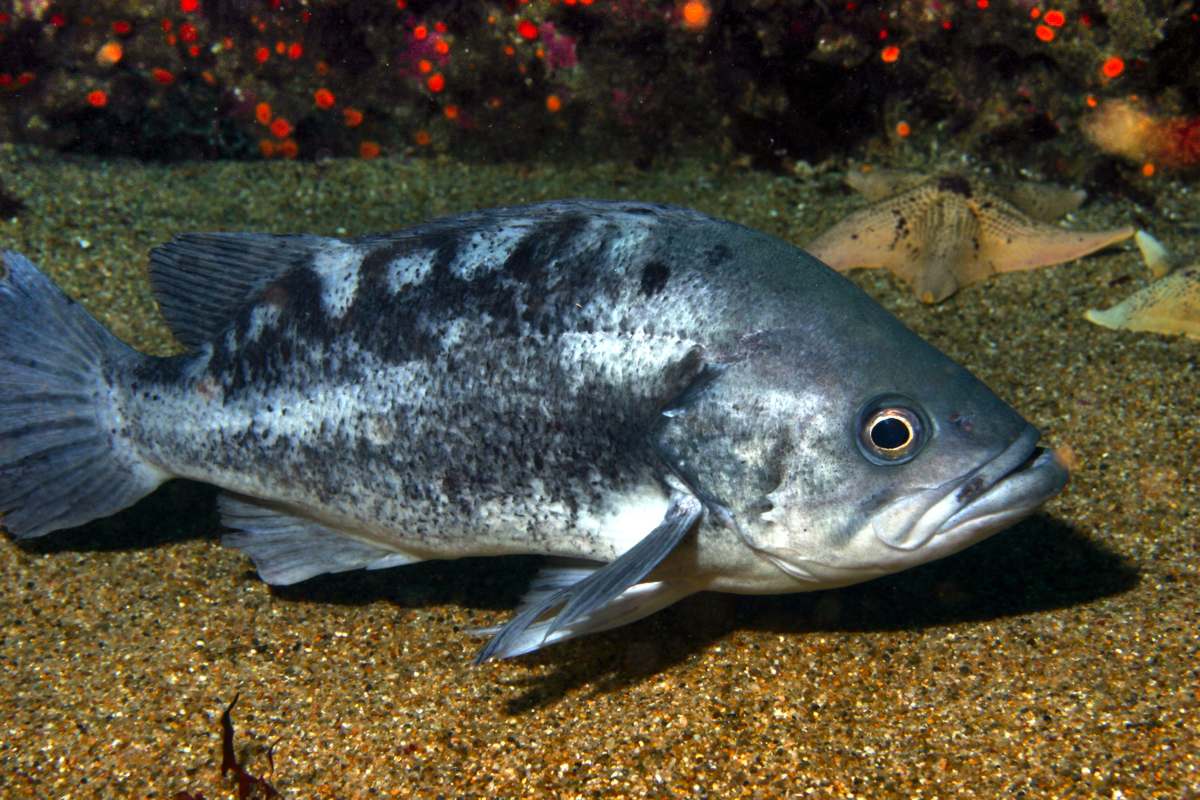
Black Rockfish (Sebastes melanops) settled on coarse sand at the edge of rock, with the dark saddling across the back and the black speckling that carries up onto the spiny dorsal fin. Photo: Chad King / NOAA Monterey Bay National Marine Sanctuary, public domain.
Say “rockfish” and most people picture something cranked up off the bottom with its eyes bugging out. Black rockfish mess that picture up. Sebastes melanops schools in the water column around nearshore rocky reefs and kelp, can live about 50 years, doesn’t mature until roughly age six to eight, and gives birth to live young after internal fertilization. A fish holding somewhere up in the column is the same puzzle a reservoir hands you in July — depth first, lure second — and that’s the part below worth arguing about. The biology is agency-measured and cited. The fishing logic is inference, and it’s labeled that way.
At a glance · The short version
Scientific name
Sebastes melanops
Maximum age
About 50 years in current ADF&G species guidance; Alaska samples include fish into the 50s.
Maturity
Roughly age 6-8 around 38-42 cm in Alaska/West Coast references.
Reproduction
Internal fertilization; females store sperm and release live larvae.
Search pattern
Nearshore kelp/rock plus midwater schools; do not default every presentation to bottom.
What fish is this?
White Belly, Dark Body, No Lower-Jaw Knob
Adult appearance
ADF&G describes adults as dark gray to black with light-gray mottling and a white or lightly colored belly. Dark bars can run from the eye toward the gill plate.
ADF&G separates black rockfish from dark and dusky species using the white belly plus the absence of pores/knob on the lower jaw. A wet dark fish should therefore get a jaw/belly check rather than a color-only call.
ADF&G notes rockfish dorsal spines can deliver relatively mild venom and still cause pain/swelling or infection. ‘Mild’ does not mean grab the dorsal fin bare-handed.
Black rockfish associate with nearshore rocky reef and kelp but are pelagic enough to school above and beside structure. Alaska’s Statewide Rockfish Initiative describes adults schooling over high-relief rocky habitats and among kelp beds.
Newly settled/juvenile black rockfish use shallow nearshore habitat including eelgrass before shifting toward adult rocky/kelp habitat. That nursery phase means a healthy adult fishery starts well inside the shallow coastal zone.
ADF&G outreach cites relatively small home ranges for black rockfish. A productive nearshore reef can therefore repeatedly expose the same school even though the fish are more mobile in the water column than quillback/yelloweye.
ADF&G lists zooplankton, Dungeness-crab larvae, herring, sand lance, and other fish, with benthic crustaceans/octopus also taken. The prey list explains why black rockfish can move between plankton-feeding and fish-feeding modes without leaving the same reef system.
If a school is visibly 20 feet over the reef, fish that layer. Dropping every lure to bottom can put the presentation below a pelagic school and create unnecessary nonpelagic bycatch.
Reproduction
Live Young After Years of Delay
Maturity
ADF&G reports black rockfish becoming sexually mature around six to eight years and 38-42 cm. This is not a fast-recruiting nearshore fish just because it schools visibly and can be easy to catch when found.
Females store sperm after mating; fertilization is internal, embryos develop inside the ovary, and live larvae are released in winter/spring. ADF&G gives roughly 125,000-1.2 million eggs per season depending on female size.
Alaska research shows strong and weak year classes rather than smooth annual replacement. A good recruitment year can support the fishery for decades; multiple poor recruitment years can leave a hole that is not obvious from one good day on one school.
Evidence level. Inference, and it belongs up here rather than buried at the bottom. What follows is built from how this fish feeds and where it sits in the water, not from a season of doing it.
First scanfield logic
Look for kelp-edge bait, birds, surface boils, and sonar schools over rocky relief. The free information is vertical: if the fish are up, keep the lure up.
Jig/fly depthinference
Cast and count through several depths rather than immediately bottoming out. When the first two fish come from the same layer, treat that layer as the pattern until it changes.
Bycatch avoidancedecision rule
If nonpelagic/protected rockfish start appearing from the deeper side, move shallower or lift the presentation. One of the advantages of a pelagic target is being able to get away from bottom without abandoning the species.
Barotrauma and handling
Shallow Doesn’t Always Mean Shallow Enough
Pressure injury
Black rockfish can still be caught deep enough to develop barotrauma. ADF&G specifically warns anglers not to puncture the protruding esophagus/stomach area and discusses recompression/descending methods used elsewhere.
Stay above the reef and fish the school instead of adding bottom contact.
Only dark fish, uncertain ID
Check white belly and lower jaw; do not sort black/dark/dusky from darkness alone.
Same reef gets harvested repeatedly
Treat the small-home-range school as locally exhaustible even if the species is pelagic.
Deep release cannot descend
Use current regional recompression/descending guidance and rethink the depth if repeated release failures appear.
— · Not established
Where the Schooling Evidence Stops
a universal tide/window for surface schooling
a claim that pelagic black rockfish roam unlimited coastwide distances
a color-only ID against dusky/dark rockfish
A quick pile of these off a kelp edge feels like abundance to whoever’s counting fish over the rail. ADF&G’s own number complicates that: six to eight years before a fish is even old enough to spawn once. That’s the stat I’d want in my head before deciding a fast bite means the reef can take another one just like it. A good afternoon and a healthy stock still aren’t the same measurement.
School height · The sonar mark changes the rig
Do Not Drop Through the Fish You Came to Catch
Marks above bottom
Stop the lure above the school and work the top edge. Dropping through it wastes time in snag water and increases unwanted demersal-rockfish contact.
Marks pinned to relief
Slow the boat, reduce horizontal scope, and make shorter controlled passes. If Quillback Rockfish appear, raise the presentation or relocate.
Identification handoff
Compare the uniform dark body and absent lower-jaw pores with Dusky Rockfish and the projecting jaw of Silvergray Rockfish before applying a management group.
— · Sources
FEEDING · IT COMES UP FOR THE BAIT
The school leaves the rock and follows bait toward the surface, so a jig on the bottom can end up well under the fish.
What it eats
Fishes, euphausiids and other crustaceans, crab larvae, and squid are important prey.
How and where it hunts
A schooling nearshore rockfish that often feeds above reef, kelp, pinnacles and rocky structure rather than remaining pinned to bottom. It can rise into the water column or near the surface with bait.
When it feeds
The profile does not support one universal diel feeding window. Bait depth, current, kelp/reef structure and season determine whether schools are near surface, midwater or deeper.
What changes as it grows
Young fish emphasize zooplankton and small crustaceans; larger Black Rockfish broaden toward fishes, larger crustaceans and squid.
Being the rockfish most likely to be near the surface does not make surface water its permanent feeding layer.
Reviewed 2026-09-14. Black rockfish are managed as pelagic rockfish in Alaska, but limits can be tightened by area and emergency order. On March 4, 2026, ADF&G announced temporary North Gulf Coast and Cook Inlet restrictions that ran through September 15, 2026. That order has now expired, and the next one can arrive with just as little warning, which is exactly why an old screenshot or last year’s booklet isn’t enough.
FIELD OBJECT
This one should leave the page.
The article is the long version. These are the pieces worth carrying into the next trip.
The 30-second version
Black rockfish school above nearshore reef and kelp instead of hugging bottom, take six to eight years to mature, and give birth to live young. Fish the layer they’re in, and check the belly and jaw before you name a dark fish.
What to watch
White Belly, Dark Body, No Lower-Jaw Knob
Nearshore Structure With Room Above It
The Water Column Is a Pantry
Live Young After Years of Delay
Field card
a universal tide/window for surface schooling
a claim that pelagic black rockfish roam unlimited coastwide distances
a color-only ID against dusky/dark rockfish
Alaska Department of Fish and Game: Black Rockfish — ID, age, maturity, reproduction, diet, barotrauma.
Alaska Fisheries Research Bulletin: Black Rockfish — age/growth and variable recruitment.
RIGHT TOOL, NEXT
Species & Presentation
Carry the species behavior and presentation question into a narrower water-to-fish-to-presentation handoff.
We use necessary cookies to operate the site. With your choice, we may also use analytics and advertising cookies. Choose Accept All, Reject, or Preferences.
Contains information related to marketing campaigns of the user. These are shared with Google AdWords / Google Ads when the Google Ads and Google Analytics accounts are linked together.
90 days
__utma
ID used to identify users and sessions
2 years after last activity
__utmt
Used to monitor number of Google Analytics server requests
10 minutes
__utmb
Used to distinguish new sessions and visits. This cookie is set when the GA.js javascript library is loaded and there is no existing __utmb cookie. The cookie is updated every time data is sent to the Google Analytics server.
30 minutes after last activity
__utmc
Used only with old Urchin versions of Google Analytics and not with GA.js. Was used to distinguish between new sessions and visits at the end of a session.
End of session (browser)
__utmz
Contains information about the traffic source or campaign that directed user to the website. The cookie is set when the GA.js javascript is loaded and updated when data is sent to the Google Anaytics server
6 months after last activity
__utmv
Contains custom information set by the web developer via the _setCustomVar method in Google Analytics. This cookie is updated every time new data is sent to the Google Analytics server.
2 years after last activity
__utmx
Used to determine whether a user is included in an A / B or Multivariate test.
18 months
_ga
ID used to identify users
2 years
_gali
Used by Google Analytics to determine which links on a page are being clicked
30 seconds
_ga_
ID used to identify users
2 years
_gid
ID used to identify users for 24 hours after last activity
24 hours
_gat
Used to monitor number of Google Analytics server requests when using Google Tag Manager
1 minute
Jetpack's built-in visitor analytics. It records page views, referring sites, search terms, and outbound link clicks, and also carries the shared visitor-tracking library used by Jetpack Instant Search and WooCommerce Analytics.