Silvergray Rockfish Give Themselves Away at the Jaw
A silvergray’s long lower jaw with a knob on the end is the check that keeps it out of the Dusky pile. It lives deep, can reach about 82 years, and needs a real plan for release.
By HunterUpdated September 14, 2026Read 7 min
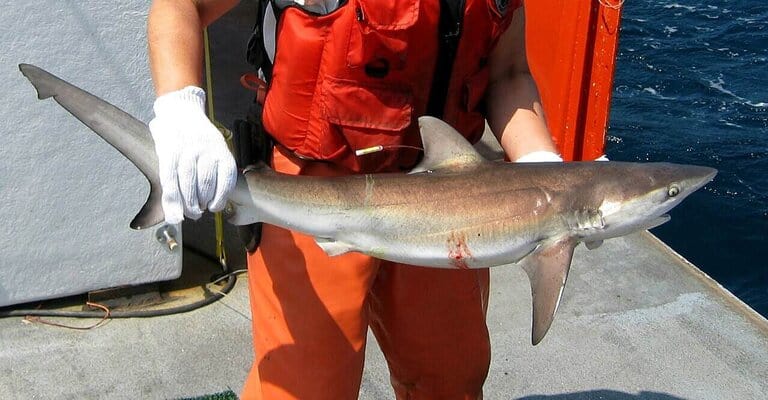
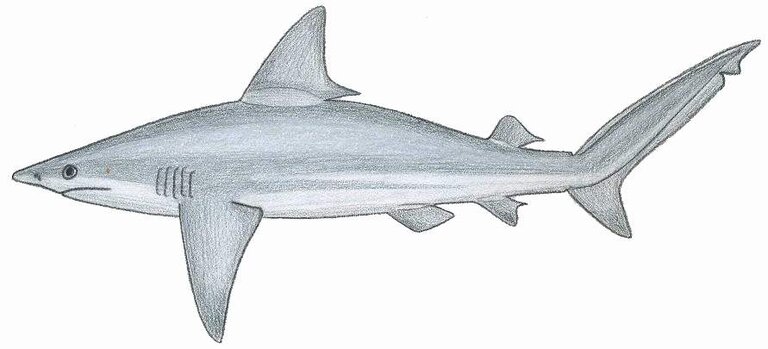
Silvergray Rockfish (Sebastes brevispinis), exact-species federal reference specimen. U.S. FDA Center for Food Safety and Applied Nutrition / Wikimedia Commons.
Silvergray Rockfish is an accurate name that still doesn’t help you much at the rail. Sebastes brevispinis can come up in the same Alaska rockfish mix as Dusky, Dark and Black Rockfish, but it’s built differently, lives deeper, and lands in a different management category. The long lower jaw and the body shape tell you more than the color in the name does.
At a glance · The short version
Scientific name
Sebastes brevispinis
Best ID clue
Long projecting lower jaw with a pronounced symphyseal knob, plus a long slender body and dark lips.
Management type
ADF&G classifies Silvergray Rockfish as nonpelagic / slope.
Typical Alaska survey depth
Southeast/Yakutat survey work found more than 99% of estimated biomass between about 101 and 300 m.
Longevity
ADF&G lists a maximum age around 82 years; age at maturity is currently listed as unknown.
Field rule
Do not use silver-gray color alone. Jaw shape, body proportions, pores and depth all belong in the call.
Which rockfish is this?
Identification
The jaw is the giveaway
ADF&G emphasizes the lower jaw: it projects well beyond the upper jaw and carries a large knob at the tip. That knob, called the symphyseal knob, changes the entire head profile. If the fish looks silver-gray but the lower jaw does not project strongly, keep working the identification.
Silvergray Rockfish are noticeably more elongated than Dusky Rockfish. NOAA’s field guide describes a long-bodied fish with a massive projecting lower jaw; ADF&G uses the body shape as one of the practical separators when Dark, Dusky, Black and Silvergray fish are laid side by side.
NOAA describes a dark gray-green to black back, silver sides, a sharp transition to red-orange or white ventrally, and blackened lips. Artificial deck light can move those colors around. The dark lips and jaw shape are more durable than deciding whether the flank looks “silver enough.”
ADF&G notes three lower-jaw pores, a character that Silvergray shares in the practical comparison with Dark and Dusky Rockfish. Pores alone do not solve the fish; the long jaw and slender head/body are what push the identification toward Silvergray.
NOAA’s identification guide gives the species a broad range from the Bering Sea south to Southern California. That does not mean it is equally common along that line. Alaska survey work found Silvergray Rockfish concentrated strongly in Yakutat and Southeast Alaska survey areas.
In the Gulf of Alaska survey synthesis, Silvergray Rockfish were caught overwhelmingly between 101 and 300 m, which accounted for more than 99% of estimated survey biomass. NOAA’s identification manual gives a common depth of roughly 100–300 m and records the species deeper. Those are survey patterns, not a rule that every fish lives at exactly the same depth.
ADF&G places Silvergray in the nonpelagic/slope management category. That is the practical contrast with Dusky Rockfish, which Alaska lists as pelagic/pelagic shelf. A long silver-gray fish coming from deeper slope water should trigger the jaw check before anything goes into the box.
NOAA survey work found mean fish size generally increasing with depth. That is useful as a population pattern, not a promise that the deepest mark contains the biggest fish. It does tell us that depth and age/size structure are linked enough to deserve attention in the trip log.
ADF&G lists a maximum age around 82 years and maximum size about 73 cm / 29.2 in. That puts Silvergray firmly in the slow-life-history rockfish problem even though the exact age at maturity remains unresolved in the agency identification table.
The current ADF&G identification program lists age at maturity as unknown. The blank stays a blank rather than borrowing another slope rockfish’s maturity schedule just because the family looks similar.
As a Sebastes rockfish, Silvergray is livebearing rather than a nest-spawning fish. NOAA’s broader rockfish work emphasizes species-specific maturity, skip-spawning and older-female effects; without a Silvergray-specific value in the current agency summary, the correct choice is to keep the mechanism and leave the unsupported schedule blank.
NOAA’s Alaska food-web tools include Silvergray Rockfish diet records, but prey composition varies by location and size. For field use, the durable point is that this is a deep slope predator, not a species with one coastwide “magic bait.” Match the presentation to what is showing in the same depth band rather than treating a generic rockfish diet list as a prescription.
Evidence level. Identification, depth distribution, longevity and management category are agency-sourced. The angling decisions below are inferences from those fields, not invented firsthand experience.
Search the slope, not just the pinnacleinference
A fish concentrated in 100–300 m survey depths and classified as slope rockfish deserves attention on the shoulder, gully, broken slope and mixed hard-bottom transition, not only on the most dramatic vertical rock.
ID the first fish before repeating the drop
If a drift is producing Silvergray, the management category has already changed from a Dusky/Black pelagic-rockfish scenario. Sort the fish while the first one is still fresh and visible rather than after a mixed pile accumulates.
Depth is a mortality variable
A deeper school is not automatically a better target if the fish are not retainable or the identification is uncertain. Every additional release from 200 m creates a release problem that does not exist in the same way in shallow water.
Release before the next drop
Barotrauma & Handling
Descending device
At the depths where Silvergray commonly occurs, barotrauma preparation is not optional trip organization.
Keep the fish wet and the ID fast
Photograph the side profile and jaw quickly if documentation is needed, then make the retain/release decision. A long identification debate on deck is the wrong way to solve a deep-water fish.
What remains unresolved?
Open Questions
Maturity
ADF&G currently lists age at maturity as unknown. That is a real gap, not a field to backfill with another slope rockfish.
Range versus fishable abundance
The species ranges far south of Southeast Alaska, but survey abundance is strongly concentrated in northern waters. Presence on a range map is not the same as a reliable recreational target.
Not established here
Left blank on purpose
a universal maturity age
a coastwide spawning month
a single prey percentage
a color-only ID rule
a guarantee that every deep mixed-bottom school is Silvergray Rockfish
The long lower jaw is the check, and it’s worth learning from photos before a real one is flopping around on deck. Get this ID wrong and you haven’t just misnamed a fish — you’ve put it in the wrong management category. I haven’t fished for silvergrays, so past the agency ID notes, the fishing calls here are inference from depth and survey data.
Jaw-first identification · Color comes second
The Lower Jaw Solves the First Question
Field mark
The slender body and long lower jaw projecting well beyond the upper jaw are more reliable than “silver-gray,” which changes underwater and on deck.
Management fork
Do not count it automatically with Black Rockfish or Dusky Rockfish. Alaska places silvergray in the slope group.
Next drop
If silvergray replace the intended species, change depth band or leave the structure. Repeatedly dropping into an unwanted school creates a release problem, not better information.
— · Sources
FEEDING ECOLOGY · STANDARDIZED
A Projecting Jaw in the Slope Band
Primary prey
Euphausiids and other pelagic crustaceans, small fishes, and squid are important prey.
Feeding mode / location
A deep schooling rockfish associated with shelf and slope habitat, feeding above and around rocky bottom rather than remaining fixed to the substrate.
Diel / seasonal pattern
The profile does not establish one universal diel feeding window. Prey layer, depth, current and season provide stronger context than a fixed clock.
Ontogenetic diet shift
The sources behind this page don’t spell out how the diet shifts from young fish to adult.
Deep-water occurrence is habitat context, not evidence of one fixed feeding depth.
Reviewed 2026-09-14. Silvergray rockfish are placed in Alaska’s slope-rockfish group, not the pelagic group used for black and dusky rockfish. The classification changes how the catch is counted. Verify the current area booklet and emergency orders before fishing.
A fish pulled up from 200 meters can’t just be tossed back and trusted to swim down on its own, which is why the descending device earns its spot in the boat. Skip it, and the same slope that quietly grows 82-year-old fish starts producing releases that never make it back to the bottom.
Saltwater & CoastalSurf, shoreline, nearshore, offshore, and deep-sea fishing — technique, gear, and safety content spanning the full range from the beach to blue water.103 articles
Species & BehaviorFish behavior, habitat, depth, forage relationships, and species-specific field decisions. Start with the Freshwater Fish Species field guide.159 articles
Cookie Consent
We use cookies to improve your experience on our site. By using our site, you consent to cookies.
Contains information related to marketing campaigns of the user. These are shared with Google AdWords / Google Ads when the Google Ads and Google Analytics accounts are linked together.
90 days
__utma
ID used to identify users and sessions
2 years after last activity
__utmt
Used to monitor number of Google Analytics server requests
10 minutes
__utmb
Used to distinguish new sessions and visits. This cookie is set when the GA.js javascript library is loaded and there is no existing __utmb cookie. The cookie is updated every time data is sent to the Google Analytics server.
30 minutes after last activity
__utmc
Used only with old Urchin versions of Google Analytics and not with GA.js. Was used to distinguish between new sessions and visits at the end of a session.
End of session (browser)
__utmz
Contains information about the traffic source or campaign that directed user to the website. The cookie is set when the GA.js javascript is loaded and updated when data is sent to the Google Anaytics server
6 months after last activity
__utmv
Contains custom information set by the web developer via the _setCustomVar method in Google Analytics. This cookie is updated every time new data is sent to the Google Analytics server.
2 years after last activity
__utmx
Used to determine whether a user is included in an A / B or Multivariate test.
18 months
_ga
ID used to identify users
2 years
_gali
Used by Google Analytics to determine which links on a page are being clicked
30 seconds
_ga_
ID used to identify users
2 years
_gid
ID used to identify users for 24 hours after last activity
24 hours
_gat
Used to monitor number of Google Analytics server requests when using Google Tag Manager
1 minute
Jetpack's built-in visitor analytics. It records page views, referring sites, search terms, and outbound link clicks, and also carries the shared visitor-tracking library used by Jetpack Instant Search and WooCommerce Analytics.