BROOK TROUT · SPECIES PROFILE
Small stream. Cold water. Spend the good cast first.
Brook trout are char, not true trout, and they’re tied to cold, clean water so tightly that the habitat usually tells you more than the fly box does. In a tiny stream the useful pocket might be three feet wide, and the fish may know you’re there before you’ve decided which cast to make.
Profile basis: National Park Service · Virginia DWR · Twardek et al. 2022
IDENTIFICATION
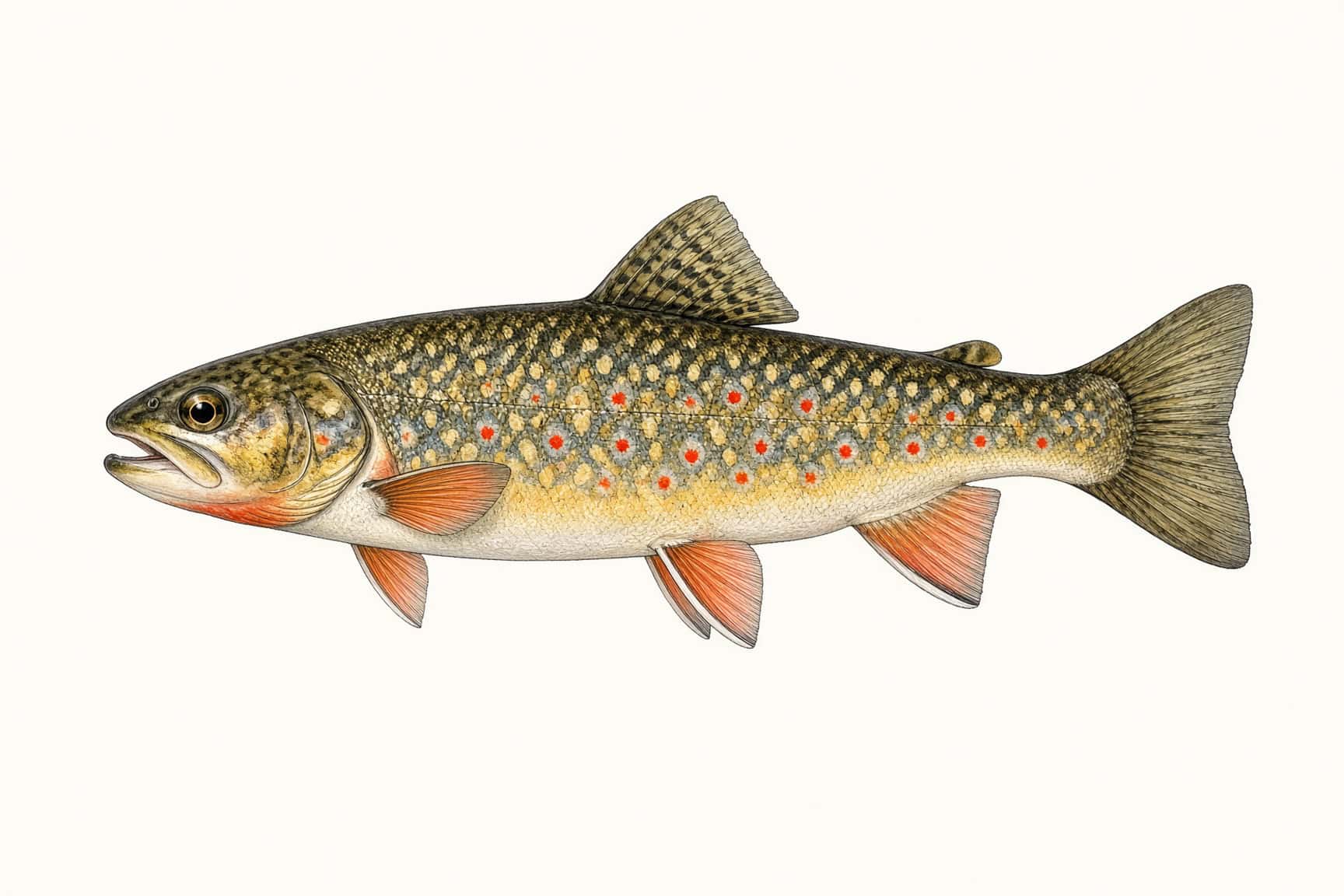
The back looks scribbled on.
The pale, worm-like markings across the back and dorsal fin are called vermiculations. Add the small red spots with blue halos and the white leading edges on the lower fins, and brook trout get fairly easy to recognize once you know what you’re looking at.
The color itself moves around. Headwater fish can be dark and intense. Lake-run and sea-run forms can go surprisingly silver. Spawning males can turn almost absurdly orange-red. Structure is safer than color.
They’re char, genus Salvelinus, which is why the light-spots-on-dark-ground pattern makes more sense once you compare them with lake trout, bull trout and Dolly Varden. Brown and rainbow trout generally carry dark spots on a lighter ground instead.
One western identification check matters more than the trivia
Where brook trout overlap bull trout, misidentification has conservation and legal consequences. Oregon’s bull-trout identification guidance tells anglers to focus on the dorsal fin: bull trout generally lack the distinct dark markings found on a brook trout dorsal. Both are char, so the usual “light spots on dark background” shortcut doesn’t separate them.
If you’re not sure in bull-trout country, that’s reason enough to handle the fish like it’s the protected one.
Sources: Oregon DFW · U.S. Fish & Wildlife Service
THE WATER HAS TO STAY COLD
If the stream cannot keep the temperature down, the fish does not get to negotiate.
Brook trout live in cold streams, spring-fed creeks, ponds and lakes with high oxygen and relatively clean substrate. The number that keeps showing up in agency guidance is around 20°C / 68°F as a practical upper edge for sustained habitat, even though laboratory fish can survive short exposure above that.
That distinction matters. A critical thermal maximum is not a fishing recommendation. A fish surviving a temperature for minutes in a laboratory does not mean it should be fought, handled and photographed in a stream sitting near its thermal limit.
Shade, groundwater and tributaries become part of the map because they create refuge. In summer, brook trout can move toward colder headwaters, spring inputs or deeper lake water. In winter, some populations move the opposite direction into larger mainstem water that was too warm in summer. Penn State work in Pennsylvania found about 20% of a brook-trout population using a larger mainstem as winter habitat, which is a useful reminder that “brook trout are headwater fish” is true and still incomplete.
Sources: U.S. Fish & Wildlife Service habitat model · Penn State — movement corridors
SMALL STREAMS
The fish may be six inches long. The approach can still be the whole problem.
Wild headwater brook trout are often small because the water is small. Six to ten inches can be an entirely normal adult. That does not make the fishing automatic.
Undercut banks, roots, boulders, fallen wood, pocket water and the head or tail of a little pool all create places where a fish can sit out of the hardest current while food still comes past. The soft side is often more important than the biggest-looking hole.
On water this tight, a bad approach can erase the test before the fly arrives. Standing tall over a clear pool, throwing a shadow across it, kicking gravel, dragging line through the pocket, or landing the first cast two feet past the useful lane can matter more than whether the fly was an Elk Hair Caddis or another small dry that looked close enough.
Virginia’s practical guidance gets this right: line management, accurate casting and a natural drift are the keys. A bow-and-arrow cast exists because sometimes the correct casting lane is basically shrubbery with water under it.
Sources: Virginia DWR — wild brook trout fishing · New Hampshire Fish and Game
FOOD
The trees feed the stream more than they look like they do.
Brook trout eat aquatic insects, terrestrial insects, crustaceans, worms and, when they get large enough, fish. The interesting part is how important the land can become.
A West Virginia bioenergetics study estimated terrestrial invertebrates supplied 38–47% of the annual prey biomass and 51–63% of the annual energy consumed in two headwater streams. Removing that terrestrial input from the model cut predicted annual growth dramatically. Summer was when the terrestrial contribution peaked.
That puts overhanging vegetation, beetles, ants, grasshoppers and other land insects in the same habitat story as shade. The trees cool the water and also drop food into it. A healthy bank is doing more than one job.
Large brook trout can become much more piscivorous. Maine work places the dietary shift toward fish around the 10–12-inch range, which is also a size many tiny-stream fish never reach. A lake brook trout and a six-inch Appalachian brookie should not be handed the same presentation menu just because the species name matches.
Sources: Utz & Hartman 2008 · Maine IFW
PRESENTATION
Natural enough to stay in the pocket. Simple enough to repeat.
Brook trout will take dry flies, nymphs, small streamers, spinners and legal bait. That broad appetite is why pretending one pattern “owns” brook trout is not especially useful.
A missed rise, refusal or fish bolting before the fly arrives is not “nothing.” It can point toward drag, shadow, approach or depth. Several clean passes through comparable pockets with no response is stronger evidence than one empty cast.
WARM WATER & RELEASE
The stream can still look beautiful after it has stopped being good trout water.
Catch-and-release work on 337 brook trout found reflex impairment increasing with air exposure and with warmer water. Larger fish were more vulnerable, and the combination of temperature and handling mattered more as the water warmed.
One useful result is that harm can begin before the water reaches a dramatic “lethal” temperature. That is why a rigid internet cutoff can be misleading. Local agencies may set specific voluntary or mandatory thresholds; use those. In their absence, rising temperature, low flow, long fights and fish that struggle to recover are all reasons to stop earlier rather than later.
The ten-second air-exposure rule from that study is easy to remember. Better still is not needing all ten seconds. Wet hands, fish supported in the water, hook out, fish gone.
Some days the right trout decision is to go find bass. The brook trout will not take it personally.
Source: Twardek et al. 2022 — air exposure, temperature and reflex impairment
AUTUMN
The gravel is carrying next spring’s fish.
Brook trout spawn in autumn as daylight shortens and water cools. Females dig redds in clean gravel, often where groundwater moves through the substrate. The eggs stay there through winter and hatch later, which means a redd remains vulnerable long after the adult fish leave it.
A clean patch of disturbed gravel in spawning water is not a convenient place to stand. Go around it. The fish do not guard the nest, so the practical conservation problem is not protecting a nest-guarding adult; it is not walking on the eggs.
Autumn also produces real movement. Pennsylvania telemetry found brook trout moving substantially during the spawning period, with rising stream flow increasing movement. A fish you thought “lived in that pool” can suddenly be using a different part of the drainage because the life-history job changed.
Sources: USGS — autumn movement · West Virginia DNR
NATIVE HERE, INVASIVE THERE
The same fish can be the restoration goal and the fish being removed.
In the eastern United States, brook trout are the native cold-water fish that many restoration programs are trying to protect and reconnect. Their range has contracted through warming, sediment, development, acidification, barriers and introduced competitors.
Move west and the story can reverse completely. Introduced brook trout have displaced native cutthroat trout, hybridized with threatened bull trout and been removed from western streams to restore native fish. Yellowstone’s Soda Butte Creek is one documented example of eradication.
So “brook trout conservation” can’t be one line tacked on at the bottom. First ask whether the fish is native to the drainage, because the responsible move can point in flat-out opposite directions depending on the answer.
Sources: Eastern Brook Trout Joint Venture · USGS NAS
DEEP REFERENCE · IF YOU CARE ABOUT THE ARGUMENTS
Good questions that don’t need answering before the first cast.
How hot is too hot?
The sources give several kinds of “upper limit”: sustained occupancy around 20°C, acute tolerance around 24–25°C, and much higher short-duration critical thermal maxima in laboratory tests. Those numbers answer different questions. For an angler, the sustained habitat and release-stress numbers are the useful ones; the fish’s maximum laboratory survival temperature isn’t a target.
Brook trout see well in very low light, so are they nocturnal?
Not necessarily. Forest Service work found extremely sensitive low-light vision, while 17 months of telemetry in a Newfoundland lake still found higher daytime activity in every season. Being able to see in the dark isn’t the same thing as a feeding schedule.
How acid-tolerant are they?
Brook trout can reproduce in surprisingly acidic streams, but pH alone doesn’t tell the whole story. Adirondack work shows inorganic aluminum mobilized by acidification can be the more direct biological problem, especially during spring high flow.
Coasters, salters, stream fish and pond fish
Brook trout express very different life histories. Great Lakes “coasters” and coastal “salters” can be much larger and more mobile than small resident headwater fish. Small-stream fish get most of the attention here because that’s the common angling situation, not because every brook trout lives that way.
Hybrids
Tiger trout are brook-trout × brown-trout hybrids; splake are brook-trout × lake-trout hybrids. Hatchery tiger trout are often deliberately produced as sterile fish, while splake can be fertile. Both are fun identification and management side stories, and neither is something you need to know before your first brook trout.
SOURCES
FEEDING ECOLOGY · STANDARDIZED
How this fish gets fed.
Warm-water handling thresholds are not presented as feeding-temperature optima.
The source shelf.
- National Park Service — Brook Trout
- Virginia DWR — Brook Trout
- Virginia DWR — Fishing Wild Brook Trout
- U.S. Fish & Wildlife Service — Habitat Suitability Model
- Twardek et al. 2022 — catch-and-release thresholds
- Utz & Hartman 2008 — terrestrial prey
- USGS — seasonal movement
- Penn State — larger-stream movement corridors
- USDA Forest Service — low-light vision
- Eastern Brook Trout Joint Venture
- USGS NAS — introduced brook trout
- Oregon DFW — bull trout identification
Profile reviewed 2026-09-02. Trout regulations, warm-water closures and bait restrictions vary by water. Check the current managing agency before the trip.