RAINBOW TROUT / STEELHEAD · SPECIES PROFILE
Same species. Two ways of spending a life.
A lot of people grow up thinking steelhead and rainbow trout are different fish. It’s an easy mistake when most of the rainbows you know live about as far from saltwater as a trout can get. They’re the same species, Oncorhynchus mykiss. A rainbow stays in freshwater. A steelhead leaves for the ocean and comes back, and that one trip changes its size, its timing, the water you fish for it and its conservation problem — without touching the species name.
Profile basis: NOAA Fisheries · Washington Department of Fish and Wildlife · Oregon Department of Fish and Wildlife
IDENTIFICATION
The tail spots help. The life history does not show up neatly in a photograph.
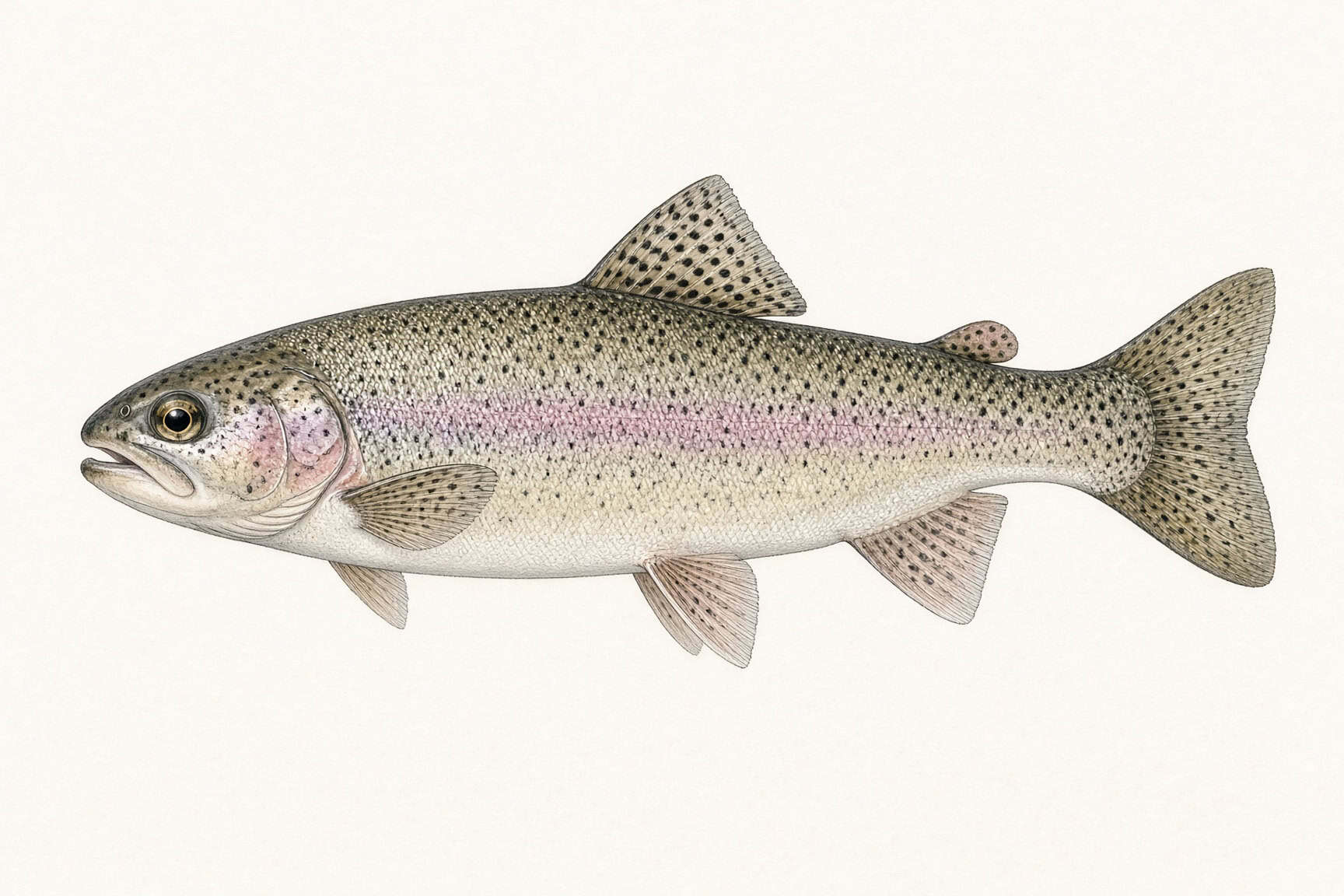
Rainbow trout usually carry a blue-green to olive back, silver sides, black spots over the body and tail, and a pink or reddish stripe along the side. Stream residents often show stronger color. Fresh steelhead returning from large water can look almost mint-silver, then darken and develop the lateral color again as they remain in freshwater.
Cutthroat trout are the important native comparison in much of the West. A bright orange or red throat slash points toward cutthroat; heavier head spotting and white fin tips point more toward rainbow ancestry. Hybrids make every single-trait shortcut less reliable. Idaho’s genotype-checked field work found pure cutthroat easier to identify correctly than hybrids or rainbows, which is a good reason not to act certain from one faint slash.
The stranger identification fact is that “steelhead” is not a second species. NOAA defines steelhead as the anadromous life-history type of rainbow trout. The fish that stays in freshwater is a rainbow. The fish that migrates to the ocean and returns is steelhead.
Sources: NOAA Fisheries · Idaho Fish and Game
IF YOU ARE FISHING A RESIDENT RAINBOW
Read the current like the food has to travel through it.
Resident rainbow trout use cold, oxygenated streams and lakes. In moving water, the most useful places often put a manageable holding lane beside faster water that delivers food: a seam, the head or tail of a pool, pocket water behind rock, a riffle edge, wood, an undercut bank or the slower side of a current break.
They are drift feeders as much as they are lure targets. Aquatic insects, terrestrial insects and small fish all matter, and the diet gets broader as the trout gets larger. In Grand Canyon work, growth was strongly tied to invertebrate prey and fish density; more trout competing for the same small food meant slower growth.
That makes a natural drift more useful than an elaborate fly list. A dry, nymph, small streamer, spinner or bait can all work if it travels through the lane at a speed and depth that makes sense. If the fly is skating across the seam or the spinner is being ripped out of the pocket by line belly, changing the pattern may just decorate the same mistake.
Small water also makes approach part of presentation. Trout generally face into the current. Working from downstream or quartering upstream can keep you out of their view longer and makes the line easier to manage through the lane.
Sources: National Park Service — Shenandoah · USGS Grand Canyon research
IF YOU ARE FISHING STEELHEAD
The fish is moving through the river, even when it pauses.
Steelhead hatch in freshwater, go to sea, grow much larger than most resident rainbows, and return to freshwater to spawn. That turns the river into both habitat and route.
New York’s Great Lakes guidance puts fish where two currents form a seam, above or below structure that buffers flow, and at the heads and tails of larger pools. Oregon’s coastal guidance adds an important high-water adjustment: fish softer water near the bank when the river is up. The point is not that every steelhead uses a three-to-four-foot lane. It is that a migrating fish still needs somewhere it can move or pause without sitting in the hardest current.
Run timing matters enormously. Oregon separates summer-run fish that enter freshwater from roughly May through October and may hold for months from winter-run fish that enter from roughly November through April and spawn relatively soon after. Alaska has its own fall and spring timing. Great Lakes fisheries use their own strain and tributary schedules. “Steelhead season” without a river is barely a season at all.
River level changes the answer too. New York notes fish moving during rising and falling water and holding during low flows or flooding. Oregon’s shorthand—“water high, fish high; water low, fish low”—is angler convention, not a law, but the physical lesson holds: flow changes where migration lanes and resting water exist.
Sources: Oregon DFW · New York DEC · Alaska ADF&G
STEELHEAD PRESENTATION
Different methods. Same demand: know the lane.
Drift fishing, float fishing, swinging flies, swinging spinners, plugs and plunking all show up in agency guidance because they solve different current problems.
A steelhead can still refuse all of this. The point is not to make the fish predictable. It is to make the presentation understandable enough that one response—or a clean lack of one—actually tells you something.
WARM WATER
A trout’s laboratory maximum is not the temperature you should fish it at.
Trout temperature numbers get passed around like they’re all the same number. They aren’t. Optimum growth, preferred habitat, the acute critical thermal maximum and the point where managers close a river answer four different questions. Mix them up and a lab number starts sounding like permission.
For an angler, agency action is the more useful scale. Yellowstone has used 68°F / 20°C as a threshold for afternoon fishing closures on affected rivers. Idaho Fish and Game has reported much higher mortality for trout landed around 73°F than below 66°F, while also noting catch rates drop sharply as the water gets that warm.
The humane choice therefore arrives well below the temperature a trout can survive for a few minutes in a laboratory. If local managers close the water, stop. If the stream is hot, low and the fish are recovering poorly even without a closure, a different species or a different morning is the better fishing decision.
Resident rainbow and steelhead share the same species physiology. A fish being larger or more impressive does not make warm-water stress less real.
Sources: National Park Service — Yellowstone warm-water closures · Idaho Fish and Game
SPAWNING & REPEAT SPAWNERS
Steelhead are Pacific salmonids that can come back and do this again.
Rainbow trout and steelhead spawn in clean gravel in moving water. The female digs a redd, eggs incubate in the gravel, and fry emerge later. The exact calendar moves wildly by latitude and life history: Missouri can have winter-spawning wild rainbows, Shenandoah peaks in spring, Alaska extends much later, and Great Lakes runs have their own schedules. Water and population are better guides than the month printed in a generic profile.
Steelhead also break one of the rules people learn from other Pacific salmon. They are iteroparous. They do not necessarily die after spawning. Many return to the ocean and can come back to spawn again in later years. Alaska notes that very large steelhead are disproportionately repeat spawners.
That makes a spent-looking downstream fish after the spawn more than a fish finishing the story. It may be trying to survive the trip back out and write another one.
Redds stay vulnerable after the adults leave. If you can see a cleaned patch of spawning gravel, do not wade through it simply because no fish is currently sitting on top.
Sources: NOAA Fisheries · Alaska ADF&G
NATIVE, STOCKED, PROTECTED, INVASIVE
The same species can be the fishery, the recovery target and the fish managers are trying to remove.
Oncorhynchus mykiss is native to Pacific-drainage North America and parts of the inland West, then was stocked across the United States and around the world. That stocking created famous fisheries and also hybridisation, competition and predation problems for native trout and other fishes.
Yellowstone removes introduced rainbow trout and rainbow-cutthroat hybrids from parts of the northern range to protect Yellowstone cutthroat. In Grand Canyon, introduced rainbow support the Lees Ferry recreational fishery while managers simultaneously work to reduce impacts farther downstream on native fishes. Outside North America, introduced rainbow trout have contributed to native fish declines in places such as New Zealand.
Steelhead adds the opposite conservation problem. NOAA currently lists one West Coast steelhead DPS as endangered, ten as threatened, plus one experimental population. The Olympic Peninsula DPS was reviewed separately in January 2026 and NOAA found ESA listing was not warranted. Those statuses attach to distinct native populations, not to every rainbow trout with the same scientific name.
The field rule is therefore boring and necessary: know the drainage and the fishery before deciding whether a rainbow is something to protect, keep, release or remove.
Sources: NOAA Fisheries · National Park Service — Yellowstone · USGS — Grand Canyon
DEEP REFERENCE · WHERE THE SIMPLE VERSION BREAKS
Same species does not mean every source is measuring the same fish.
Resident rainbow versus steelhead is biological and regulatory, not just cosmetic
NOAA treats steelhead as an anadromous life-history type of rainbow trout. Research reviewed by Kendall and colleagues shows residency and anadromy can remain connected within populations and that offspring can express a different life history from their parents. Regulation can draw a cleaner line than biology does; in its January 2026 Olympic Peninsula finding, NOAA treated the resident form as outside that steelhead DPS even though the life histories belong to the same species.
Warm-water closure threshold versus critical thermal maximum
Yellowstone management has used 20°C / 68°F for fishing restrictions, while laboratory work has measured acute critical thermal maxima around 29–31°C depending on acclimation. Those numbers are not conflicting instructions. The lower one protects wild fish from stress during angling; the higher one is an acute experimental endpoint. The study itself notes physiological limits appear before CTmax.
“Spring spawner” covers a remarkable amount of calendar
Source timing ranges from winter in some Missouri populations through spring in Shenandoah and into early summer in Alaska. Temperature, latitude, strain and run type matter. Month names travel badly.
Global abundance versus native-run collapse
The species is globally widespread partly because humans moved it almost everywhere. That fact can coexist with threatened and endangered steelhead DPSs inside the native range and with invasive impacts outside it. A species-wide label tells you very little about the fish in one river.
Barometer, fronts and the feeding-temperature question
Nothing in the research sets a universal rainbow or steelhead bite response to barometric pressure, cold fronts, one wind direction or one exact “optimal feeding temperature.” Light, flow, temperature, run timing, habitat and presentation all have much better support than any of those.
FEEDING ECOLOGY · STANDARDIZED
How this fish gets fed.
The profile deliberately does not claim one exact optimal feeding temperature for rainbow trout or steelhead.
SOURCES
The source shelf.
- NOAA Fisheries — Steelhead
- NOAA Fisheries — Olympic Peninsula steelhead finding, 2026
- Washington Department of Fish and Wildlife — Rainbow Trout
- Oregon DFW — Rainbow Trout
- Oregon DFW — Steelhead
- Oregon DFW — How to Fish for Steelhead
- New York DEC — Lake Ontario Tributary Steelhead
- Alaska ADF&G — Rainbow Trout
- Alaska ADF&G — Steelhead Trout
- Kendall et al. 2015 — anadromy and residency review
- Idaho Fish and Game — field identification of cutthroat, rainbow and hybrids
- Idaho Fish and Game — warm-water trout fishing
- National Park Service — Yellowstone warm-water closures
- Conservation Physiology — rainbow trout thermal acclimation
- USGS — Rainbow Trout in Grand Canyon
Profile reviewed 2026-09-02. Trout and steelhead seasons, wild/hatchery retention rules, mark requirements, closures and ESA restrictions are river-specific. Check the current managing agency for the exact water before fishing or keeping a fish.